RoMo-SMPL
收藏资源简介:
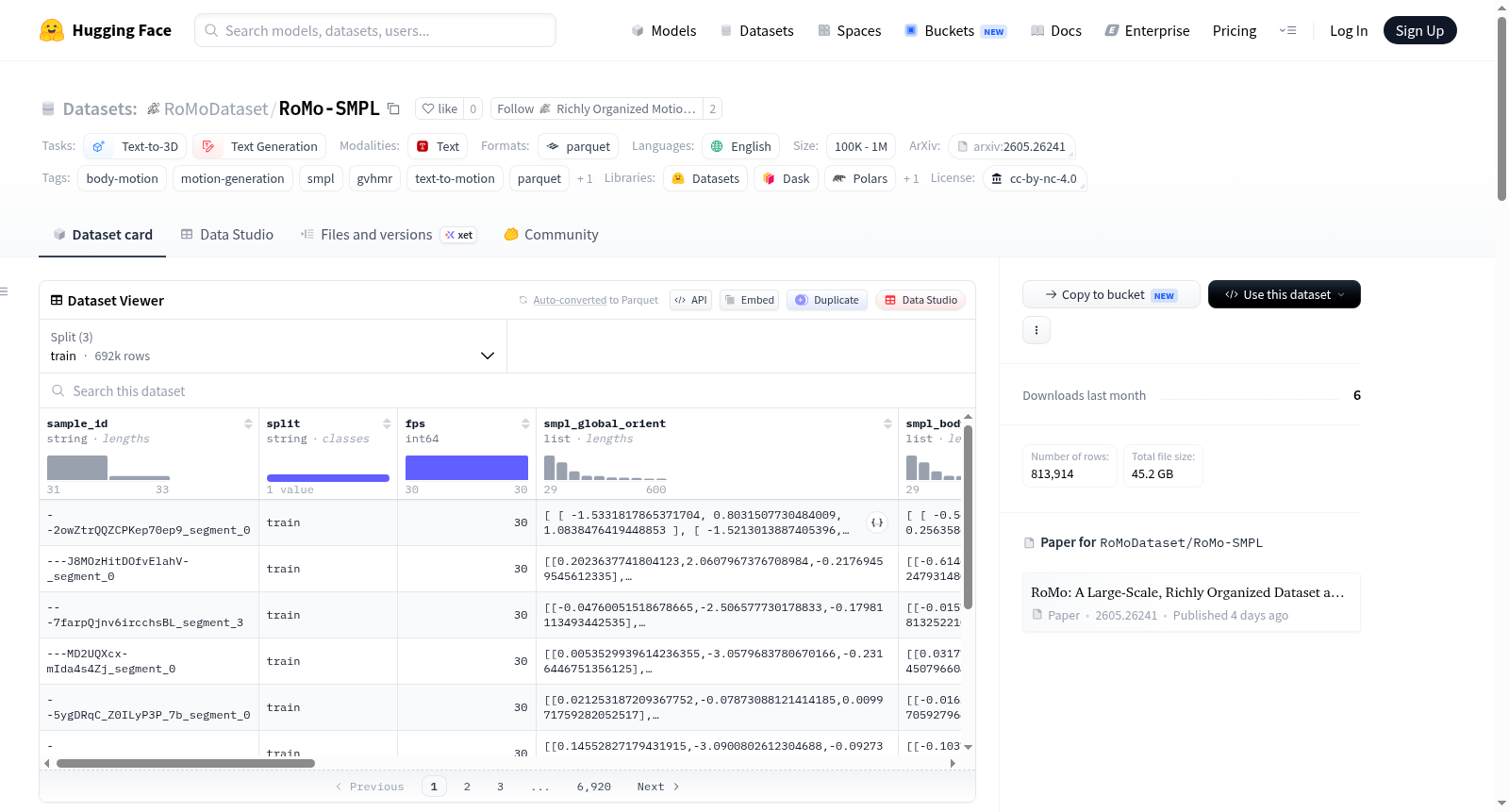
RoMo-SMPL是一个大规模、组织丰富的人体运动生成数据集,以SMPL身体参数空间表示,是RoMo论文的核心发布。该数据集旨在为文本到3D运动生成任务提供高质量、语义丰富的训练和评估资源。数据集包含813,938个运动序列(核心集),按固定比例划分为训练集(691,989)、验证集(81,271)和测试集(40,678)。每个序列以30帧每秒的速率提供,身体运动数据通过GVHMR方法从原始视频中恢复,表示为SMPL模型参数,包括全局方向(smpl_global_orient,形状为(T, 3))、身体关节姿态(smpl_body_pose,形状为(T, 63))、形状参数(smpl_betas)和根平移(smpl_transl,形状为(T, 3))。每个运动片段附带有五个不同详细程度的文本描述(caption_l0到caption_l4),从标签式到段落式,以及一个三级语义分类体系:顶层分类(taxonomy_category)、中层分类(taxonomy_subcategory)和细粒度原子动作标签(taxonomy_atomic_action)。数据集以Parquet格式存储,采用zstd压缩分片,遵循CC BY-NC 4.0许可协议。注意,该版本仅包含身体运动数据,不包含手部姿态或手部描述。RoMo-SMPL适用于文本到3D运动生成、运动理解、运动分类等任务,并可与同系列的其他表示形式数据集(如RoMo-HML-263、RoMo-HML-272、RoMo-SOMA-77)结合使用。
RoMo-SMPL is a large-scale and well-organized human motion generation dataset represented in the SMPL body parameter space, serving as a core release of the RoMo paper. This dataset aims to provide high-quality, semantically rich training and evaluation resources for text-to-3D motion generation tasks. It contains 813,938 motion sequences (core set), divided into fixed proportions for training (691,989), validation (81,271), and test sets (40,678). Each sequence is provided at 30 frames per second, with body motion data recovered from raw videos using the GVHMR method and represented as SMPL model parameters, including global orientation (smpl_global_orient, shape (T, 3)), body joint poses (smpl_body_pose, shape (T, 63)), shape parameters (smpl_betas), and root translation (smpl_transl, shape (T, 3)). Each motion clip is accompanied by five text descriptions of varying detail levels (caption_l0 to caption_l4), ranging from label-style to paragraph-style, and a three-level semantic classification system: top-level category (taxonomy_category), middle-level subcategory (taxonomy_subcategory), and fine-grained atomic action labels (taxonomy_atomic_action). The dataset is stored in Parquet format with zstd compression sharding, following the CC BY-NC 4.0 license. Note that this version only includes body motion data, excluding hand poses or hand descriptions. RoMo-SMPL is suitable for tasks such as text-to-3D motion generation, motion understanding, and motion classification, and can be used in conjunction with other representation datasets in the same series (e.g., RoMo-HML-263, RoMo-HML-272, RoMo-SOMA-77).
数据集概述:RoMo-SMPL
RoMo-SMPL 是 RoMo 论文中对应的人体运动语料库,使用 SMPL 人体参数空间(包括全局朝向、21个关节的人体姿态、形状和位移)表示。每个运动片段包含 5个文本描述 和 三级语义分类(类别、子类别、原子动作),并带有固定的训练/验证/测试集划分。
- 来源论文:RoMo: A Large-Scale, Richly Organized Dataset and Semantic Taxonomy for Human Motion Generation (arXiv:2605.26241)
- 许可协议:CC BY-NC 4.0
数据集属性
| 属性 | 数值 |
|---|---|
| 总序列数 | 813,938 (论文核心集) |
| 训练集 / 验证集 / 测试集 | 691,989 / 81,271 / 40,678 |
| 帧率 | 30 fps |
| 人体模型 | SMPL (通过 GVHMR 恢复) |
| 姿态来源 | GVHMR |
| 描述层级 | 5 级 (caption_l0 至 caption_l4) |
| 语义分类 | category / subcategory / atomic_action |
| 数据格式 | Parquet (zstd 分片,位于 data/ 目录下) |
| 数据规模 | 100K < n < 1M |
| 任务类型 | text-to-3d, text-generation |
| 语言 | 英文 |
注意:该版本仅包含身体运动,不包含手部姿态及手部描述。
数据模式 (Schema)
| 列名 | 类型 | 描述 |
|---|---|---|
sample_id |
string | 规范的 RoMo 片段 ID |
split |
string | 数据集划分:train, val, test |
fps |
int64 | 固定值 30 |
smpl_global_orient |
list<list<float32>> |
全局朝向 (轴角表示),维度 (T, 3) |
smpl_body_pose |
list<list<float32>> |
身体关节点轴角,维度 (T, 63) |
smpl_betas |
list<list<float32>> |
体型参数 (逐帧或广播) |
smpl_transl |
list<list<float32>> |
位移 (根节点),维度 (T, 3) |
caption_l0 … caption_l4 |
string | 从标签到段落的5级文本描述 |
taxonomy_category |
string | 顶层分类领域 |
taxonomy_subcategory |
string | 中层分类 |
taxonomy_atomic_action |
string | 细粒度动作标签 |
数据加载
使用 datasets 库直接加载:
python from datasets import load_dataset
ds = load_dataset("RoMoDataset/RoMo-SMPL") sample = ds["train"][0] print(sample["caption_l0"], sample["taxonomy_category"])
相关数据集
| 数据集 | 表示形式 |
|---|---|
| RoMo-HML-263 | HumanML3D 263维特征 |
| RoMo-HML-272 | HumanML3D 272维特征 |
| RoMo-SOMA-77 | Kimodo SOMA-77 933维特征 |
引用
bibtex @article{zhang2026romo, title={RoMo: A Large-Scale, Richly Organized Dataset and Semantic Taxonomy for Human Motion Generation}, author={Zhang, Jiahao and others}, journal={arXiv preprint arXiv:2605.26241}, year={2026} }