
LERA: Lower Extremity Radiographs
收藏DataCite Commons2024-11-20 更新2025-04-16 收录
下载链接:
https://aimi.stanford.edu/datasets/lera-lower-extremity-radiographs
下载链接
链接失效反馈官方服务:
资源简介:
Musculoskeletal disorders (MSDs), which encompass a wide variety of bone, soft tissue, and joint abnormalities, are a major healthcare challenge around the world. MSDs are typically diagnosed using radiographs; however, variations in diagnostic interpretation quality can often lead to diagnostic errors. This problem is often compounded by a lack of available tools to triage large volumes of unread examinations, which can result in numerous adverse downstream effects related to delay of diagnosis and treatment.The recent revolution in deep learning techniques for image analysis suggests that convolutional neural networks (CNNs) can serve as an effective tool for computer-aided detection of radiograph abnormalities. To aid computational models in accurately identifying diverse abnormalities in highly-variable radiographs of multiple body parts, we are releasing LERA (Lower Extremity RAdiographs). This dataset was used as the held-out test set in our recent study, which found that a single pre-trained CNN was effective in performing generalized abnormality detection in lower extremities [citation after publication].
肌肉骨骼疾病(Musculoskeletal disorders, MSDs)涵盖各类骨骼、软组织及关节异常,是全球范围内的重大医疗卫生挑战。此类疾病通常通过X光片进行诊断,但诊断解读质量的差异往往会引发诊断失误。而现有工具的匮乏难以对海量未读检查影像进行分流处理,进一步加剧了这一问题,进而导致诸多与诊断和治疗延误相关的不良连锁后果。
近年来图像分析领域深度学习技术的革新表明,卷积神经网络(Convolutional Neural Networks, CNNs)可作为X光片异常计算机辅助检测的有效工具。为助力计算模型精准识别多部位多变X光片中的各类异常,我们发布了LERA(下肢X光片数据集,Lower Extremity RAdiographs)。该数据集曾作为我们近期研究的预留测试集使用,研究发现单个预训练卷积神经网络可有效实现下肢异常的泛化检测[待出版后补充引用信息]。
创建时间:
2024-10-15
搜集汇总
数据集介绍
背景与挑战
背景概述
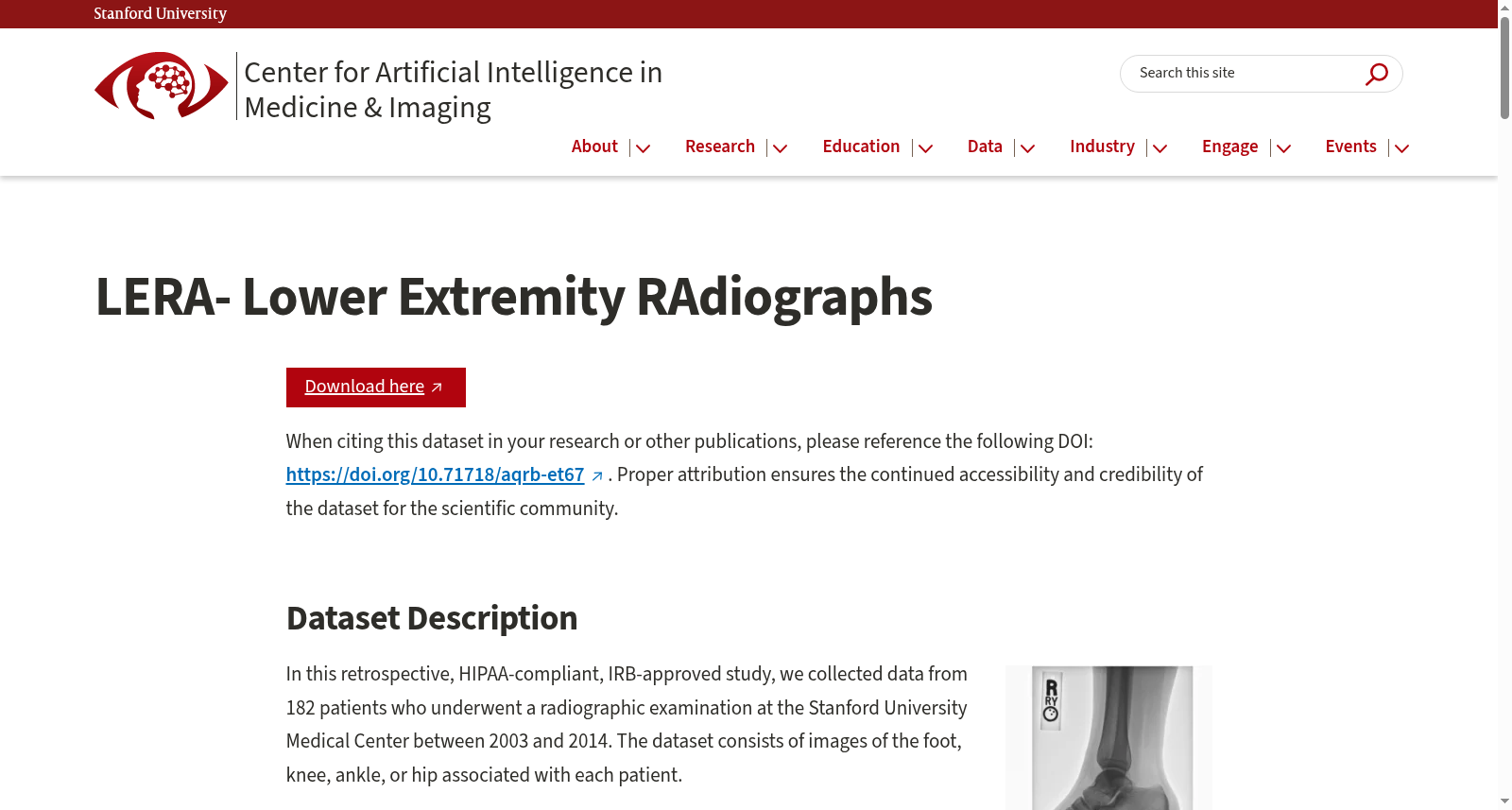
LERA数据集是一个专注于下肢放射影像(包括足、膝、踝和髋部位)的医学影像数据集,包含182名患者的影像,采集于2003年至2014年。数据集提供患者级的二元分类标签(正常或异常),标注经过两名放射科医生的独立验证和共识,确保高准确性;影像在大小、分辨率和颜色上具有高度可变性,可能包含重复图像,适用于测试深度学习模型在异常检测中的泛化能力。
以上内容由遇见数据集搜集并总结生成


