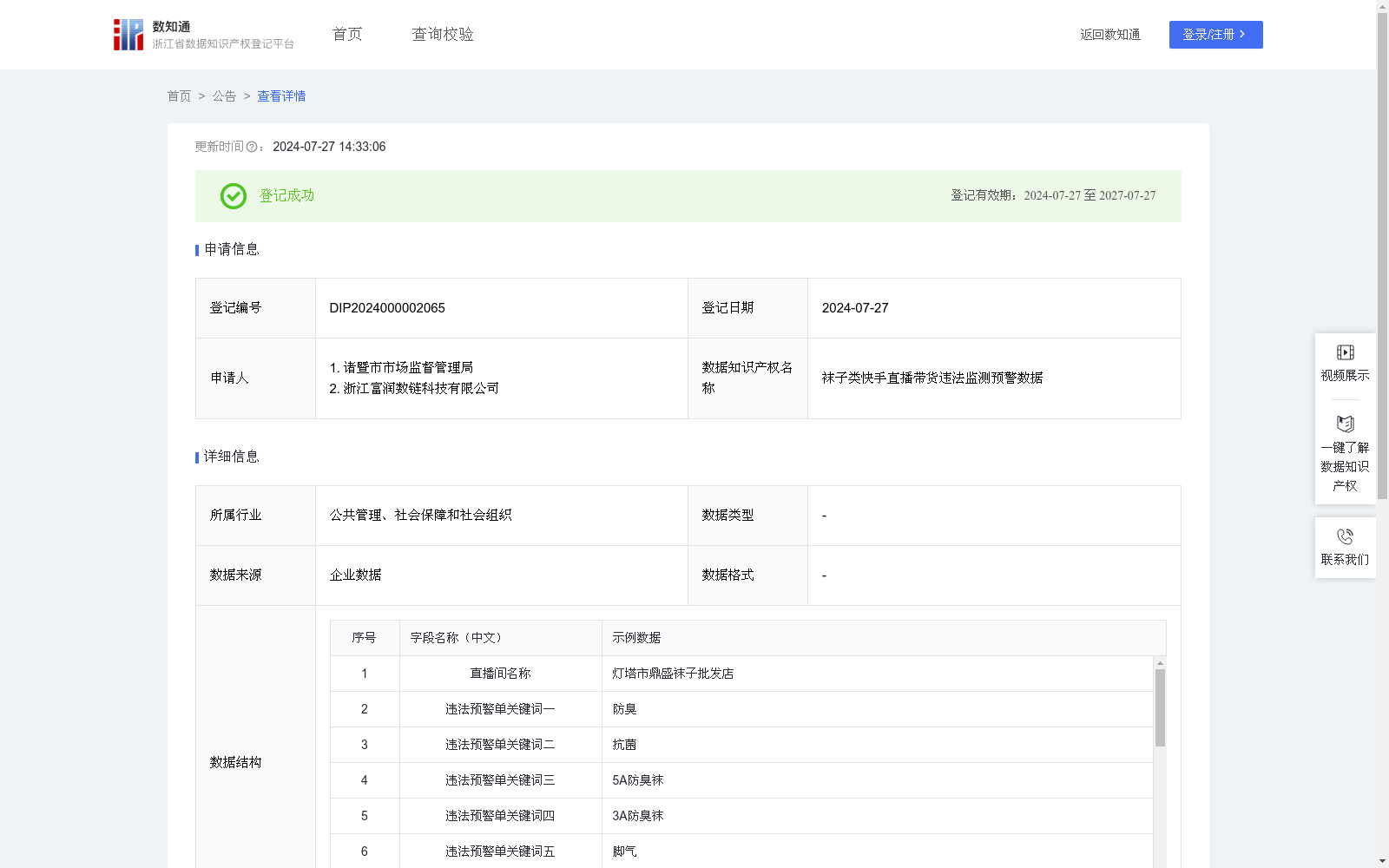
袜子类快手直播带货违法监测预警数据
收藏资源简介:
对采集的快手平台带货品类为袜子类的达人直播视频内容进行转译分析,对达人口播语言内容进行处理、分析,根据达人在直播过程中对预先设置的违规敏感词(比如:防臭,抗菌,5A防臭袜,3A防臭袜,脚气,脚汗,脚臭,吸湿排汗,吸汗,透气等)违反的次数和频率,依据触发条件规则提出警告或处理。为诸暨市市场监督局管理区域内规范企业快手直播行为,提供数据支持。将采集完成的直播视频进行进行预处理,第一步:基于原始视频文件,以最大10分钟单位对原始视频进行切片。第二步:对于已完成的切片视频,进行视频内容转语音操作。第三步:对于已完成视频转语音操作的切片,进行语音转文本操作。第四步:使用OCR技术对原始视频中抓取的图片进行文字提取操作。第五步:将所得到的文字内容与违法预警关键词库进行匹配。最终运用多标准决策分析模型,对主播在直播过程中出现的违规语句进行分析计算,得出违法预警值和是否预警判断。 违法预警值=(违法预警单关键词命中次数*0.25)+(违法预警组合关键词命中次数* 0.3)+(图片识别命中预警组合关键词个数*0.35)+(直播间近一个月历史违规记录数*0.1) 通过公式计算出最终违法预警值,违法预警值 ≤1 时,不触发预警提示,违法预警值 >1 时触发违法预警提示。
This dataset involves the transcription and analysis of live streaming video content from Kuaishou platform influencers promoting sock products. We process and analyze the oral language content delivered by the influencers, and issue warnings or take targeted actions based on trigger rules, according to the frequency and count of violations of pre-set sensitive violation keywords (such as deodorant, antibacterial, 5A deodorant socks, 3A deodorant socks, beriberi, foot sweat, foot odor, moisture wicking, sweat absorption, breathability, etc.) during the live broadcast. This work provides data support for standardizing the live streaming behavior of enterprises within the regulatory jurisdiction of the Zhuji Municipal Market Supervision Administration. The collected live streaming videos undergo the following preprocessing steps: 1. Slice the original video files into segments with a maximum duration of 10 minutes. 2. Convert the sliced video content into audio. 3. Perform speech-to-text conversion on the sliced videos that have completed the video-to-audio conversion. 4. Extract text from images captured in the original videos using OCR technology. 5. Match the obtained text content against the violation early warning keyword database. Finally, a multi-criteria decision analysis model is employed to analyze and calculate the violation statements made by the streamer during the live broadcast, to derive the violation early warning value and the early warning judgment result. The violation early warning value is calculated via the following formula: Violation Early Warning Value = (Number of hits for single violation warning keyword × 0.25) + (Number of hits for combined violation warning keywords × 0.3) + (Number of combined warning keywords identified via image recognition × 0.35) + (Number of historical violation records of the live broadcast room in the past month × 0.1) According to the calculation result: no early warning prompt is triggered when the final violation early warning value is ≤ 1; a violation early warning prompt is triggered when the value is > 1.