manojdahal191gom/claude-opus-4.6-4.7-reasoning-8.7k
收藏资源简介:
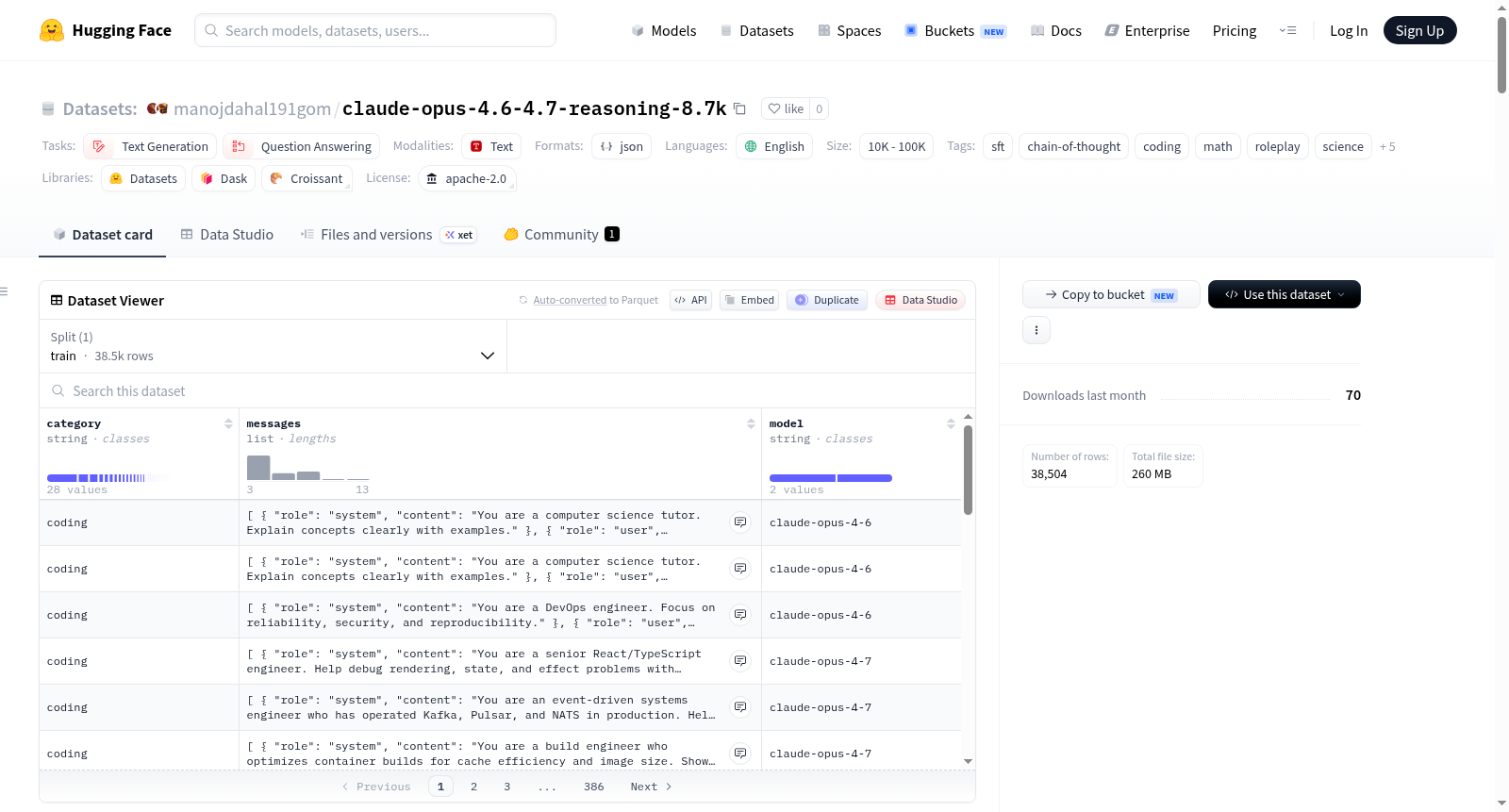
--- license: apache-2.0 task_categories: - text-generation - question-answering language: - en tags: - sft - chain-of-thought - coding - math - roleplay - science - humanities - art - multi-turn - text - json pretty_name: Claude Opus 4.6/4.7 Reasoning Dataset size_categories: - 1K<n<10K --- # Background Ended up with some tokens to burn on a Claude Max plan. Assembly began during 4.6 and moved to 4.7. Model is tagged. The development evolved as it went along. The dataset has not been manually reviewed. It's entirely Claude developed. # Clarification on Reasoning The reasoning is not Claude's actual chain-of-thought (cot) and is not summarized cot. It's a fully synthetic cot created as part of the Assistant response to mimic the type of "thinking" expected to reach the Assistant response. There are now non-reasoning versions as well. ## Files Four datasets provided: | Split | File | Examples | Contents | |-------|------|---------:|----------| | **Full** | `full_train.jsonl` | 8,706 | All examples across all 28 categories. | | **Instruct** | `instruct_train.jsonl` | 7,217 | All 24 instructional categories — coding, math, sciences, humanities, arts, finance, medicine, law, business, linguistics, creative writing, general. | | **Roleplay** | `roleplay_train.jsonl` | 1,489 | The four creative categories — `roleplay_hero`, `roleplay_villain`, `roleplay_crossover`, `narrative_prose`. | | **Code** | `code_train.jsonl` | 1,840 | `coding` + `math` only. For coding/math-focused fine-tunes. | # SLOP Readme A synthetic instruction-tuning dataset designed to teach language models **how to think**, not just what to say. Every example is written to expert standards across 28 categories spanning coding, math, the sciences, the humanities, the arts, finance, medicine, law, business, linguistics, creative writing, roleplay, and narrative prose. Every assistant turn includes a `<think>` block — genuine deliberation, not a reformatted answer. ## Dataset Summary | Metric | Value | |--------|-------| | **Total examples** | 8,706 | | **Estimated tokens** | ~17.0M | | **Categories** | 28 (all populated) | | **With reasoning tags** | 8,706 (100%) | | **Multi-turn conversations** | 3,454 (39.7%) | | **Unique system prompts** | 5,814 | | **Format** | OpenAI chat (JSONL) | | **Language** | English | | **Teacher models** | Claude Opus 4.6 (53.7%), Claude Opus 4.7 (46.3%) | ## What Makes This Dataset Different - **Genuine chain-of-thought reasoning, on every example.** Each assistant turn opens with a `<think>...</think>` block of 150–500 words showing the model considering multiple angles, weighing alternatives, and planning response structure — not "Step 1, Step 2" reformulations of the answer. - **Expert-level depth.** Responses are written to satisfy senior practitioners. Coding answers explain design trade-offs. History answers engage with historiographical debate. Creative-writing critique includes line-level rewrites. Roleplay characters have internally coherent worldviews. - **Natural user voice.** User messages sound like real people — frustrated developers pasting broken code, students challenging an explanation, novelists stuck mid-draft, editors asking for a tonal shift. Hard rule: at most ~20% of user messages start with *What* or *How*. - **5,814 unique system prompts.** Domain-specific personas (e.g. *"You are a database performance consultant working on a Postgres query that's hitting timeouts under load"*) rather than one generic *"helpful assistant"* repeated thousands of times. - **Character-accurate roleplay.** Roleplay examples are built around source-material voice, verbal habits, and worldview — not surface costumes. Includes a deliberately *dark* track of villain, hero, and crossover examples written in the literary register of Le Carré, McCarthy, Atwood, Tartt, Flynn, Bakker, and similar reference points. - **No refusals or safety hedging.** Refusals, content warnings, and clarification-only turns are intentionally excluded. This dataset is for teaching *capability*, not for replacing alignment training. ## Categories 28 categories grouped into instructional and creative/roleplay sets. All 28 are populated; the largest categories carry the foundational legacy content, while the newer per-discipline categories give per-domain coverage. ### Instructional categories (24) | Category | Description | |----------|-------------| | `coding` | Working code with design trade-offs, debugging, architecture. Python, TypeScript, Go, Rust, SQL, more. | | `math` | Pure and applied mathematics, statistics, probability, geometry, algebra, calculus, logic. | | `physics` | Mechanics, thermodynamics, quantum, relativity, electromagnetism, optics. | | `biology` | Genetics, evolution, ecology, microbiology, neuroscience, cell biology. | | `chemistry` | Organic, inorganic, biochemistry, materials science. | | `earth_science` | Geology, climate, meteorology, oceanography, astronomy, paleontology. | | `science` | General-science catch-all for cross-disciplinary topics. | | `history` | Events, historiography, primary sources, ancient through modern. | | `philosophy` | Epistemology, ethics, logic, metaphysics, aesthetics. | | `psychology` | Cognition, behavior, development, social psychology. | | `political_science` | Governance, international relations, policy, political theory. | | `sociology` | Social structures, institutions, inequality, demography. | | `economics` | Macro/microeconomics, econometrics, development economics, game theory. | | `geography` | Human and physical geography, cartography, geopolitics, urban planning. | | `literature` | Literary criticism, poetry analysis, comparative literature, theory. | | `humanities` | Catch-all for cross-disciplinary humanities topics. | | `arts` | Music, film, theater, painting, sculpture, architecture, photography, design. | | `finance` | Investing, accounting, banking, markets, personal finance, trading. | | `medicine` | Clinical reasoning, pharmacology, anatomy, public health, epidemiology. | | `law` | Constitutional, contracts, criminal, civil, jurisprudence, regulation. | | `business` | Management, strategy, leadership, operations, marketing, entrepreneurship. | | `linguistics` | Translation, etymology, phonetics, grammar, syntax, language acquisition. | | `creative_writing` | Craft-focused coaching with concrete techniques, before/after rewrites, line-level analysis. | | `general` | Practical advice, explanations, life questions. Depth matched to question complexity. | ### Creative / roleplay categories (4) | Category | Description | |----------|-------------| | `roleplay_hero` | Heroic and morally complex protagonists with rich, source-accurate voices. | | `roleplay_villain` | Antagonists with internally coherent worldviews — not cartoonish evil. | | `roleplay_crossover` | Cross-canon character pairings with distinct voices and dramatic dynamics. | | `narrative_prose` | Publishable-quality literary fiction in named author voices (Hemingway, Tolstoy, Austen, Pynchon, McCarthy, Le Carré, etc.) and genres. | ## Overall | Metric | Value | |---|---:| | Examples | 8,706 | | Tokens (estimated) | 17,013,533 | | Avg tokens / example | 1,954 | | With reasoning | 8,706 (100.0%) | | Multi-turn | 3,454 (39.7%) | | Single-turn | 5,252 (60.3%) | ## Category Counts | Category | Examples | Tokens | Multi-turn % | |----------|---------:|-------:|-------------:| | coding | 1,628 | 2,545,221 | 30.4% | | humanities | 862 | 1,849,708 | 32.5% | | science | 737 | 1,681,346 | 37.4% | | roleplay_hero | 419 | 640,084 | 63.5% | | roleplay_villain | 378 | 635,984 | 60.8% | | narrative_prose | 377 | 710,807 | 43.0% | | roleplay_crossover | 315 | 581,188 | 56.8% | | creative_writing | 281 | 532,504 | 30.6% | | medicine | 280 | 519,662 | 22.1% | | biology | 277 | 541,013 | 21.3% | | general | 276 | 284,696 | 37.0% | | arts | 245 | 576,170 | 41.2% | | chemistry | 221 | 508,546 | 52.9% | | physics | 220 | 512,196 | 56.8% | | math | 212 | 394,907 | 54.2% | | geography | 155 | 358,321 | 42.6% | | history | 155 | 348,822 | 41.3% | | economics | 155 | 380,372 | 42.6% | | political_science | 154 | 374,901 | 38.3% | | sociology | 154 | 378,261 | 42.2% | | business | 152 | 315,065 | 38.2% | | earth_science | 152 | 358,209 | 41.4% | | finance | 151 | 328,607 | 38.4% | | philosophy | 150 | 335,514 | 41.3% | | linguistics | 150 | 306,889 | 39.3% | | literature | 150 | 299,606 | 38.7% | | psychology | 150 | 339,565 | 39.3% | | law | 150 | 375,360 | 41.3% | Per-category JSONL splits live in `categories/`. ## By Model Every example carries a `model` field identifying which Claude model generated it. | Model | Count | Share | Tokens | |---|---:|---:|---:| | claude-opus-4-6 | 4,675 | 53.7% | 6,304,169 | | claude-opus-4-7 | 4,031 | 46.3% | 10,709,363 | The two model populations are roughly balanced by example count, but Opus 4.7 examples carry ~70% more tokens on average — newer waves trend toward longer multi-turn content. ## Turn Distribution | Turns | Examples | % | |------:|---------:|---:| | 1 | 5,252 | 60.3% | | 2 | 1,491 | 17.1% | | 3 | 1,858 | 21.3% | | 4 | 82 | 0.9% | | 5 | 21 | 0.2% | | 6 | 2 | 0.0% | Multi-turn conversations are designed to teach models to build on context, handle follow-ups that change direction, defend a craft choice, revise on request, and adjust depth based on user response. ## Response Length Distribution Assistant message length, in characters: | Percentile | Characters | |------------|-----------:| | p10 | 2,061 | | p25 | 2,914 | | Median | 4,239 | | p75 | 5,682 | | p90 | 7,052 | | Max | 30,026 | Reasoning blocks themselves are typically 150–500 words; the rest is the user-facing answer. ## Format Standard OpenAI chat format in JSONL. Each line is one JSON object with `category`, `messages`, and `model` fields: ```json { "category": "coding", "model": "claude-opus-4-7", "messages": [ {"role": "system", "content": "You are a senior backend engineer reviewing performance issues..."}, {"role": "user", "content": "Explain move semantics to me..."}, {"role": "assistant", "content": "<reasoning>\nThe user understands C++ fundamentals but...\n</reasoning>\n\n`std::move` does not move anything. It is a cast..."} ] } ``` The `category` and `model` fields are metadata for filtering and provenance — fine-tuning APIs read only `messages`. ## Terms Use it for things you should use it for but don't use it for anything you shouldn't use it for. Like Anthropic does, always respect terms of use...
A synthetic instruction-tuning dataset designed to teach language models how to think, not just what to say. Every example is written to expert standards across 28 categories spanning coding, math, the sciences, the humanities, the arts, finance, medicine, law, business, linguistics, creative writing, roleplay, and narrative prose. Every assistant turn includes a <reasoning> block — genuine deliberation, not a reformatted answer. The dataset features expert-level depth, natural user voice, 5,814 unique system prompts, character-accurate roleplay, and no refusals or safety hedging. It is in OpenAI chat format (JSONL), with 8,706 examples, ~17.0M tokens, 39.7% multi-turn conversations, and generated by Claude Opus 4.6 (53.7%) and 4.7 (46.3%) models.