
Slang-Q
收藏资源简介:
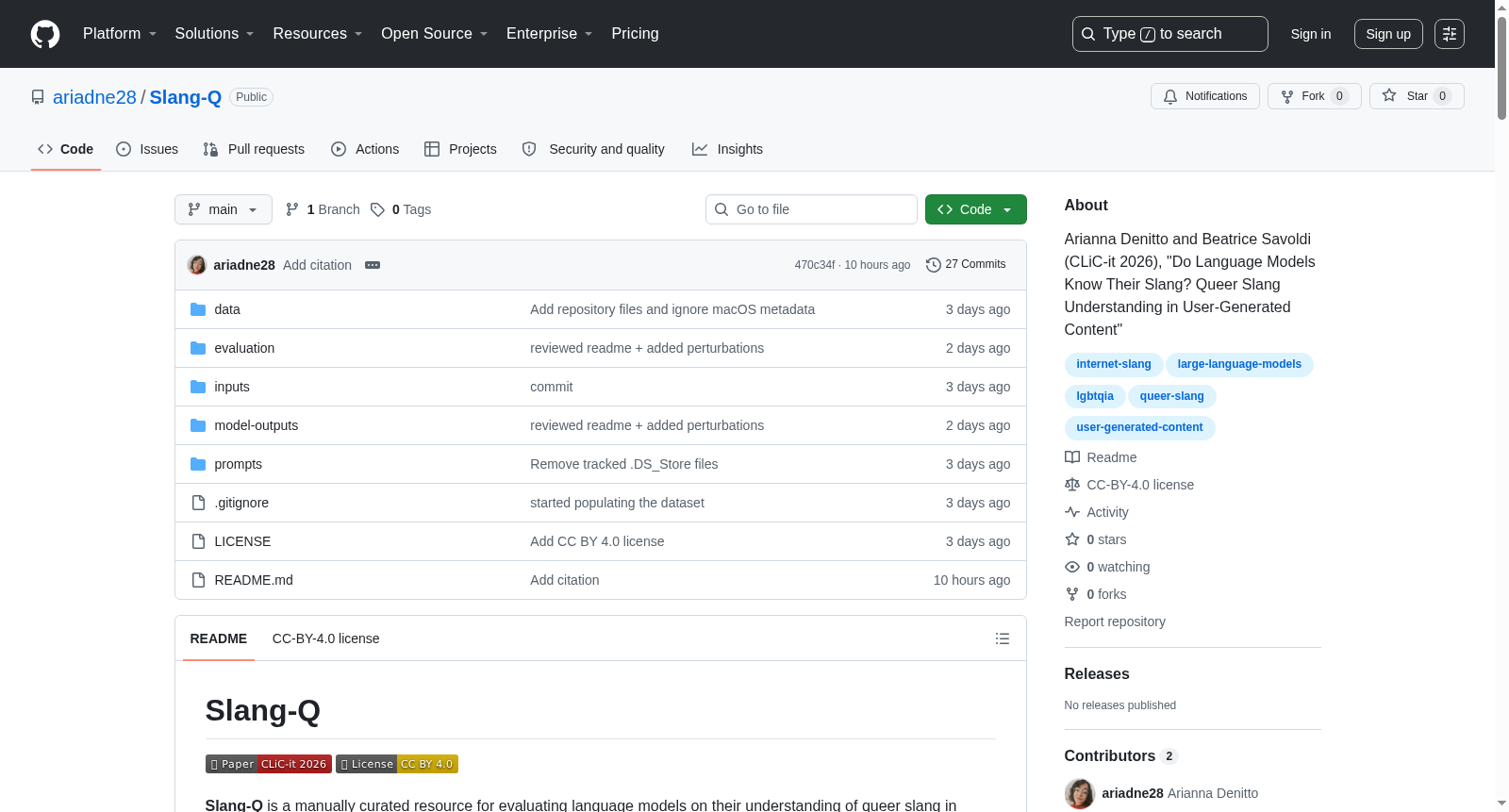
Slang-Q是一个由都灵大学与布鲁诺·凯斯勒基金会联合创建的人工精选评估数据集,聚焦于英语用户生成内容中的酷儿俚语理解。该数据集包含1,024条手工标注的句子,每条句子配有一个酷儿俚语术语及其参考定义,术语来源于涵盖118个词汇的新建分类体系。数据构建过程基于Urban Dictionary语料库,通过自动提取与人工筛选相结合,剔除了语义无关及有害内容,最终保留77个术语的有效实例。该数据集旨在评估大语言模型对社区特异性语言的掌握程度,尤其关注模型能否准确理解并解释酷儿俚语,从而为减轻NLP系统中的偏见与信息缺失提供基础资源。
Slang-Q is a manually curated evaluation dataset jointly created by the University of Turin and Bruno Kessler Foundation, focusing on queer slang comprehension in English user-generated content. This dataset comprises 1,024 manually annotated sentences, each paired with a queer slang term and its reference definition. The terms are derived from a newly constructed taxonomy consisting of 118 vocabulary items. The dataset construction process is based on the Urban Dictionary corpus, combining automatic extraction and manual screening to remove semantically irrelevant and harmful content, ultimately retaining valid instances of 77 distinct terms. This dataset aims to evaluate the proficiency of Large Language Models (LLMs) in comprehending community-specific language, with particular focus on the model's ability to accurately understand and explain queer slang, thereby providing foundational resources for mitigating bias and information gaps in NLP systems.
数据集概述
Slang-Q 是一个人工整理的数据集,用于评估语言模型对英语用户生成内容中酷儿俚语(Queer Slang)的理解能力。该数据集与论文 Do Language Models Know Their Slang? Queer Slang Understanding in User-Generated Content(CLiC-it 2026)配套发布。
数据集规模
- 包含118个与酷儿相关的术语分类体系(Taxonomy)
- 1,024条经过人工筛选的用户生成句子
- 1,073个术语-句子评估对(因部分句子包含多个目标术语)
- 覆盖77个在最终句子数据集中出现的术语
- 200个模型输出的手动标注子集
分类体系(Taxonomy)
数据集中每个术语关联以下信息:
- 参考定义(reference definition)
- 一个或多个宽泛类别,包括:
- Identity(身份)
- Slang(俚语)
- Intersectional(交叉性)
- 零个或多个语言子类别,包括:
- Reclaimed(回收术语)
- Shorthand(缩写)
- Idiomatic expression(习语表达)
- Pronoun(代词)
- Spelling variation(拼写变体)
分类体系独立于源语料构建,因此并非所有118个术语都出现在最终句子数据集中。
句子数据集
data/slangq_sentences.csv 包含1,024条经人工验证的唯一用户生成句子,来源于Urban Dictionary,并经过语义相关性和有害/粗俗内容的过滤。
句子数据集的字段包括:
| 字段 | 说明 |
|---|---|
contributor |
Urban Dictionary条目的贡献者用户名 |
date |
原始条目提交日期 |
downvotes |
原始条目收到的踩数 |
example |
包含匹配术语的用户生成例句 |
meaning |
原始Urban Dictionary释义 |
upvotes |
原始条目收到的赞数 |
word |
原始条目的词目 |
matched_terms |
提取时匹配到的酷儿相关术语(多个以分号分隔) |
评估设置
提示条件
数据集包含四个主要提示条件,结合两个维度:
- 输入内容:仅提供目标术语 vs. 提供术语及句子上下文
- 提示框架:通用语言专家框架 vs. 明确的酷儿俚语知情框架
四个条件分别为:术语基线(terms_base)、术语俚语知情(terms_informed)、上下文基线(context_base)、上下文俚语知情(context_informed)。
模型输出
包含四个评估模型的原始生成结果:
- Claude Sonnet 4.6
- Llama 3.3 70B
- Llama 4 Scout
- Qwen3 32B
每个模型目录下包含对应四个提示条件的输出文件。
自动评估
evaluation/metrics_scores.csv 包含行级别的模型输出、三个参考定义及对应的ROUGE-L和BERTScore值。每个生成定义均与三个参考(原始人工编写的分类定义和两个经人工验证的GPT-5.5生成的替代定义)进行独立评估,最终分数为三个参考的平均值。聚合结果时,先对同一术语对应的所有句子取平均,再对术语取平均,以防止高频术语主导最终结果。
手动评估
evaluation/manual_evaluation.csv 包含200个输出的手动标注,覆盖50个术语-句子对、两个模型(Claude Sonnet 4.6和Llama 4 Scout)以及两个提示条件(术语基线和俚语知情上下文条件)。每个输出标注为:
- Correct:正确传达预期含义
- Partially correct:识别出相关俚语或酷儿含义,但遗漏或扭曲了一个核心成分
- Incorrect:模型选择了无关含义、凭空捏造含义或未能定义该术语
用途与许可
该数据集旨在支持社区特定语言和俚语的研究,可用于复现论文中的定义生成、自动评估和手动分析等实验流程。数据集以 Creative Commons Attribution 4.0 International License 发布,使用时应引用配套的CLiC-it 2026论文。
- 1Do Language Models Know Their Slang? Queer Slang Understanding in User-Generated Content都灵大学; 布鲁诺·凯斯勒基金会 · 2026年


