
SpikeProphecy benchmark (Steinmetz 2019 + IBL Repeated Site)
收藏资源简介:
SpikeProphecy是由加州大学圣克鲁兹分校研究团队创建的大规模自回归神经群体尖峰预测基准,其核心整合了Steinmetz 2019和IBL Repeated Site两个公开的Neuropixels电生理学数据集。该基准包含总计105个记录会话,涵盖约89,800个神经元的活动数据,数据源来自小鼠在视觉辨别任务中的高密度电极探针记录,原始尖峰时间被预处理为50毫秒时间窗的整数计数向量。数据集的创建过程涉及严格的时序分割、标准化预处理流程以及包含14项测试的数据完整性审计套件,以防止信息泄露。该数据集主要应用于神经科学和脑机接口领域,旨在系统评估和比较不同序列架构在因果性、自回归尖峰计数预测任务上的性能,并解决现有评估指标单一、无法揭示时空保真度等细粒度结构的问题。
SpikeProphecy is a large-scale autoregressive neural population spike prediction benchmark developed by a research team at the University of California, Santa Cruz. It integrates two publicly available Neuropixels electrophysiology datasets: Steinmetz 2019 and IBL Repeated Site. This benchmark includes a total of 105 recording sessions, covering activity data from approximately 89,800 neurons. The data are sourced from high-density electrode probe recordings of mice engaged in visual discrimination tasks, with original spike times preprocessed into integer count vectors within 50-millisecond time windows. The dataset creation process involves rigorous temporal segmentation, standardized preprocessing workflows, and a data integrity audit suite containing 14 tests to prevent information leakage. Primarily applied in the fields of neuroscience and brain-computer interfaces (BCIs), this benchmark aims to systematically evaluate and compare the performance of different sequential architectures on causal, autoregressive spike count prediction tasks, and address the limitations of existing single evaluation metrics that fail to reveal fine-grained structures such as spatiotemporal fidelity.
SpikeProphecy / Steinmetz 2019(处理版)数据集概述
基本信息
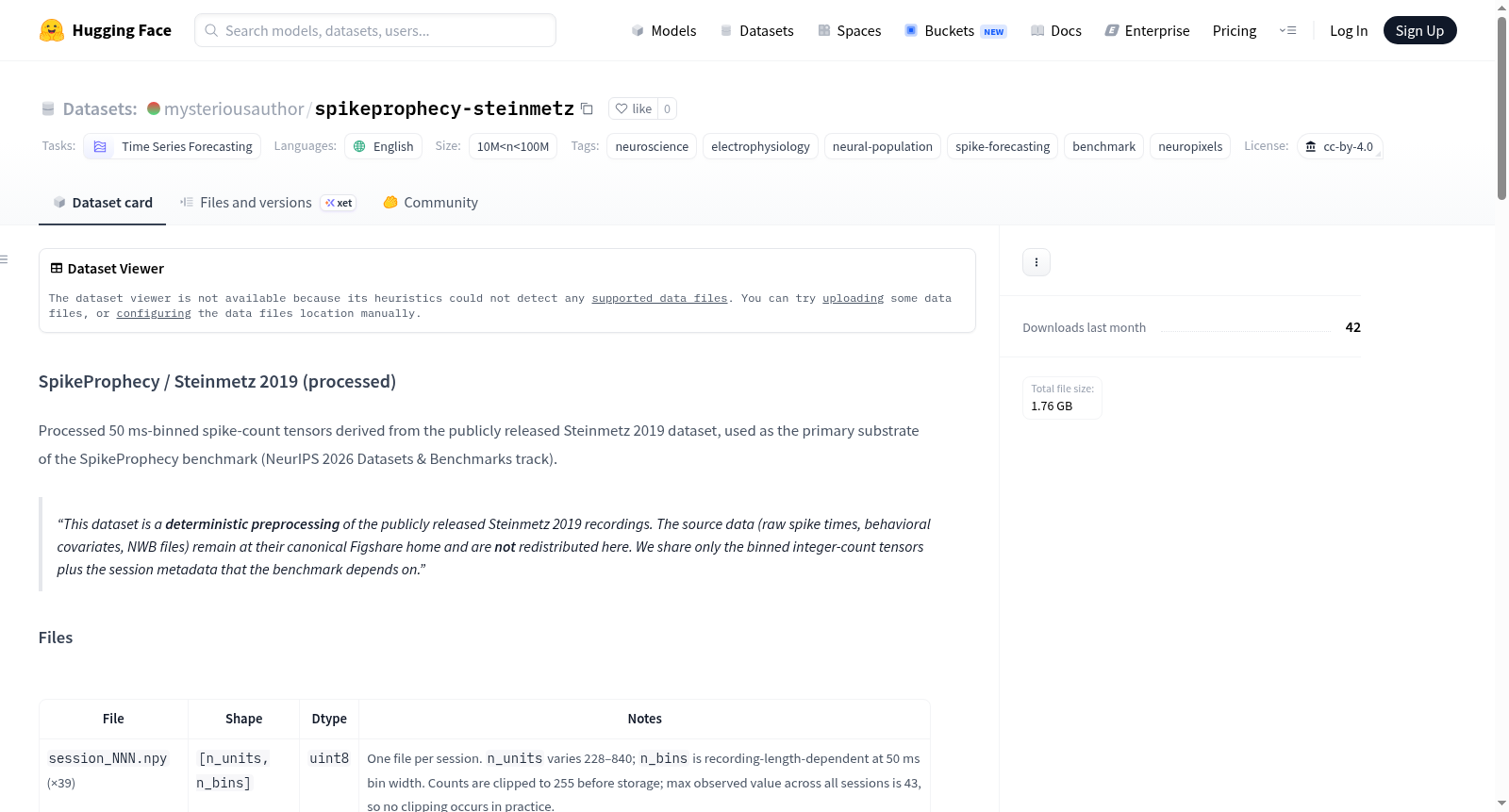
- 数据集名称:SpikeProphecy / Steinmetz 2019 (processed)
- 许可证:CC-BY-4.0
- 语言:英语
- 标签:神经科学、电生理学、神经群体、尖峰预测、基准测试、Neuropixels
- 大小:1000万至1亿条记录
- 任务类型:时间序列预测
数据来源与处理
该数据集是对Steinmetz等人(2019)公开数据集的确定性预处理结果,来源于发表在Nature 576:266–273上的论文《Distributed coding of choice, action and engagement across the mouse brain》。原始数据(原始尖峰时间、行为协变量、NWB文件)保留在Figshare平台,本数据集仅分享分箱后的整数计数张量和会话元数据。
预处理流程
- 读取NWB尖峰时间数据
- 以Δt = 50毫秒进行分箱,生成整数计数向量(转换为uint8类型)
- 删除平均发放率低于0.1 Hz的近静默单元
- 输出每个会话的[n_units, n_bins]张量,以及70/15/15的训练/验证/测试时间分割边界元数据
文件结构
| 文件 | 形状 | 数据类型 | 说明 |
|---|---|---|---|
session_NNN.npy(×39个) |
[n_units, n_bins] | uint8 | 每个会话一个文件。n_units范围228–840;n_bins取决于记录时长(50毫秒箱宽)。计数值截断至255之前存储,所有会话中最大观测值为43,因此实际无截断发生 |
metadata.json |
— | — | 每个会话的元数据,包含单元数量、箱数、时长、分割边界(训练结束、验证结束)以及每个单元的脑区信息(Allen CCF缩写)。顶层参数包括:m_max=1240,bin_width_ms=50,history_bins=10 |
数据划分
采用70/15/15的训练/验证/测试时间分割策略,在每个会话内部按时间顺序划分为第一段(训练)、中间段(验证)、最后段(测试)。分割边界以原始箱索引形式编码在metadata.json中,而非预分割数组。该数据集附带了14项自动化泄漏审计套件,验证五种具体泄漏向量:
- 训练/测试箱重叠
- 滑动窗口边界穿越
- 跨会话溢出
- 使用未来统计数据进行归一化
- 历史特征泄漏
使用示例
python import numpy as np import json from pathlib import Path from huggingface_hub import snapshot_download
local = snapshot_download(repo_id="mysteriousauthor/spikeprophecy-steinmetz", repo_type="dataset") local = Path(local)
meta = json.loads((local / "metadata.json").read_text()) print(meta["num_sessions"], "sessions, M_max =", meta["m_max"])
会话4(703个单元,论文图1中用作典型中值会话)
counts = np.load(local / "session_004.npy") # [703, 60887], uint8 sb = meta["sessions"][4]["split_boundaries"] train = counts[:, :sb["train_end"]] val = counts[:, sb["train_end"]:sb["val_end"]] test = counts[:, sb["val_end"]:]
引用信息
若使用本处理后的数据集,请同时引用原始Steinmetz论文和SpikeProphecy基准:
- 原始论文:Steinmetz et al. (2019), Distributed coding of choice, action and engagement across the mouse brain, Nature 576:266–273
- 基准论文:SpikeProphecy: A Large-Scale Benchmark for Autoregressive Neural Population Forecasting, NeurIPS 2026 Datasets and Benchmarks Track
其他
- 数据集根目录包含符合Croissant 1.0标准的JSON-LD元数据文件
croissant.json - 数据集许可证为CC-BY-4.0,与源数据集许可证一致
- 1SpikeProphecy: A Large-Scale Benchmark for Autoregressive Neural Population Forecasting加州大学圣克鲁兹分校·电气与计算机工程系; 加州大学圣克鲁兹分校·基因组学研究所; 加州大学圣克鲁兹分校·计算机科学与工程系; 加州大学圣克鲁兹分校·应用数学系; 加州大学圣克鲁兹分校·生物分子工程系 · 2026年


