
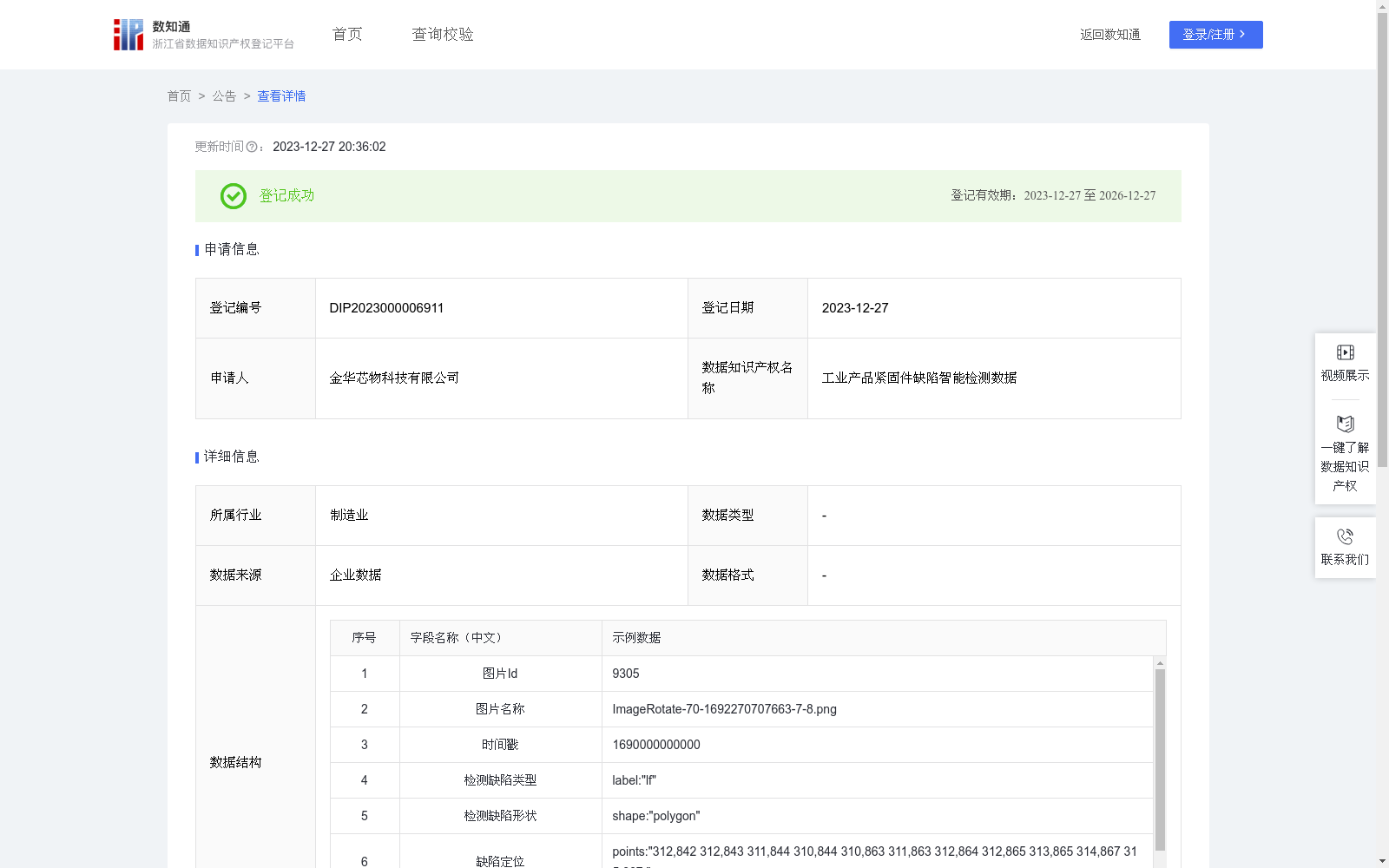
工业产品紧固件缺陷智能检测数据
收藏浙江省数据知识产权登记平台2023-12-27 更新2024-05-08 收录
下载链接:
https://www.zjip.org.cn/home/announce/trends/23450
下载链接
链接失效反馈官方服务:
资源简介:
本数据主要以拍摄的紧固件图片为基础,构建卷积神经网络模型,实现对紧固件的缺陷检测和分类,本数据可用于紧固件是否有明显的裂缝、缺块、杂质、凹痕等缺陷检测场景,能够为紧固件缺陷检测平台提供数据支持。1、数据准备:使用相机获取工业产品紧固件表面的图像。同时对采集到的图片进行预处理,包括去除图像中的噪声、对图像进行裁剪、数据平滑等操作,并且对采集到的图片进行裂缝、缺块、凹痕等缺陷标注,用于模型学习紧固件的特征和模式以区分正常的紧固件和有缺陷的紧固件。2、模型训练:首先基于深度学习,构建卷积神经网络,该网络主要由特征提取部分以及缺陷检测部分组成,每一部分由多个卷积模块组成,卷积模块由多个参数确定。然后将预处理后的图像输入构建好的卷积神经网络以提取边缘、纹理、形状等特征,在训练过程中将模型的输出结果和带有裂缝、缺块、凹痕等标注的图片进行对比,通过反向传播算法减小对比偏差并更新模型的权重和参数,减小模型的预测误差。 3、模型优化:根据模型训练和测试的结果,对模型的参数进行优化调整,从而提升模型的预测能力。4、数据应用:根据基于深度学习建立的卷积神经网络模型,对工业产品紧固件的缺陷进行智能检测。通过上述规则算法描述,可以对工业产品紧固件缺陷智能检测数据进行卷积神经网络模型的建立,提高模型的准确度和可靠性,为紧固件缺陷检测平台提供数据支持。
This dataset is constructed based on captured fastener images to develop a Convolutional Neural Network (CNN) model for fastener defect detection and classification. It can be applied to scenarios for detecting defects such as obvious cracks, chipping, impurities, and dents on fasteners, providing data support for fastener defect detection platforms.
1. Data Preparation: Images of the surfaces of industrial fasteners are collected using cameras. The collected images are then preprocessed, including operations like noise removal, image cropping, and data smoothing. Furthermore, defects including cracks, chipping, and dents are annotated on the collected images, allowing the model to learn the features and patterns of fasteners to differentiate between normal and defective fasteners.
2. Model Training: First, a Convolutional Neural Network is built based on deep learning. The network primarily comprises a feature extraction section and a defect detection section, with each section composed of multiple convolutional modules whose parameters are configurable. Preprocessed images are input into the established CNN to extract features such as edges, textures, and shapes. During the training process, the model's output results are compared with the annotated images containing defects like cracks, chipping, and dents. The backpropagation algorithm is employed to reduce the comparison deviation, update the model's weights and parameters, and minimize the model's prediction error.
3. Model Optimization: Based on the results of model training and testing, the model's parameters are optimized and adjusted to enhance the model's predictive capability.
4. Data Application: The CNN model established based on deep learning is used to perform intelligent defect detection on industrial fasteners. Following the aforementioned algorithmic descriptions, CNN models can be developed for intelligent defect detection data of industrial fasteners, improving the accuracy and reliability of the model and providing data support for fastener defect detection platforms.
提供机构:
哇亚(杭州)科技有限公司
创建时间:
2023-12-05
搜集汇总
数据集介绍
以上内容由遇见数据集搜集并总结生成



