
Homocysteine and cysteine interconversion
收藏wikipathways.github.io2025-03-25 收录
下载链接:
https://wikipathways.github.io/pathways/WP128.html
下载链接
链接失效反馈官方服务:
资源简介:
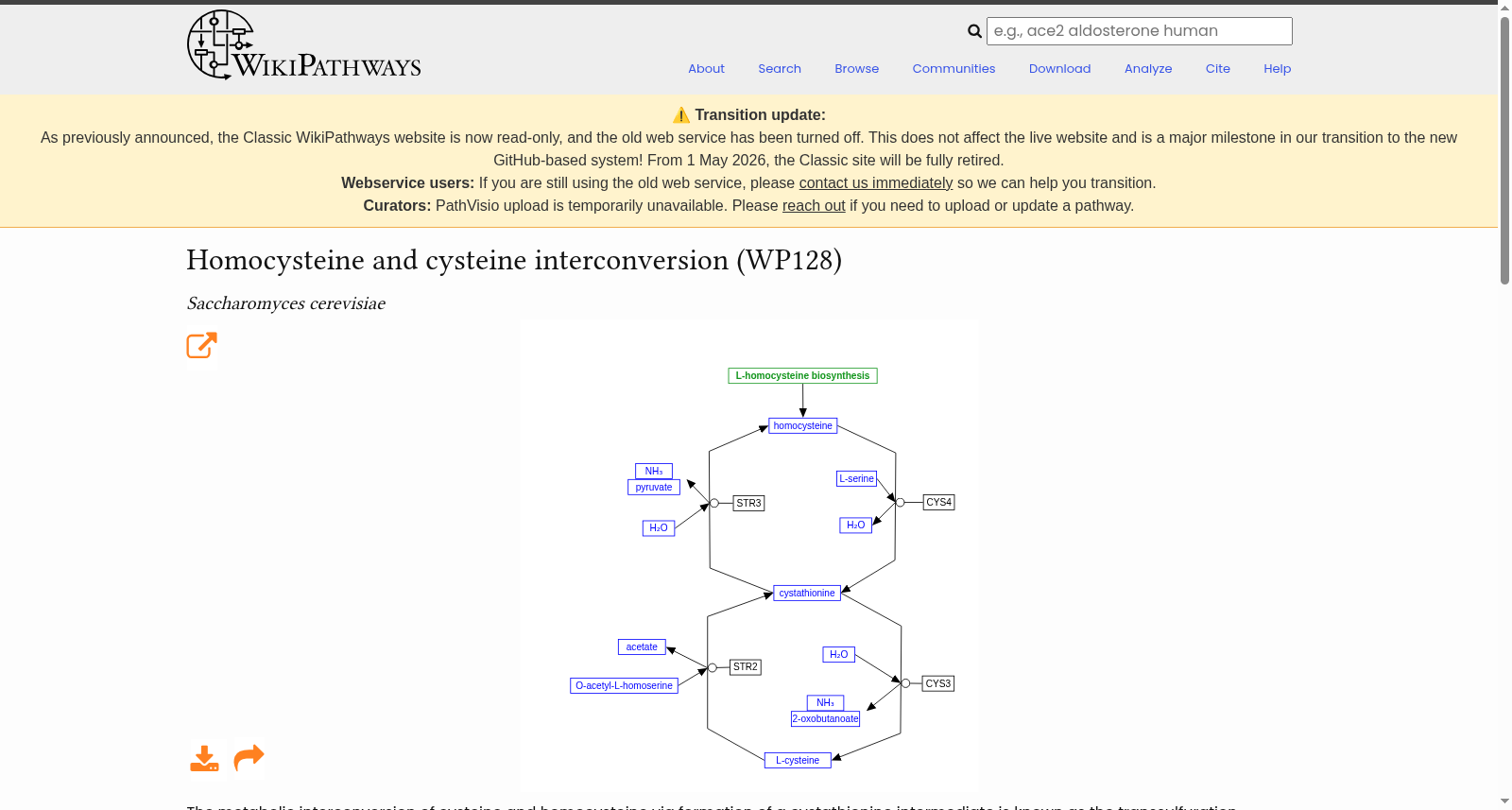
The metabolic interconversion of cysteine and homocysteine via formation of a cystathionine intermediate is known as the transsulfuration pathway. While the transsulfuration pathway proceeds in only one direction in many bacteria and fungi, S. cerevisiae encodes for both a forward and reverse version of the pathway and is able to convert cysteine and homocysteine to one or the other reversibly. In the forward pathway, cysteine reacts with O-acetylhomoserine in a reaction catalyzed by cystathionine -synthase to form cystathionine. Cystathionine is then cleaved by cystathionine -lyase, yielding pyruvate, ammonia, and homocysteine. In S. cerevisiae, cystathionine -synthase and -lyase are thought to be encoded by STR2 and STR3 respectively, due to their similarity to the aforementioned enzymes in other organisms and the inability of str2 or str3 null mutants to utilize cysteine as a sole sulfur source. In the reverse pathway, cystathionine -synthase (Cys4p) catalyzes the condensation of homocysteine and serine to form cystathionine. Cystathionine -lyase (Cys3p) then catalyzes hydrolysis of cystathionine to produce cysteine, -ketobutyrate, and ammonia. The presence of two transsulfuration pathways in S. cerevisiae enables the cell to acquire methionine from cysteine and vice-versa by using homocysteine as an intermediate. Homocysteine derived from cysteine in the forward transsulfuration pathway can be converted to methionine, while homocysteine derived from methionine can be converted to cysteine via the reverse transsulfuration pathway. This enables S. cerevisiae to utilize methionine or cysteine as a sole source of sulfur. Source: https://pathway.yeastgenome.org/
胱氨酸与同型半胱氨酸通过形成牛磺氨酸中间体而进行的代谢互变过程,被称为转硫途径。在许多细菌和真菌中,转硫途径仅单向进行,而酿酒酵母(S. cerevisiae)编码了该途径的正反两版,并能可逆地将胱氨酸和同型半胱氨酸相互转换。在正向途径中,胱氨酸与O-乙酰同型丝氨酸在牛磺氨酸合酶的催化下反应生成牛磺氨酸。随后,牛磺氨酸在牛磺氨酸裂解酶的作用下被裂解,产生丙酮酸、氨和同型半胱氨酸。在酿酒酵母中,由于牛磺氨酸合酶和裂解酶与其他生物中类似酶的相似性,以及str2或str3突变体无法利用胱氨酸作为唯一的硫源,因此认为牛磺氨酸合酶和裂解酶分别由STR2和STR3编码。在逆向途径中,牛磺氨酸合酶(Cys4p)催化同型半胱氨酸和丝氨酸的缩合,形成牛磺氨酸。随后,牛磺氨酸裂解酶(Cys3p)催化牛磺氨酸的水解,产生胱氨酸、β-酮丁酸和氨。酿酒酵母中存在两种转硫途径,使得细胞能够通过使用同型半胱氨酸作为中间体,从胱氨酸获得蛋氨酸,反之亦然。正向转硫途径中由胱氨酸衍生出的同型半胱氨酸可转化为蛋氨酸,而由蛋氨酸衍生出的同型半胱氨酸可通过逆向转硫途径转化为胱氨酸。这使得酿酒酵母能够将蛋氨酸或胱氨酸作为硫的唯一来源进行利用。来源:https://pathway.yeastgenome.org/
提供机构:
wikipathways.github.io
搜集汇总
数据集介绍
背景与挑战
背景概述
该数据集描述了酿酒酵母中高半胱氨酸和半胱氨酸通过转硫途径进行的双向可逆代谢转换,涉及胱硫醚中间体以及STR2、CYS3等关键基因产物。它突出了酿酒酵母与其他生物不同,能够利用该通路实现硫氨基酸的互变,支持细胞以甲硫氨酸或半胱氨酸作为唯一硫源。
以上内容由遇见数据集搜集并总结生成



