---
language:
- pl
license:
- cc-by-nc-sa-4.0
multilinguality:
- monolingual
size_categories:
- 1K<n<10K
task_categories:
- text-classification
task_ids:
- semantic-similarity-classification
pretty_name: Polish Paraphrase Corpus
dataset_info:
features:
- name: sentence_A
dtype: string
- name: sentence_B
dtype: string
- name: label
dtype:
class_label:
names:
0: not used
1: exact paraphrases
2: similar sentences
3: non-paraphrases
splits:
- name: train
num_bytes: 539121
num_examples: 5000
- name: validation
num_bytes: 107010
num_examples: 1000
- name: test
num_bytes: 106515
num_examples: 1000
---
# PPC - Polish Paraphrase Corpus
### Dataset Summary
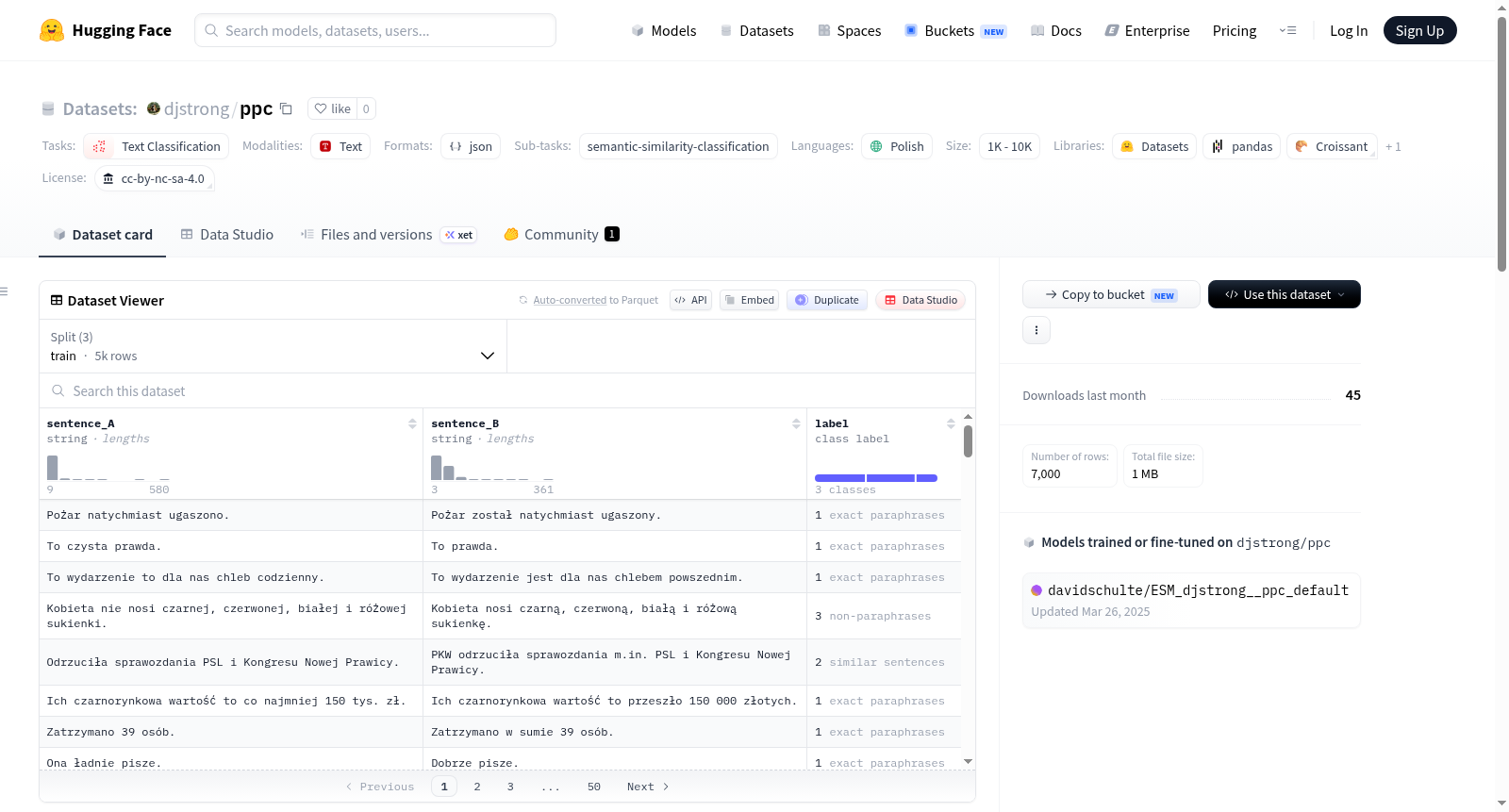
Polish Paraphrase Corpus contains 7000 manually labeled sentence pairs. The dataset was divided into training, validation and test splits. The training part includes 5000 examples, while the other parts contain 1000 examples each. The main purpose of creating such a dataset was to verify how machine learning models perform in the challenging problem of paraphrase identification, where most records contain semantically overlapping parts. Technically, this is a three-class classification task, where each record can be assigned to one of the following categories:
- Exact paraphrases - Sentence pairs that convey exactly the same information. We are interested only in the semantic meaning of the sentence, therefore this category also includes sentences that are semantically identical but, for example, have different emotional emphasis.
- Close paraphrases - Sentence pairs with similar semantic meaning. In this category we include all pairs which contain the same information, but in addition to it there may be other semantically non-overlapping parts. This category also contains context-dependent paraphrases - sentence pairs that may have the same meaning in some contexts but are different in others.
- Non-paraphrases - All other cases, including contradictory sentences and semantically unrelated sentences.
The corpus contains 2911, 1297, and 2792 examples for the above three categories, respectively. The process of annotating the dataset was preceded by an automated generation of candidate pairs, which were then manually labeled. We experimented with two popular techniques of generating possible paraphrases: backtranslation with a set of neural machine translation models and paraphrase mining using a pre-trained multilingual sentence encoder. The extracted sentence pairs are drawn from different data sources: Taboeba, Polish news articles, Wikipedia and Polish version of SICK dataset. Since most of the sentence pairs obtained in this way fell into the first two categories, in order to balance the dataset, some of the examples were manually modified to convey different information. In this way, even negative examples often have high semantic overlap, making this problem difficult for machine learning models.
### Data Instances
Example instance:
```
{
"sentence_A": "Libia: lotnisko w w Trypolisie ostrzelane rakietami.",
"sentence_B": "Jedyne lotnisko w stolicy Libii - Trypolisie zostało w nocy z wtorku na środę ostrzelane rakietami.",
"label": "2"
}
```
### Data Fields
- sentence_A: first sentence text
- sentence_B: second sentence text
- label: label identifier corresponding to one of three categories
### Citation Information
```
@inproceedings{9945218,
author={Dadas, S{\l}awomir},
booktitle={2022 IEEE International Conference on Systems, Man, and Cybernetics (SMC)},
title={Training Effective Neural Sentence Encoders from Automatically Mined Paraphrases},
year={2022},
volume={},
number={},
pages={371-378},
doi={10.1109/SMC53654.2022.9945218}
}
```
---
language:
- 波兰语(Polish)
license:
- 知识共享署名-非商业性使用-相同方式共享4.0国际许可协议(CC-BY-NC-SA-4.0)
multilinguality:
- 单语
size_categories:
- 1千<样本数<1万
task_categories:
- 文本分类
task_ids:
- 语义相似度分类
pretty_name: 波兰语释义语料库(Polish Paraphrase Corpus)
dataset_info:
features:
- name: sentence_A
dtype: 字符串
- name: sentence_B
dtype: 字符串
- name: label
dtype:
类别标签(class_label):
类别名称:
0: 未使用
1: 完全释义句对
2: 相似句对
3: 非释义句对
splits:
- name: 训练集
字节数: 539121
样本数: 5000
- name: 验证集
字节数: 107010
样本数: 1000
- name: 测试集
字节数: 106515
样本数: 1000
---
# 波兰语释义语料库(Polish Paraphrase Corpus,简称PPC)
## 数据集概述
波兰语释义语料库包含7000条人工标注的句子对,数据集被划分为训练集、验证集与测试集:训练集包含5000条样本,验证集与测试集各包含1000条样本。构建该数据集的核心目的是验证机器学习模型在释义识别这一挑战性任务上的性能,该任务中多数样本包含语义重叠部分。从技术层面而言,这是一个三类分类任务,每条样本可被归入以下类别之一:
- 完全释义句对:传递完全一致信息的句子对。本分类仅关注句子的语义内涵,因此也包含语义完全相同但情感强调方式不同的句子。
- 近似释义句对:语义相似的句子对。本分类涵盖所有传递相同核心信息,但额外附带其他语义非重叠部分的句对,同时也包含上下文相关释义:即部分语境下语义一致、其他语境下存在差异的句子对。
- 非释义句对:所有其他情况,包括矛盾句与语义无关的句子。
该语料库的三类样本数分别为2911、1297与2792。数据集的标注流程首先通过自动化方式生成候选句对,随后由人工进行标注。我们尝试了两种主流的候选释义生成技术:基于多组神经机器翻译模型的回译,以及使用预训练多语言句子编码器的释义挖掘。提取得到的句子对来自多个不同数据源:Taboeba、波兰新闻文章、维基百科以及波兰语版SICK数据集(SICK dataset)。由于通过上述方式获取的多数句子对属于前两类,为平衡数据集,我们手动修改了部分样本以使其传递不同的信息。如此一来,即便负样本通常也具备较高的语义重叠度,这使得该任务对机器学习模型而言更具挑战性。
## 数据示例
示例样本:
{
"sentence_A": "利比亚:的黎波里的机场遭火箭弹袭击。",
"sentence_B": "利比亚首都唯一的机场——的黎波里机场于周二周三夜间遭火箭弹袭击。",
"label": "2"
}
## 数据字段
- sentence_A:第一句文本内容
- sentence_B:第二句文本内容
- label:对应三类类别的标签标识符
## 引用信息
@inproceedings{9945218,
author={Dadas, Sławomir},
booktitle={2022年IEEE系统、人与控制论国际会议(SMC)},
title={从自动挖掘的释义中训练高效的神经句子编码器},
year={2022},
volume={},
number={},
pages={371-378},
doi={10.1109/SMC53654.2022.9945218}
}