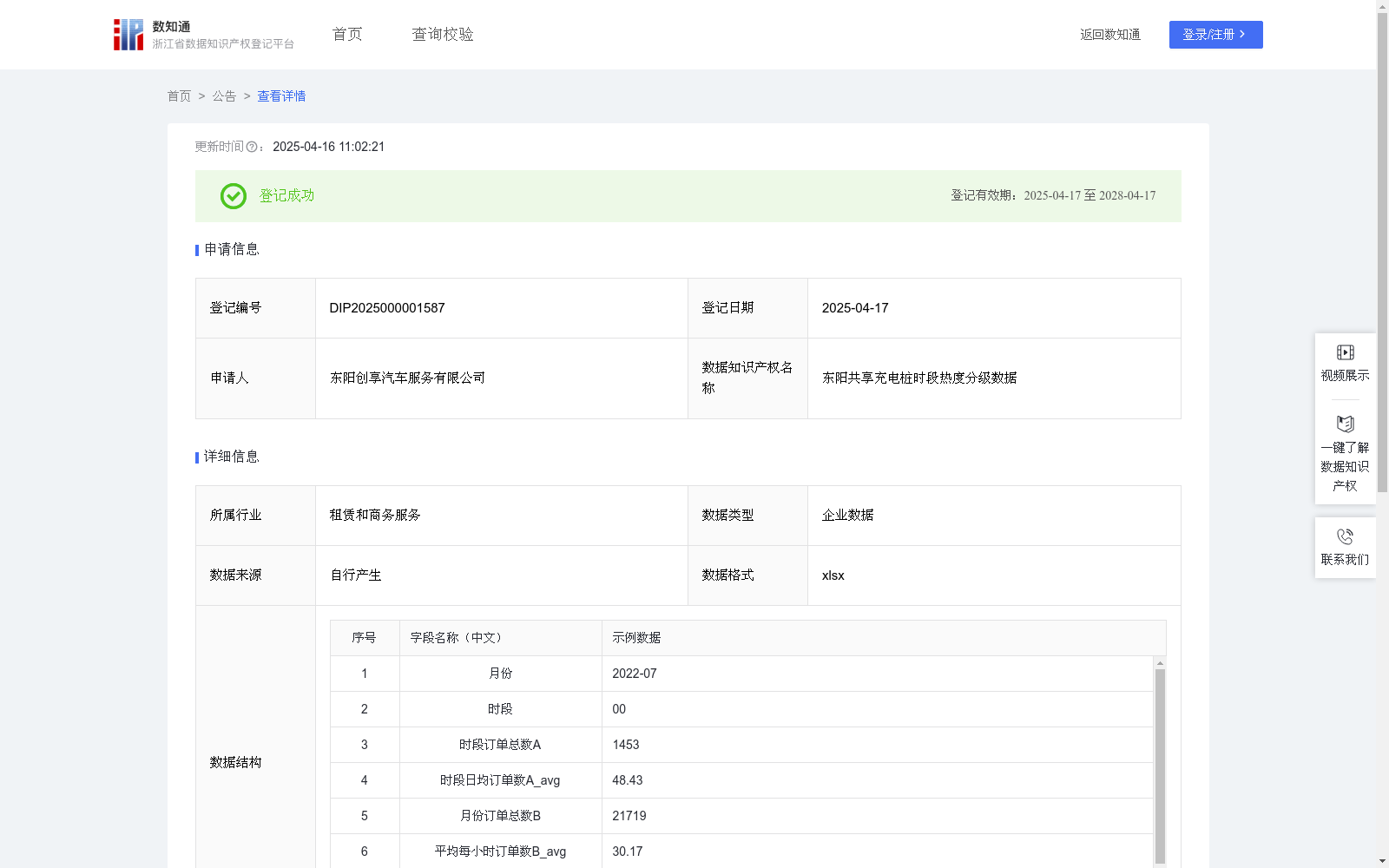
东阳共享充电桩时段热度分级数据
收藏资源简介:
通过分析历史充电订单的时段分布特征(如早高峰、午间平峰、夜间低谷),将全天划分为高热度时段(充电需求密集)和低热度时段(需求稀疏)。基于该分类结果,指导运维人员在低热度时段集中进行故障维修、充电桩维护等作业,避免高需求时段因运维活动占用充电桩导致的用户充电受阻问题,同时优化运维人力成本与充电桩使用效率的平衡。1、数据来源:从东阳创享汽车服务有限公司的东阳创享新能源汽车充电云管理系统中,采集用户订单流水数据。 2、数据处理:对采集的数据进行数据清洗,剔除异常用户订单流水数据。通过订单发生时间,标记每一条数据对应的“月份”和“时段”(如订单创建时间为2025-01-01 08:00:00,则月份标记为“2025-01”,时段标记为“08”)。通过count函数,统计每个月每个时段的订单总数(即时段订单总数A)和每个月的订单总数(即月份订单总数B)。 3、数据计算: (1)一个月按照30天来算,计算每个时段的时段日均订单数A_avg=时段订单总数A/30. (2)一个月按照720个小时(即30x24小时)来算,计算平均每小时订单数B_avg=月份订单总数B/720 (3)计算热度系数=A_avg/B_avg(结果取一位小数)。 (4)根据热度系数判断对应时段的热度类型。若热度系数>1.3,则为高峰时段,若热度系数<0.7,则为低谷时段,其余时段则为常规时段。
By analyzing the temporal distribution characteristics of historical charging orders (such as morning peak hours, midday flat peak hours, and nighttime off-peak hours), the entire day is divided into high-demand periods (with intensive charging demand) and low-demand periods (with sparse demand). Based on this classification result, operation and maintenance (O&M) staff are guided to conduct centralized maintenance tasks including fault repair and charging pile maintenance during low-demand hours, so as to prevent user charging disruptions caused by occupying charging piles during peak demand periods due to O&M activities, while optimizing the balance between O&M labor costs and charging pile utilization efficiency. 1. Data Source: User order transaction data was collected from the Dongyang Chuangxiang New Energy Vehicle Charging Cloud Management System of Dongyang Chuangxiang Automotive Service Co., Ltd. 2. Data Processing: Clean the collected data to eliminate abnormal user order transaction records. Mark the "month" and "time slot" corresponding to each record based on the order occurrence time. For example, if the order creation time is 2025-01-01 08:00:00, the month will be marked as "2025-01" and the time slot will be marked as "08". Use the COUNT function to count the total number of orders per time slot in each month (referred to as total orders per time slot A) and the total number of orders per month (referred to as total monthly orders B). 3. Data Calculation: (1) Calculate the average daily orders per time slot A_avg = total orders per time slot A / 30, assuming a month consists of 30 days. (2) Calculate the average hourly orders B_avg = total monthly orders B / 720, assuming a month has 720 hours (i.e., 30 × 24 hours). (3) Calculate the heat coefficient = A_avg / B_avg (the result is rounded to one decimal place). (4) Determine the heat category of the corresponding time slot based on the heat coefficient. If the heat coefficient is greater than 1.3, it is classified as a peak period; if the heat coefficient is less than 0.7, it is classified as an off-peak period; the remaining time slots are classified as regular periods.