UKPLab/TexPrax
收藏资源简介:
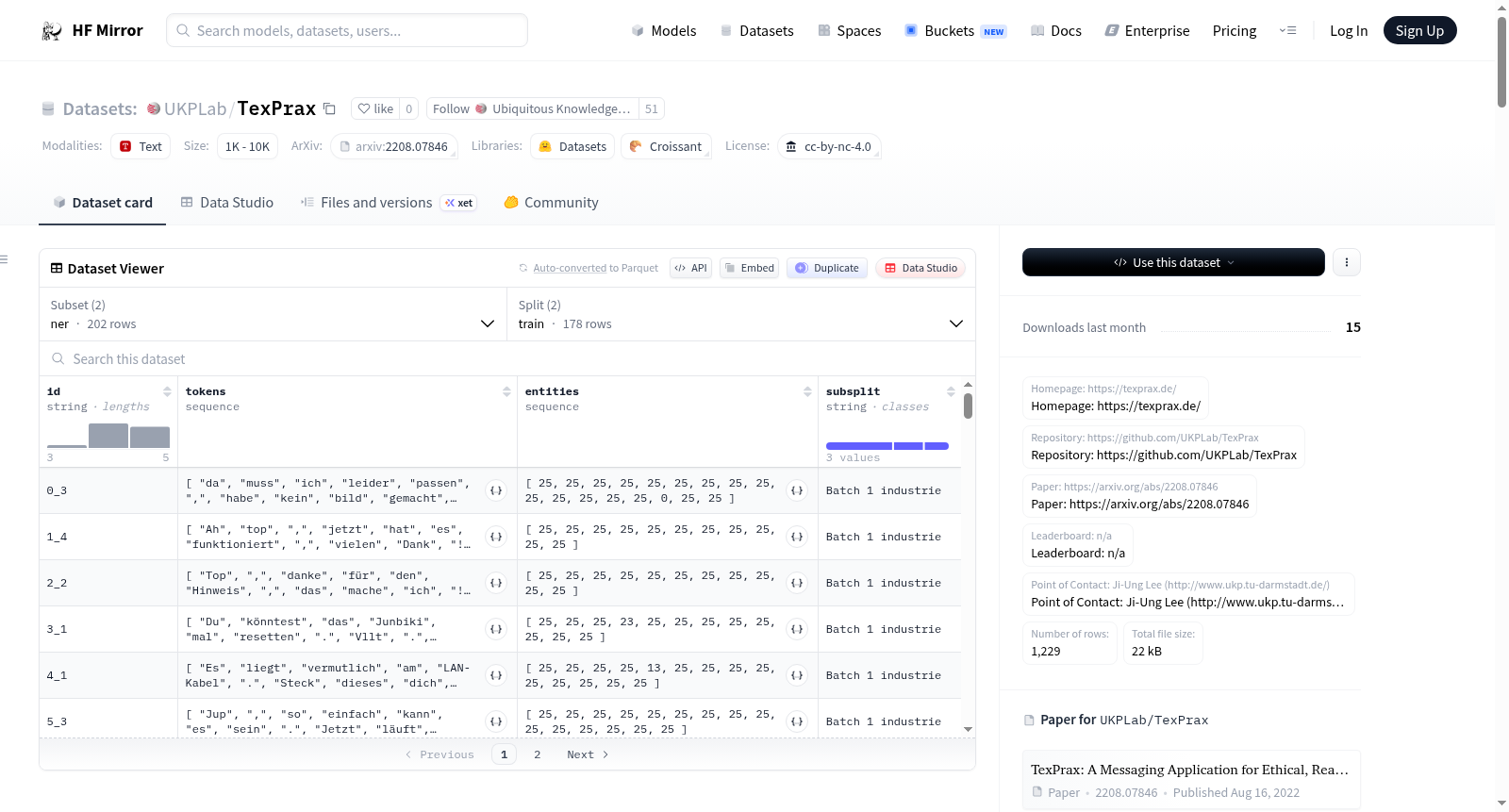
--- license: cc-by-nc-4.0 --- # Dataset Card for TexPrax ## Table of Contents - [Table of Contents](#table-of-contents) - [Dataset Description](#dataset-description) - [Dataset Summary](#dataset-summary) - [Supported Tasks and Leaderboards](#supported-tasks-and-leaderboards) - [Languages](#languages) - [Dataset Structure](#dataset-structure) - [Data Instances](#data-instances) - [Data Fields](#data-fields) - [Data Splits](#data-splits) - [Dataset Creation](#dataset-creation) - [Curation Rationale](#curation-rationale) - [Source Data](#source-data) - [Annotations](#annotations) - [Personal and Sensitive Information](#personal-and-sensitive-information) - [Considerations for Using the Data](#considerations-for-using-the-data) - [Social Impact of Dataset](#social-impact-of-dataset) - [Discussion of Biases](#discussion-of-biases) - [Other Known Limitations](#other-known-limitations) - [Additional Information](#additional-information) - [Dataset Curators](#dataset-curators) - [Licensing Information](#licensing-information) - [Citation Information](#citation-information) - [Contributions](#contributions) ## Dataset Description - **Homepage: https://texprax.de/** - **Repository: https://github.com/UKPLab/TexPrax** - **Paper: https://arxiv.org/abs/2208.07846** - **Leaderboard: n/a** - **Point of Contact: Ji-Ung Lee (http://www.ukp.tu-darmstadt.de/)** ### Dataset Summary This dataset contains dialogues collected from German factory workers at the _Center for industrial productivity_ ([CiP](https://www.prozesslernfabrik.de/)). The dialogues mostly concern issues workers encounter during their daily work, such as machines breaking down, material missing, etc. The dialogues are further expert-annotated on a sentence level (problem, cause, solution, other) for sentence classification and on a token level for named entity recognition using a BIO tagging scheme. Note, that the dataset was collected in three rounds, each around one year apart. Here, we provide the data only split into train and test data where the test data was collected at the last round (July 2022). Additionally, the data from the first round is split into two subdomains, industry 4.0 (industrie) and machining (zerspanung). The splits were made according to the respective groups of people working at different assembly lines in the factory. ### Supported Tasks and Leaderboards This dataset supports the following tasks: * Sentence classification * Named entity recognition (will be updated soon with the new indexing) * Dialog generation (so far not evaluated) ### Languages German ## Dataset Structure ### Data Instances On sentence level, each instance consists of the dialog-id, turn-id, sentence-id, the sentence (raw), the label, the domain, and the subsplit. ``` {"185";"562";993";"wie kriege ich die Dichtung raus?";"P";"n/a";"3"} ``` On token level, each instance consists of a unique identifier, a list of tokens containing the whole dialog, the list of labels (bio-tagged entities), and the subsplit. ``` {"178_0";"['Hi', 'wie', 'kriege', 'ich', 'die', 'Dichtung', 'raus', '?', 'in', 'der', 'Schublade', 'gibt', 'es', 'einen', 'Dichtungszieher']";"['O', 'O', 'O', 'O', 'O', 'B-PRE', 'O', 'O', 'O', 'O', 'B-LOC', 'O', 'O', 'O', 'B-PE']";"Batch 3"} ``` ### Data Fields Sentence level: * dialog-id: unique identifier for the dialog * turn-id: unique identifier for the turn * sentence-id: unique identifier for the dialog * sentence: the respective sentence * label: the label (_P_ for Problem, _C_ for Cause, _S_ for solution, and _O_ for Other) * domain: the subdomains where the data was collected from. Domains are industry, machining, or n/a (for batch 2 and batch 3). * subsplit: the respective subsplit of the data (see below) Token level: * id: the identifier * tokens: a list of tokens (i.e., the tokenized dialogue) * entities: the named entity in a BIO scheme (_B-X_, _I-X_, or O). * subsplit: the respective subsplit of the data (see below) ### Data Splits The dataset is split into train and test splits, but contains further subsplits (subsplit column). Note, that the splits are collected at different times with some turnaround in the workforce. Hence, later data (especially the data from batch 2) contains more turns (due to increased search for a cause) as more inexperienced workers who newly joined were employed in the factory. Train: * Batch 1 industrie: data collected in October 2020 from workers in the industry 4.0 assembly line * Batch 1 zerspanung: data collected in October 2020 from workers in the machining assembly line * Batch 2: data collected in-between October 2021-June 2022 from all workers Test: * Batch 3: data collected in July 2022 together with the system usability study run Sentence level statistics: | Batch | Dialogues | Turns | Sentences | |---|---|---|---| | 1 | 81 | 246 | 553 | | 2 | 97 | 309 | 432 | | 3 | 24 | 36 | 42 | | Overall | 202 | 591 | 1,027 | Token level statistics: [Needs to be added] ## Dataset Creation ### Curation Rationale This dataset provides task-oriented dialogues that solve a very domain specific problem. ### Source Data #### Initial Data Collection and Normalization The data was generated by workers at the [CiP](https://www.prozesslernfabrik.de/). The data was collected in three rounds (October 2020, October 2021-June 2022, July 2022). As the dialogues occurred during their daily work, one distinct property of the dataset is that all dialogues are very informal 'ne', contain abbreviations 'vll', and filler words such as 'ah'. For a detailed description please see the [paper](https://arxiv.org/abs/2208.07846). #### Who are the source language producers? German factory workers working at the [CiP](https://www.prozesslernfabrik.de/) ### Annotations #### Annotation process **Token level.** Token level annotation was done by researchers who are responsible for supervising and teaching workers at the CiP. The data was first split into three parts, each annotated by one researcher. Next, each researcher cross-examined the other researchers' annotations. If there were disagreements, all three researchers discussed the final label. **Sentence level.** Sentence level annotations were collected from the factory workers who also generated the dialogues. For details about the data collection, please see the [TexPrax demo paper](https://arxiv.org/abs/2208.07846). #### Who are the annotators? **Token level.** Researchers working at the CiP. **Sentence level.** The factory workers themselves. ### Personal and Sensitive Information This dataset is fully anonymized. All occurrences of names have been manually checked during annotation and replaced with a random token. ## Considerations for Using the Data ### Social Impact of Dataset Informal language especially used in short messages, however, seldom considered in existing NLP datasets. This dataset could serve as an interesting evaluation task for transferring language models to low-resource, but highly specific domains. Moreover, we note that despite all abbreviations, typos, and local dialects used in the messages, all workers were able to understand the questions as well as replies. This should be a standard future NLP models should be able to uphold. ### Discussion of Biases The dialogues are very much on a professional level. The workers were informed (and gave their consent) in advance that their messages are being recorded and processed, which may have influenced them to hold only professional conversations, hence, all dialogues concern inanimate objects (i.e., machines). ### Other Known Limitations [More Information Needed] ## Additional Information You can download the data via: ``` from datasets import load_dataset dataset = load_dataset("UKPLab/TexPrax") # default config is sentence classification dataset = load_dataset("UKPLab/TexPrax", "ner") # use the ner tag for named entity recognition ``` Please find more information about the code and how the data was collected on [GitHub](https://github.com/UKPLab/TexPrax). ### Dataset Curators Curation is managed by our [data manager](https://www.informatik.tu-darmstadt.de/ukp/research_ukp/ukp_research_data_and_software/ukp_data_and_software.en.jsp) at UKP. ### Licensing Information [CC-by-NC 4.0](https://creativecommons.org/licenses/by-nc/4.0/) ### Citation Information Please cite this data using: ``` @article{stangier2022texprax, title={TexPrax: A Messaging Application for Ethical, Real-time Data Collection and Annotation}, author={Stangier, Lorenz and Lee, Ji-Ung and Wang, Yuxi and M{\"u}ller, Marvin and Frick, Nicholas and Metternich, Joachim and Gurevych, Iryna}, journal={arXiv preprint arXiv:2208.07846}, year={2022} } ``` ### Contributions Thanks to [@Wuhn](https://github.com/Wuhn) for adding this dataset. ## Tags annotations_creators: - expert-generated language: - de language_creators: - expert-generated license: - cc-by-nc-4.0 multilinguality: - monolingual pretty_name: TexPrax-Conversations size_categories: - n<1K - 1K<n<10K source_datasets: - original tags: - dialog - expert to expert conversations - task-oriented task_categories: - token-classification - text-classification task_ids: - named-entity-recognition - multi-class-classification
数据集概述
数据集名称
TexPrax
数据集描述
TexPrax数据集包含从德国工厂工人收集的对话,主要涉及日常工作中遇到的问题,如机器故障、材料缺失等。对话经过专家在句子级别(问题、原因、解决方案、其他)进行标注,以及在令牌级别使用BIO标记方案进行命名实体识别。
支持的任务
- 句子分类
- 命名实体识别
- 对话生成(尚未评估)
语言
德语
数据集结构
数据实例
- 句子级别:每个实例包括对话ID、轮次ID、句子ID、句子内容、标签、领域和子分割。
- 令牌级别:每个实例包括唯一标识符、令牌列表、标签列表(BIO标记实体)和子分割。
数据字段
- 句子级别:对话ID、轮次ID、句子ID、句子、标签、领域、子分割。
- 令牌级别:标识符、令牌列表、实体、子分割。
数据分割
数据集分为训练和测试集,包含进一步的子分割。训练数据来自2020年10月和2021年10月至2022年6月,测试数据来自2022年7月。
数据集创建
来源数据
数据由CiP的工厂工人产生,分三轮收集。
标注过程
- 令牌级别:由CiP的研究人员进行,经过交叉检查和讨论确定最终标签。
- 句子级别:由工厂工人进行。
个人和敏感信息
数据集已完全匿名化,所有名称已被替换为随机令牌。
使用数据的考虑
社会影响
该数据集可用于评估语言模型在低资源但高度特定领域的转移能力。
偏见讨论
对话主要涉及专业层面,可能受限于仅讨论机器等非生物对象。
其他已知限制
[需要更多信息]
附加信息
数据集可通过datasets库加载,详细信息请参阅GitHub仓库。
许可证
CC-by-NC 4.0
引用信息
@article{stangier2022texprax, title={TexPrax: A Messaging Application for Ethical, Real-time Data Collection and Annotation}, author={Stangier, Lorenz and Lee, Ji-Ung and Wang, Yuxi and M{"u}ller, Marvin and Frick, Nicholas and Metternich, Joachim and Gurevych, Iryna}, journal={arXiv preprint arXiv:2208.07846}, year={2022} }