
juliensimon/omni-solar-wind-parameters
收藏Hugging Face2026-04-21 更新2026-03-29 收录
下载链接:
https://hf-mirror.com/datasets/juliensimon/omni-solar-wind-parameters
下载链接
链接失效反馈官方服务:
资源简介:
---
license: cc-by-4.0
pretty_name: "OMNI Hourly Solar Wind Parameters"
language:
- en
description: "Merged hourly near-Earth solar wind magnetic field, plasma, energetic particle parameters combined with geomagnetic and solar activity indices from NASA's OMNI dataset. The master bridge dataset for s"
task_categories:
- tabular-regression
- time-series-forecasting
tags:
- space
- solar-wind
- imf
- magnetic-field
- space-weather
- nasa
- open-data
- tabular-data
- parquet
size_categories:
- 100K<n<1M
configs:
- config_name: default
data_files:
- split: train
path: data/omni_solar_wind_parameters.parquet
default: true
---
# OMNI Hourly Solar Wind Parameters
<div align="center">
<img src="banner.jpg" alt="Aurora borealis blankets the Earth, seen from the ISS" width="400">
<p><em>Credit: NASA</em></p>
</div>
*Part of a [dataset collection](https://huggingface.co/collections/juliensimon/space-weather-datasets-69c24cae98f1666f2101ca70) on Hugging Face.*
## Dataset description
Merged hourly near-Earth solar wind magnetic field, plasma, energetic particle parameters combined with geomagnetic and solar activity indices from NASA's OMNI dataset. The master bridge dataset for space weather analysis -- it time-aligns IMF, solar wind, and geomagnetic response in a single file.
The OMNI dataset from NASA's Goddard Space Flight Center merges solar wind observations from multiple spacecraft (IMP 8, ACE, Wind, DSCOVR, and others) into a single consistent hourly time series at Earth's bow shock nose. It combines interplanetary magnetic field (IMF) components, solar wind plasma parameters, energetic particle fluxes, and geomagnetic activity indices. Key parameter groups include IMF (field magnitude, Bx/By/Bz in GSE and GSM), solar wind plasma (proton density, temperature, bulk flow speed), derived quantities (flow pressure, plasma beta, electric field, Alfven and magnetosonic Mach numbers), geomagnetic indices (Kp, Dst, AE, AL, AU, ap, PC(N)), solar indices (F10.7, sunspot number), and energetic particles (proton fluxes at >1 to >60 MeV).
A key feature of the OMNI processing is the time-shifting of upstream spacecraft data to the Earth's bow shock nose. Observations from monitors at the L1 Lagrange point (ACE, Wind, DSCOVR -- roughly 1.5 million km upstream) are propagated to the bow shock using the measured solar wind speed, ensuring temporal alignment with the geomagnetic indices they drive.
The derived quantities encode important plasma physics. Plasma beta distinguishes magnetically dominated structures such as magnetic clouds (beta << 1) from the ambient solar wind (beta ~ 1). The Alfven Mach number characterizes how supersonic the flow is relative to the Alfven wave speed. The convective electric field (-V x B) quantifies magnetic flux transport toward the magnetopause and is a key input to empirical geomagnetic activity models.
This dataset is suitable for **tabular regression, time-series forecasting** tasks.
## Schema
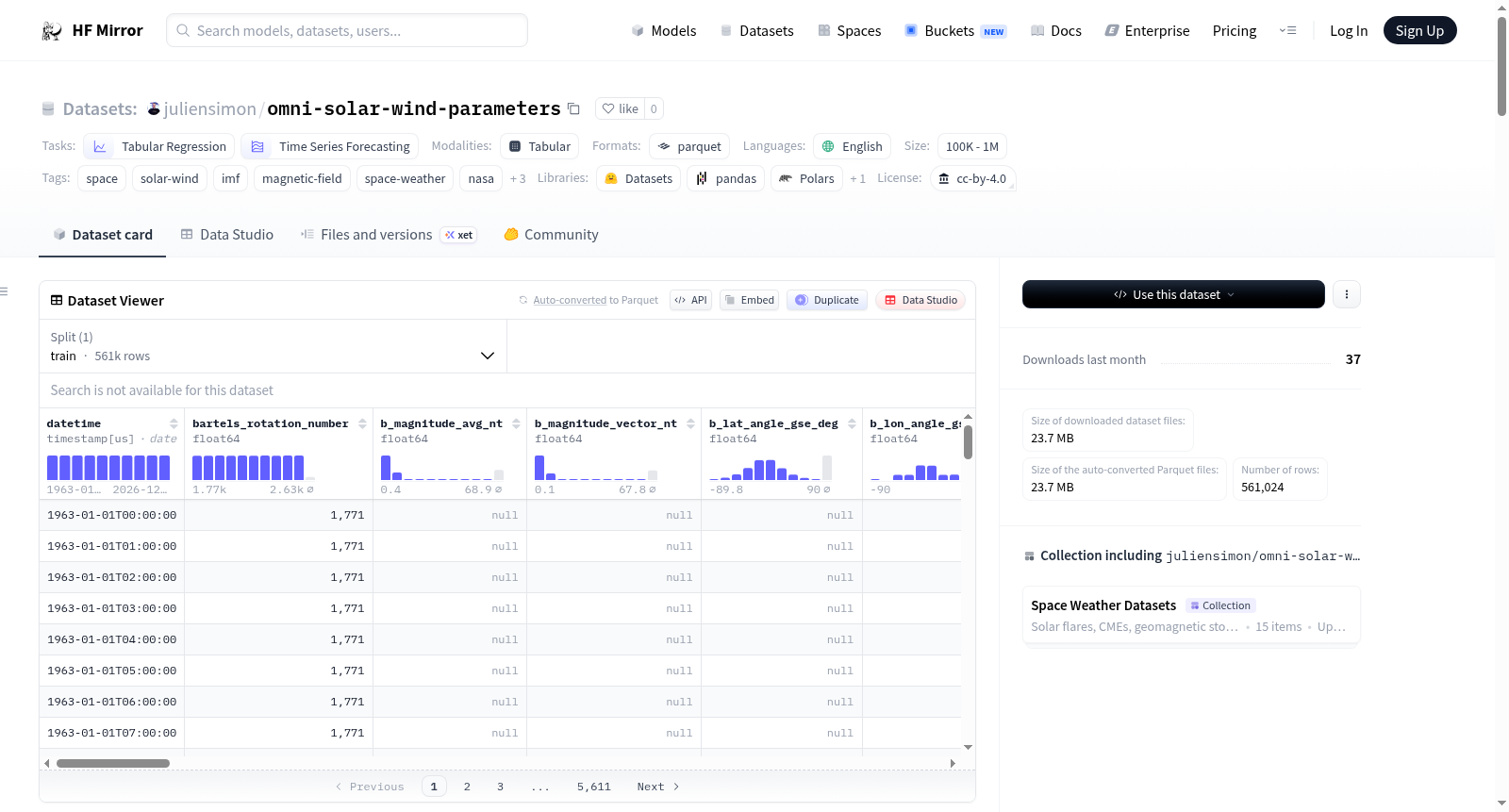
| Column | Type | Description | Sample | Null % |
|--------|------|-------------|--------|--------|
| `datetime` | datetime64[us] | Observation timestamp (UTC, hourly cadence). OMNI data begins 1963 and is updated daily. | 1963-01-01 00:00:00 | 0.0% |
| `bartels_rotation_number` | float64 | Bartels solar rotation number: sequential count of 27-day rotation periods; used to align data with the solar rotation cycle. | 1771.0 | 1.1% |
| `b_magnitude_avg_nt` | float64 | Average IMF magnitude 1/N SUM \|B\| (nT); scalar average of field magnitude over the hour. | 4.5 | 23.3% |
| `b_magnitude_vector_nt` | float64 | Magnitude of the hourly-averaged field vector (nT); differs from b_magnitude_avg_nt when the field direction varies within the hour. | 3.4 | 23.3% |
| `b_lat_angle_gse_deg` | float64 | Latitude angle of the average IMF vector in GSE coordinates (degrees); +90 = northward, -90 = southward. | 3.4 | 23.3% |
| `b_lon_angle_gse_deg` | float64 | Longitude angle of the average IMF vector in GSE coordinates (degrees); 0 = sunward, 180 = anti-sunward. | 154.0 | 23.3% |
| `bx_gse_nt` | float64 | IMF Bx component in GSE/GSM coordinates (nT); positive sunward along the Sun-Earth line. Bx is identical in GSE and GSM. | -3.0 | 23.3% |
| `by_gse_nt` | float64 | IMF By component in GSE coordinates (nT); positive dawnward (opposite to Earth's orbital motion). | 1.5 | 23.3% |
| `bz_gse_nt` | float64 | IMF Bz component in GSE coordinates (nT); positive northward (perpendicular to ecliptic). | 0.2 | 23.3% |
| `by_gsm_nt` | float64 | IMF By component in GSM coordinates (nT); GSM rotates with Earth's dipole tilt, important for magnetospheric coupling. | 1.5 | 23.3% |
| `bz_gsm_nt` | float64 | IMF Bz component in GSM coordinates (nT); negative (southward) Bz drives magnetic reconnection and geomagnetic storms. | -0.2 | 23.3% |
| `sigma_b_magnitude_nt` | float64 | RMS standard deviation of \|B\| within the averaging hour (nT); measures IMF variability. | 0.7 | 26.3% |
| `sigma_b_vector_nt` | float64 | RMS standard deviation of the field vector magnitude within the hour (nT). | 3.1 | 23.3% |
| `sigma_bx_nt` | float64 | RMS standard deviation of Bx component, GSE (nT). | 1.4 | 23.4% |
| `sigma_by_nt` | float64 | RMS standard deviation of By component, GSE (nT). | 2.1 | 23.4% |
| `sigma_bz_nt` | float64 | RMS standard deviation of Bz component, GSE (nT). | 1.8 | 23.4% |
| `proton_temperature_k` | float64 | Solar wind proton temperature (K); typical range 10^4-5x10^5 K; elevated in fast streams, depressed in ICMEs. | 55488.0 | 29.9% |
| `proton_density_cm3` | float64 | Solar wind proton number density (cm^-3); typical 5-10 cm^-3 at 1 AU; spikes during CME sheaths. | 10.5 | 26.9% |
| `flow_speed_kms` | float64 | Solar wind bulk plasma speed (km/s); slow wind: 350-450 km/s, fast streams: 600-800 km/s. | 285.0 | 24.0% |
| `flow_lon_angle_deg` | float64 | Flow longitude angle in quasi-GSE coordinates (degrees); small departures from 180 deg indicate non-radial flow. | -2.5 | 29.6% |
| `flow_lat_angle_deg` | float64 | Flow latitude angle in GSE coordinates (degrees); small departures from 0 deg indicate north/south deflections. | 3.7 | 36.0% |
| `alpha_proton_ratio` | float64 | He2+/H+ number density ratio (Na/Np); typical 0.02-0.08; elevated in fast streams and CMEs. | 0.04 | 42.0% |
| `flow_pressure_npa` | float64 | Solar wind dynamic (ram) pressure 0.5*rho*v^2 (nPa); typical 1-10 nPa; high values compress the dayside magnetopause. | 1.71 | 26.9% |
| `sigma_t_k` | float64 | Intra-hour standard deviation of proton temperature (K); reflects solar wind variability within the averaging window. | 10200.0 | 30.6% |
| `sigma_n_cm3` | float64 | Intra-hour standard deviation of proton density (cm^-3). | 1.7 | 30.7% |
| `sigma_v_kms` | float64 | Intra-hour standard deviation of flow speed (km/s). | 10.0 | 29.7% |
| `sigma_phi_v_deg` | float64 | Intra-hour standard deviation of flow longitude angle (degrees). | 1.5 | 32.3% |
| `sigma_theta_v_deg` | float64 | Intra-hour standard deviation of flow latitude angle (degrees). | 1.3 | 38.4% |
| `sigma_alpha_proton_ratio` | float64 | Intra-hour standard deviation of the He2+/H+ density ratio. | 0.018 | 42.0% |
| `electric_field_mvpm` | float64 | Interplanetary electric field component -V x Bz (mV/m); negative (southward Bz) drives magnetospheric energy input; typical range -10 to +10 mV/m. | 0.06 | 28.2% |
| `plasma_beta` | float64 | Ratio of thermal pressure to magnetic pressure (nkT / B^2/8pi); beta < 1 = magnetically dominated, beta > 1 = thermally dominated. | 3.93 | 32.7% |
| `alfven_mach_number` | float64 | Solar wind speed divided by Alfven speed; typical ~8-10 at 1 AU; determines bow shock and magnetopause standoff. | 10.3 | 29.9% |
| `kp_index` | float64 | Planetary geomagnetic 3-hourly Kp index stored as integer x 10 (e.g. 27 = Kp 2.7); scale 0-90; Kp >= 50 = geomagnetic storm. | 7.0 | 1.1% |
| `sunspot_number` | float64 | International sunspot number (SILSO v2); tracks the 11-year solar cycle; range ~0-300. | 33.0 | 1.2% |
| `dst_index_nt` | float64 | Disturbance Storm Time ring-current index (nT); 0 = quiet; -30 to -50 nT = minor storm; < -100 nT = intense storm. | -6.0 | 1.1% |
| `ae_index_nt` | float64 | Auroral Electrojet AE index (nT) = AU - AL; measures substorm and auroral zone current intensity; 0-2000+ nT. | 119.0 | 6.6% |
| `proton_flux_gt1mev` | float64 | Energetic proton flux for particles > 1 MeV (1/cm^2 s sr); elevated during solar proton events (SPEs). | 415.56 | 58.3% |
| `proton_flux_gt2mev` | float64 | Energetic proton flux for particles > 2 MeV (1/cm^2 s sr). | 0.3 | 64.8% |
| `proton_flux_gt4mev` | float64 | Energetic proton flux for particles > 4 MeV (1/cm^2 s sr). | 0.29 | 64.8% |
| `proton_flux_gt10mev` | float64 | Energetic proton flux for particles > 10 MeV (1/cm^2 s sr); NOAA SPE threshold: 10 pfu at this energy. | 4.39 | 34.9% |
| `proton_flux_gt30mev` | float64 | Energetic proton flux for particles > 30 MeV (1/cm^2 s sr). | 1.51 | 34.9% |
| `proton_flux_gt60mev` | float64 | Energetic proton flux for particles > 60 MeV (1/cm^2 s sr). | 0.93 | 34.9% |
| `ap_index_nt` | float64 | Linear equivalent of Kp index (nT); 3-hourly; range 0-400 nT; ap >= 100 = major geomagnetic storm. | 3.0 | 1.1% |
| `f107_index_sfu` | float64 | Solar 10.7 cm radio flux index (SFU, 1 SFU = 10^-22 W/m^2/Hz); solar cycle range ~65-300 SFU; proxy for EUV output. | 77.0 | 1.2% |
| `pc_n_index` | float64 | Polar Cap (North) magnetic activity index from Thule/Qaanaaq magnetometer; tracks cross-polar-cap potential and substorm precursors. | 0.5 | 21.9% |
| `al_index_nt` | float64 | Auroral Electrojet lower (AL) index (nT); measures westward electrojet intensity; negative excursions indicate substorm onset. | -19.0 | 11.3% |
| `au_index_nt` | float64 | Auroral Electrojet upper (AU) index (nT); measures eastward electrojet intensity; AE = AU - AL. | -2.0 | 11.3% |
| `magnetosonic_mach_number` | float64 | Solar wind speed divided by the fast magnetosonic wave speed; determines bow shock geometry; typical ~6-8 at 1 AU. | 6.6 | 32.7% |
## Quick stats
- **561,024** hourly records (1963-01-01 to 2026-12-31)
- **48** parameters spanning IMF, solar wind, geomagnetic indices, and energetic particles
- Bz coverage: **76.7%**, flow speed: **76.0%**, Dst: **98.9%**
- Standard reference dataset for solar wind-magnetosphere coupling studies
## Usage
```python
from datasets import load_dataset
ds = load_dataset("juliensimon/omni-solar-wind-parameters", split="train")
df = ds.to_pandas()
```
```python
from datasets import load_dataset
ds = load_dataset("juliensimon/omni-solar-wind-parameters", split="train")
df = ds.to_pandas()
# Southward IMF (Bz < 0) and geomagnetic storms (Dst < -50)
storms = df[(df["bz_gsm_nt"] < -5) & (df["dst_index_nt"] < -50)]
print(f"Storm hours with strong southward IMF: {len(storms):,}")
# Solar wind speed distribution
print(df["flow_speed_kms"].describe())
# Plasma beta vs Alfven Mach number
import matplotlib.pyplot as plt
sub = df[["plasma_beta", "alfven_mach_number"]].dropna()
plt.scatter(sub["plasma_beta"], sub["alfven_mach_number"], s=0.1, alpha=0.1)
plt.xlabel("Plasma Beta")
plt.ylabel("Alfven Mach Number")
plt.xscale("log")
plt.yscale("log")
plt.title("OMNI: Plasma Beta vs Alfven Mach Number")
plt.show()
```
## Data source
https://omniweb.gsfc.nasa.gov/
## Related datasets
- [juliensimon/solar-wind](https://huggingface.co/datasets/juliensimon/solar-wind)
- [juliensimon/dst-index](https://huggingface.co/datasets/juliensimon/dst-index)
- [juliensimon/geomagnetic-kp-index](https://huggingface.co/datasets/juliensimon/geomagnetic-kp-index)
- [juliensimon/auroral-electrojet-index](https://huggingface.co/datasets/juliensimon/auroral-electrojet-index)
- [juliensimon/f107-solar-flux](https://huggingface.co/datasets/juliensimon/f107-solar-flux)
> If you find this dataset useful, please consider [giving it a like](https://huggingface.co/datasets/juliensimon/omni-solar-wind-parameters) on Hugging Face. It helps others discover it.
## About the author
Created by [Julien Simon](https://julien.org) — AI Operating Partner at Fortino Capital. Part of the [Space Datasets](https://julien.org/datasets) collection.
## Citation
```bibtex
@dataset{omni_solar_wind_parameters,
title = {OMNI Hourly Solar Wind Parameters},
author = {juliensimon},
year = {2026},
url = {https://huggingface.co/datasets/juliensimon/omni-solar-wind-parameters},
publisher = {Hugging Face}
}
```
## License
[CC-BY-4.0](https://creativecommons.org/licenses/by/4.0/)
提供机构:
juliensimon
搜集汇总
数据集介绍
构建方式
在空间天气研究领域,构建一个能够精确反映太阳风与地球磁层相互作用的综合性数据集至关重要。OMNI数据集通过整合来自多个航天器的观测数据,包括IMP 8、ACE、Wind和DSCOVR等,形成了一致的小时级时间序列。其核心构建方法在于采用相位前沿技术,将位于L1拉格朗日点的上游监测数据,依据实测的太阳风速,传播至地球弓激波鼻部,从而校正了约30至60分钟的传输延迟。这种时间对齐处理确保了行星际磁场和等离子体参数与它们所驱动的地磁指数在时序上精确匹配,为耦合研究提供了可靠的数据基础。
使用方法
研究人员可利用该数据集进行广泛的太阳风-磁层耦合分析与空间天气预测模型开发。通过加载数据集并转换为Pandas DataFrame,可以便捷地执行数据筛选、统计描述及相关性分析等操作。例如,可以提取南向行星际磁场条件与强烈地磁暴事件相关联的时段,以研究其触发机制;亦可分析太阳风速的分布特征,或探究等离子体贝塔值与阿尔芬马赫数之间的物理关系。数据集的小时级时间分辨率和长期跨度,使其适用于时间序列预测、回归建模以及磁流体动力学模拟的边界条件设定等多种科学计算场景。
背景与挑战
背景概述
OMNI小时级太阳风参数数据集由NASA戈达德太空飞行中心(GSFC)主导构建,作为空间天气研究领域的基石性资源,其历史可追溯至上世纪六十年代。该数据集系统整合了IMP 8、ACE、Wind、DSCOVR等多颗航天器的观测数据,通过时间对齐与相位前移技术,将行星际磁场、太阳风等离子体参数与地磁指数融合为统一的小时级时间序列。其核心科学目标在于揭示太阳风与地球磁层之间的能量耦合机制,特别是南向行星际磁场触发磁重联、驱动地磁暴与亚暴的物理过程。自发布以来,OMNI数据集已成为经验模型开发、磁流体力学模拟验证及空间天气预报研究不可或缺的基准数据,深刻推动了日地关系物理学的发展。
当前挑战
该数据集致力于解决空间天气因果关联与预测建模中的核心挑战:太阳风-磁层耦合过程具有高度非线性与滞后性,如何从多变量时序中准确提取驱动响应关系、构建稳健的预报模型是一大难题。在数据构建层面,挑战主要源于多源异构数据的融合:不同航天器的仪器精度、采样频率与坐标系统存在差异,需进行严格的交叉校准与误差修正;同时,将位于L1点的上游观测数据精确传播至地球弓激波鼻部,依赖于太阳风速测量的准确性,任何速度误差都会导致时间对齐偏差,进而影响因果推断的可靠性。此外,长达数十年的数据跨度中,仪器更迭与数据缺失问题也增加了数据集的一致性与连续性维护难度。
常用场景
经典使用场景
在空间天气研究领域,OMNI数据集作为基准参考,其经典应用场景在于分析太阳风与地球磁层之间的耦合机制。通过整合多航天器的观测数据,该数据集提供了时间对齐的太阳风等离子体参数、行星际磁场分量以及地磁活动指数,使得研究人员能够深入探究太阳风能量输入与磁层响应的动态关联,例如研究南向行星际磁场(Bz负值)如何触发地磁暴,为理解空间天气的物理驱动过程提供了关键数据支撑。
解决学术问题
该数据集有效解决了太阳风-磁层耦合研究中的关键学术问题,特别是关于太阳风参数与地磁活动之间因果关系的量化分析。通过提供经过时间偏移处理的统一时间序列,OMNI数据集使得学者能够精确评估太阳风对流电场、阿尔芬马赫数等衍生物理量对地磁指数(如Dst、Kp)的影响,从而推动了经验性耦合函数(如Newell耦合函数)的发展,并为磁流体动力学模拟的验证提供了可靠基准,显著提升了空间天气预测模型的物理基础与准确性。
实际应用
在实际应用层面,OMNI数据集被广泛用于空间天气业务预报与风险评估。其长期、连续的观测记录支持开发基于机器学习的太阳风参数与地磁暴预报模型,为卫星运行、电网稳定、航空通信等关键基础设施提供预警服务。例如,利用数据集中的太阳风速度、密度及磁场数据,可以预测高能粒子通量变化,从而帮助航天器运营商采取防护措施,减轻辐射损伤风险,保障空间与地面技术系统的安全可靠运行。
数据集最近研究
最新研究方向
在空间天气预测领域,OMNI数据集作为太阳风与地球磁层耦合研究的基准,正驱动着基于深度学习的磁暴预报模型的发展。研究者们利用其对齐的太阳风参数与地磁指数时间序列,构建Transformer和LSTM神经网络,以捕捉太阳风南向磁场分量与地磁扰动之间的非线性关联。随着太阳活动进入新周期,对高能粒子通量事件的预测成为热点,该数据集支持了对极端空间天气事件因果机制的探索,为卫星防护和电网稳定提供了关键数据支撑。
以上内容由遇见数据集搜集并总结生成



