
AGBonnet/augmented-clinical-notes
收藏Hugging Face2024-01-24 更新2024-03-04 收录
下载链接:
https://hf-mirror.com/datasets/AGBonnet/augmented-clinical-notes
下载链接
链接失效反馈官方服务:
资源简介:
---
license: mit
task_categories:
- text-generation
language:
- en
pretty_name: Augmented Clinical Notes
size_categories:
- 10K<n<100K
configs:
- config_name: default
data_files:
- split: train
path: augmented_notes_30K.jsonl
tags:
- medical
- health
dataset_info:
features:
- name: idx
dtype: string
- name: note
dtype: string
- name: full_note
dtype: string
- name: conversation
dtype: string
- name: summary
dtype: string
---
# Augmented Clinical Notes
The Augmented Clinical Notes dataset is an extension of existing datasets containing 30,000 triplets from different sources:
- **Real clinical notes** (*[PMC-Patients](https://arxiv.org/abs/2202.13876)*): Clinical notes correspond to patient summaries from the PMC-Patients dataset, which are extracted from PubMed Central case studies.
- **Synthetic dialogues** (*[NoteChat](https://arxiv.org/abs/2310.15959)*): Synthetic patient-doctor conversations were generated from clinical notes using GPT 3.5.
- **Structured patient information** (*ours*): From clinical notes, we generate structured patient summaries using GPT-4 and a tailored medical information template (see details below).
This dataset was used to train [**MediNote-7B**](https://huggingface.co/AGBonnet/medinote-7b) and [**MediNote-13B**](https://huggingface.co/AGBonnet/medinote-13b), a set of clinical note generators fine-tuned from the [**MediTron**](https://huggingface.co/epfl-llm/meditron-7b) large language models.
Our full report is available [here](./report.pdf).
## Dataset Details
<!-- Provide a longer summary of what this dataset is. -->
- **Curated by:** Antoine Bonnet and Paul Boulenger
- **Language(s):** English only
- **Repository:** [EPFL-IC-Make-Team/ClinicalNotes](https://github.com/EPFL-IC-Make-Team/ClinicalNotes)
- **Paper:** *[MediNote: Automated Clinical Notes](report.pdf)*
## Dataset Creation
**Clinical notes**. Our primary source of clinical notes is *[PMC-Patients](https://arxiv.org/abs/2202.13876)*. This large-scale dataset contains 167K patient summaries extracted from open-access case studies published in PubMed Central. Each note encapsulates a detailed case presentation as written by a doctor, presenting a thorough summary encompassing the patient’s visit, medical history, symptoms, administered treatments, as well as the discharge summary and outcome of the intervention. These comprehensive case presentations offer a rich and diverse collection of medical scenarios, forming a robust foundation for our model training and evaluation.
**Synthetic dialogues**. Distribution of confidential patient-doctor conversations is forbidden, so no large scale dataset is publicly available for training. We circumvent the lack of real dialogue data by building upon [NoteChat](https://huggingface.co/datasets/akemiH/NoteChat), an extension of PMC-Patients with 167K synthetic patient-doctor conversations. Each dialogue transcript within the NoteChat dataset was generated from a clinical note by ChatGPT (version `gpt-3.5-turbo-0613`).
**Patient information**. We augment the PMC-Patients and NoteChat datasets by extracting structured patient information from the 30K longest clinical notes. To do so, we prompt GPT-4 (version `gpt-4-turbo-0613`) with zero-shot instructions, providing clinical notes and a structured template of patient medical information with feature definitions. This template, shown below, encapsulates crucial aspects of a clinical note such as the patient’s admission to a care center, medical history, current symptoms, as well as the doctor’s diagnosis and treatment plan.
The full data pipeline is shown below.
<p align="center">
<img width=70% src="data_pipeline.pdf" alt="Data pipeline" title="Data pipeline">
</p>
### Medical information template
Here is shown the medical template we used to structurize clinical notes. A JSON version is also available as `template_definitions.json`.
<p align="center">
<img width=70% src="template.pdf" alt="Data pipeline" title="Data pipeline">
</p>
### Dialogue Quality
The primary aim of synthetic dialogues is to distill comprehensive information from the case presentation, transforming it into a plausible and engaging conversation.
Newer versions of the dataset include higher quality dialogues generated by GPT-4 and NoteChat, a multi-agent dialogue generation pipeline (see the [NoteChat repository](https://github.com/believewhat/Dr.NoteAid) for more information).
Dialogues produced by ChatGPT tend to lack realism and frequently adhere to a pattern where the doctor poses a series of questions mirroring the facts from the original clinical notes, receiving simple ’Yes’ responses from the patient. Nevertheless, we decided to use ChatGPT dialogues as they were the only ones available during the training phase.
Clinical notes within NoteChat were truncated prior to the dialogue generation process. Consequently, the information lost due to truncation from the clinical note is also missing in the resulting dialogue. While complete notes were accessible from PMC-Patients, a conscious decision was made to fine-tune our models using truncated notes. This decision aimed at preventing our fine-tuned models from being inadvertently trained to hallucinate information towards the conclusion of a note. Notably, certain ChatGPT dialogues involving scenarios where a patient passes away and a subsequent dialogue with a family member commences revealed instances of prompt leaks. These leaks manifested as the prompt used for synthetic dialogue generation being inadvertently repeated within the dialogue.
## Dataset Structure
<!-- This section provides a description of the dataset fields, and additional information about the dataset structure such as criteria used to create the splits, relationships between data points, etc. -->
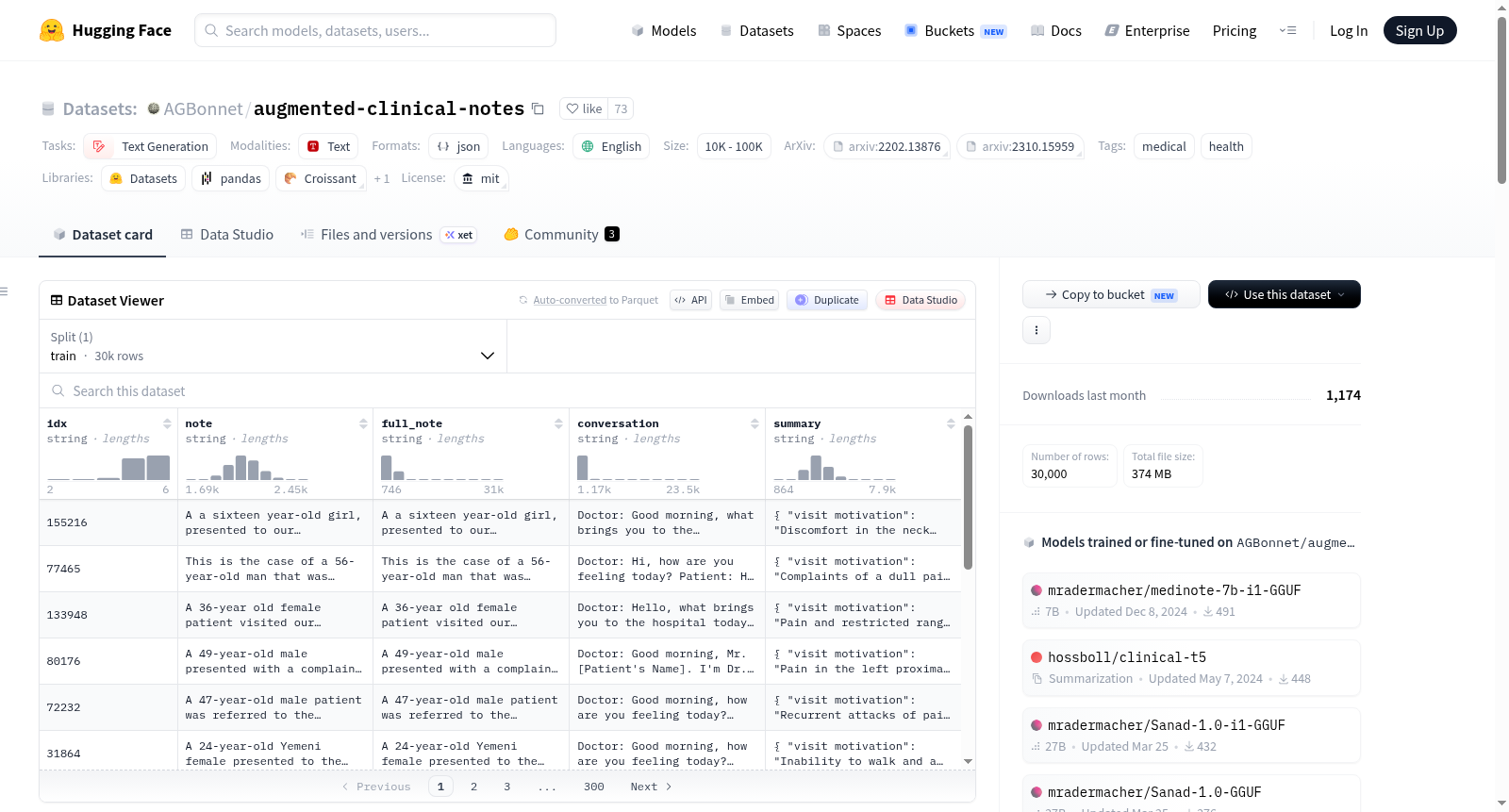
Each row of the dataset represents one dialogue-summary-note triplet, and consists of the following dataset fields (all strings):
| Field | Description | Source |
|-|-|-|
| `idx` | Unique identifier, index in the original NoteChat-ChatGPT dataset | NoteChat |
| `note` | Clinical note used by NoteChat (possibly truncated) | NoteChat |
| `full_note` | Full clinical note | PMC-Patients |
| `conversation` | Patient-doctor dialogue | NoteChat |
| `summary`| Patient information summary (JSON) | ours |
## Uses
<!-- Address questions around how the dataset is intended to be used. -->
While this dataset was originally used to fine-tune LLMs to extract structured patient information from dialogue, it can also be used for diverse applications in the healthcare domain, such as training models to extract comprehensive tabular patient features from clinical notes.
## Bias, Risks, and Limitations
<!-- This section is meant to convey both technical and sociotechnical limitations. -->
- **Synthetic Data**: NoteChat dialogues were synthetically generated from clinical notes; they are not completely realistic and therefore fail to accurately represent real patient-doctor conversations. Real patient-doctor conversations are of course preferred, but their distribution is forbidden in the US by the [Health Insurance Portability and Accountability Act of 1996](https://www.cdc.gov/phlp/publications/topic/hipaa.html).
- **Representation**: PMC-Patients clinical notes have been extracted from English PubMed Central publications, and therefore over-represent clinical settings from English-speaking countries.
## Acknowledgments
We thank Prof. Mary-Anne Hartley for her advice on the appropriate template for structured medical patient summaries.
<!--
## Citation
If you use the Augmented Clinical Notes dataset, please cite out work:
```
ADD CITATION
```
--!>
提供机构:
AGBonnet原始信息汇总
增强临床笔记数据集
数据集概述
- 名称: 增强临床笔记数据集(Augmented Clinical Notes)
- 许可: MIT
- 任务类别: 文本生成
- 语言: 英语
- 数据规模: 10K<n<100K
- 配置:
- 默认配置: 包含30,000条数据,文件路径为
augmented_notes_30K.jsonl
- 默认配置: 包含30,000条数据,文件路径为
- 标签: 医疗、健康
数据集详情
- 特征:
idx: 字符串,唯一标识符note: 字符串,NoteChat使用的临床笔记(可能被截断)full_note: 字符串,完整的临床笔记conversation: 字符串,患者-医生对话summary: 字符串,患者信息摘要(JSON格式)
数据集来源
- 临床笔记: 来自PMC-Patients,包含167K条患者总结,从PubMed Central的开放获取病例研究中提取。
- 合成对话: 使用GPT 3.5从临床笔记生成的合成患者-医生对话,基于NoteChat。
- 结构化患者信息: 从临床笔记中提取的结构化患者总结,使用GPT-4和定制的医疗信息模板生成。
数据集创建
- 临床笔记: 主要来源是PMC-Patients。
- 合成对话: 基于NoteChat,使用ChatGPT生成。
- 患者信息: 从30K条最长临床笔记中提取结构化患者信息,使用GPT-4和零样本指令。
数据集结构
- 字段:
idx: 唯一标识符note: NoteChat使用的临床笔记full_note: 完整的临床笔记conversation: 患者-医生对话summary: 患者信息摘要(JSON格式)
数据集用途
- 用于微调大型语言模型(LLMs)从对话中提取结构化患者信息,也可用于医疗领域的其他应用,如从临床笔记中提取综合表格患者特征。
偏差、风险和限制
- 合成数据: NoteChat对话是合成生成的,不完全真实,无法准确代表真实的患者-医生对话。
- 代表性: PMC-Patients临床笔记来自英语PubMed Central出版物,因此过度代表英语国家的临床环境。
搜集汇总
数据集介绍
构建方式
在临床自然语言处理领域,高质量的数据集是驱动模型进步的关键基石。AGBonnet/augmented-clinical-notes 数据集通过整合三大数据源构建而成:首先,以 PMC-Patients 数据集中的真实临床笔记为核心,这些笔记源自 PubMed Central 的公开病例研究,提供了详尽的患者就诊记录;其次,利用 GPT-3.5 从这些笔记中合成生成 NoteChat 医患对话,弥补真实对话数据因隐私法规无法公开的缺憾;最后,借助 GPT-4 和定制的医学信息模板,从最长的 3 万条临床笔记中提取结构化患者摘要,从而形成包含索引、笔记、完整笔记、对话和摘要五元组的高质量数据集。
特点
该数据集展现出鲜明的特点:一是多模态融合,将真实临床笔记、合成对话和结构化摘要有机整合,为模型提供丰富的训练信号;二是规模适中且聚焦,包含约 3 万个三元组,覆盖从入院到出院的完整临床场景;三是来源可靠,所有数据均源于权威的 PubMed Central 病例库,并经过精心筛选与增强。此外,数据集还揭示了合成对话的局限性,如 ChatGPT 生成的对话存在模式化问题和提示泄露风险,而 NoteChat 的多智能体管线则提升了对话的真实性,这种对数据质量的透明记录为后续研究提供了宝贵的参考。
使用方法
该数据集的使用灵活多样,主要面向文本生成任务。用户可通过 HuggingFace Datasets 库加载默认配置,获取包含 'idx'、'note'、'full_note'、'conversation' 和 'summary' 字段的数据行。原始设计用于微调大型语言模型(如 MediNote 系列)以从对话中提取结构化患者信息,但同样适用于从临床笔记中抽取表格化特征、训练摘要生成模型或评估合成对话质量等下游任务。使用时需注意数据为英文,且合成对话可能不完全真实,建议结合领域知识进行验证与调优。
背景与挑战
背景概述
在临床自然语言处理领域,结构化医疗信息的自动提取与生成是提升诊疗效率与数据可用性的关键挑战。Augmented Clinical Notes数据集由Antoine Bonnet与Paul Boulenger于2023年创建,隶属于瑞士洛桑联邦理工学院(EPFL)研究团队。该数据集的核心研究问题聚焦于如何利用大规模语言模型,从非结构化的临床笔记中生成结构化的患者摘要与医患对话,进而训练出能够自动化撰写临床笔记的智能系统。通过整合PMC-Patients中的真实临床病例、NoteChat的合成对话以及GPT-4提取的结构化患者信息,该数据集为MediNote系列模型(如MediNote-7B与MediNote-13B)的微调提供了30,000组三元组数据,显著推动了临床文本生成与信息结构化方向的研究进展。
当前挑战
该数据集面临多重挑战。首先,在领域问题层面,临床笔记的自动生成需解决从自由文本中精准提取关键医疗实体、保持诊断逻辑一致性以及避免信息幻觉等核心难题,尤其是面对患者死亡等复杂场景时,合成对话易出现提示泄露问题。其次,在构建过程中,由于美国《健康保险可携带性与责任法案》禁止真实医患对话数据的公开分发,研究团队不得不依赖GPT-3.5生成的合成对话,这导致对话内容缺乏真实感,常表现为医生机械式提问与患者简单应答的模式。此外,原始临床笔记在生成对话前被截断,造成部分信息丢失,而PMC-Patients来源的英语国家偏倚也限制了数据集的跨文化适用性。这些因素共同构成了数据集在真实性与代表性上的显著局限。
常用场景
经典使用场景
在医疗自然语言处理领域,Augmented Clinical Notes数据集最为经典的使用场景是训练和评估临床笔记自动生成模型。该数据集巧妙地整合了真实临床笔记、合成医患对话以及结构化患者摘要,为构建能够从医患对话中自动提取关键信息并生成结构化临床文档的语言模型提供了高质量的训练素材。研究者通常利用该数据集对大型语言模型进行指令微调,使其掌握从非结构化对话文本到标准化医疗记录的转换能力,这一过程深刻模拟了临床医生在诊疗后撰写病历的认知流程。
衍生相关工作
该数据集直接催生了MediNote-7B和MediNote-13B两个临床笔记生成模型,它们基于MediTron系列医学大语言模型进行微调,在临床文档生成任务上展现出卓越性能。此外,该工作还衍生出关于合成对话质量评估的系统性研究,揭示了ChatGPT生成的对话存在模式化问答、信息截断和提示泄露等问题,为后续合成医疗数据生成方法提供了重要的质量基准。数据集构建过程中开发的医患对话-结构化摘要-临床笔记三元组框架,也为其他医疗NLP任务(如信息提取、文本摘要和对话系统)提供了可复用的方法论范式。
数据集最近研究
最新研究方向
在医疗健康领域,大规模语言模型的临床文本生成能力正成为前沿研究热点。Augmented Clinical Notes数据集通过融合真实临床笔记、合成医患对话和结构化患者信息摘要,为训练自动化临床笔记生成模型提供了高质量三元组资源。该数据集支持从对话中提取结构化患者特征并生成连贯的临床笔记,直接关联了电子健康记录自动化、临床决策支持系统优化等热点应用。基于该数据集微调的MediNote系列模型展示了LLM在医疗文本生成中的潜力,推动了从非结构化对话到规范化医疗文档的端到端转换研究。这一方向不仅有望减轻临床文书负担,还通过合成数据策略规避了隐私法规限制,为医疗AI的数据可用性难题提供了创新解决方案,对提升医疗效率和数据标准化具有深远影响。
以上内容由遇见数据集搜集并总结生成


