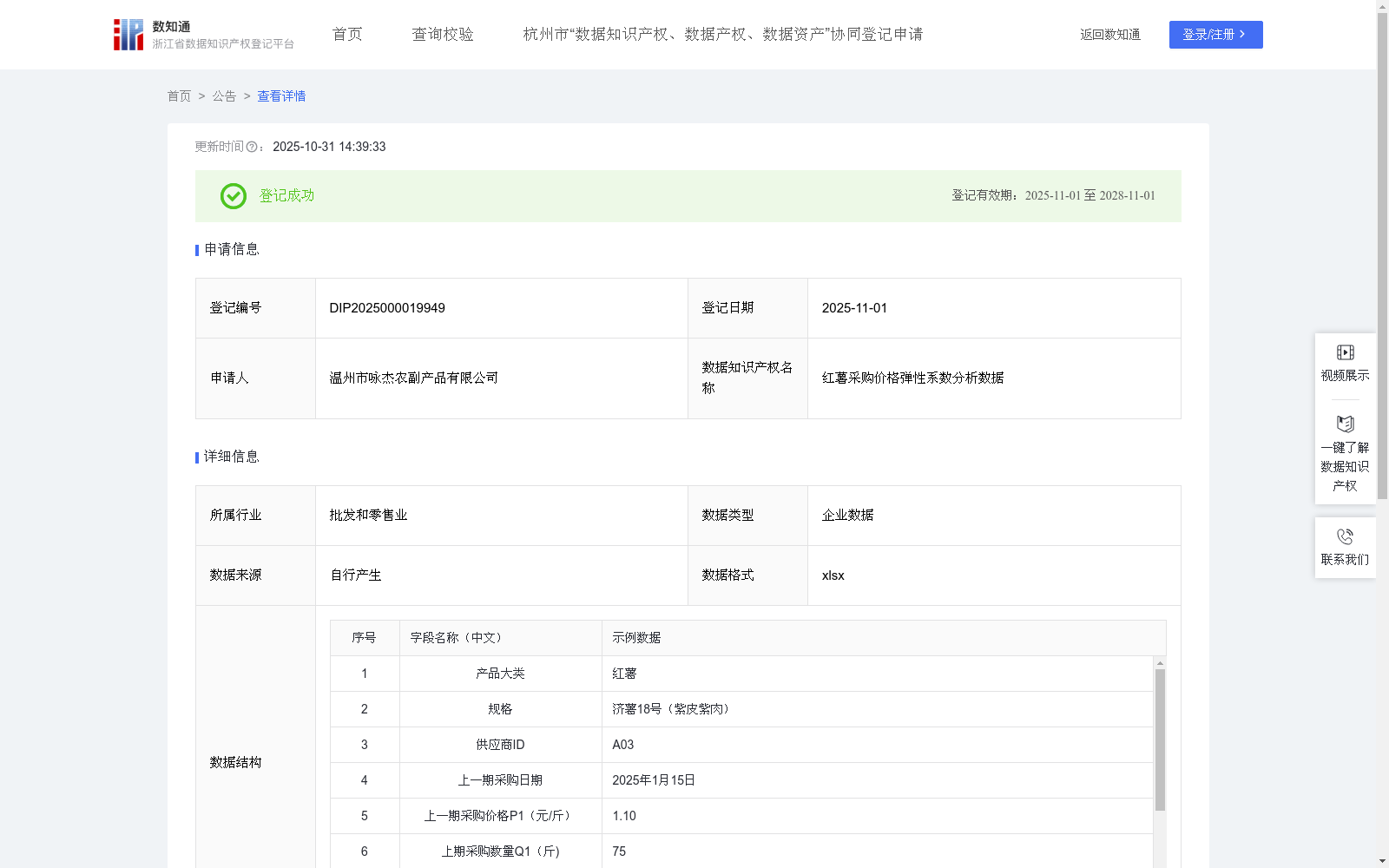
红薯采购价格弹性系数分析数据
收藏资源简介:
红薯采购价格弹性系数是指红薯采购量对于价格变动作出反应的敏感程度。通常用采购量变动的幅度对价格变动幅度的比值,即采购价格弹性系数来表示。农产品采购价格弹性系数是分析农产品的市场采购需求量对其价格变动反应的灵敏度。通过对红薯采购价格弹性系数进行分析,可以为: (1)政府运用支持价格、或限制价格之类经济政策对市场进行干预提供数据支持。 (2)利用市场本身的调节作用机制进行价格调节。 (3)构建有效的信息传导机制,降低菜农盲目生产种植。 (4)组建农产品共富链,加强农产品市场信息服务体系建设。健全市场信息进乡村、进农户的服务网络,及时为农民提供农产品产销、市场供求、价格盈亏等信息,指导生产有序进行。1、数据采集自企业内部,对数据进行清洗,去除异常值、消除重复数据,确保数据的准确性。 2、算法公式: |Es| ={(Q2-Q1)/((Q2+Q1)/2)}/{(P2-P1)/((P2+P1)/2 )}, |Es|为红薯采购价格弹性系数,P1为红薯上一期采购价格 (元/斤);P2为红薯本期采购价格P2(元/斤);Q1为红薯上一期采购数量(斤);Q2 为红薯本期采购数量(斤) (1)富有弹性:|Es| >1,表明采购量变动大于价格变动,意味着需要调整生产规模,以应对价格变化。 (2)缺乏弹性:|Es| <1,即采购量变动小于价格变动,说明价格变动对数量影响较小。 (3)单位弹性:|Es| =1,此时采购量变动与价格变动相等 (4)完全无弹性:|Es| =0,采购量对价格变动毫无反应, 3、|Es|反映了红薯采购量变动对于价格变动的反应程度,即价格上升或下降时,随之而来采购量的变化情况。
The sweet potato procurement price elasticity coefficient refers to the sensitivity of sweet potato procurement volume to price fluctuations. It is typically measured by the ratio of the relative change in procurement volume to the relative change in price, which is exactly the definition of the procurement price elasticity coefficient. The agricultural product procurement price elasticity coefficient is used to analyze the sensitivity of the market procurement demand for agricultural products to changes in their respective prices. By analyzing the sweet potato procurement price elasticity coefficient, support can be provided for the following aspects: 1. Providing data support for government intervention in the market through economic policies such as price support or price ceiling. 2. Conducting price regulation by leveraging the self-regulatory mechanism of the market. 3. Building an effective information transmission mechanism to reduce blind production and planting among vegetable farmers. 4. Establishing an agricultural product common prosperity chain, and strengthening the construction of the agricultural product market information service system. Specifically, improving the service network for disseminating market information to rural areas and farm households, providing farmers with timely information on agricultural product production and sales, market supply and demand, price profitability and loss, etc., to guide orderly agricultural production. 1. Data is collected from within the enterprise, followed by data cleaning procedures to remove outliers and duplicate records, ensuring data accuracy. 2. Algorithmic formula: $$|E_s| = frac{frac{Q_2 - Q_1}{(Q_2 + Q_1)/2}}{frac{P_2 - P_1}{(P_2 + P_1)/2}}$$ Where $|E_s|$ denotes the sweet potato procurement price elasticity coefficient; $P_1$ is the procurement price of sweet potato in the previous period (unit: yuan per jin); $P_2$ is the procurement price of sweet potato in the current period (unit: yuan per jin); $Q_1$ is the procurement volume of sweet potato in the previous period (unit: jin); $Q_2$ is the procurement volume of sweet potato in the current period (unit: jin). The elasticity types are defined as follows: (1) Elastic demand: $|E_s| > 1$, indicating that the magnitude of change in procurement volume is greater than that of price change, which means the production scale needs to be adjusted to respond to price fluctuations. (2) Inelastic demand: $|E_s| < 1$, meaning the magnitude of change in procurement volume is smaller than that of price change, indicating that price changes have a relatively limited impact on procurement volume. (3) Unitary elasticity: $|E_s| = 1$, where the magnitude of change in procurement volume is equal to that of price change. (4) Perfectly inelastic demand: $|E_s| = 0$, where procurement volume does not respond at all to price changes. 3. $|E_s|$ reflects the degree of response of sweet potato procurement volume to price fluctuations, i.e., the changes in procurement volume that occur alongside increases or decreases in prices.