银川黄河物源
收藏资源简介:
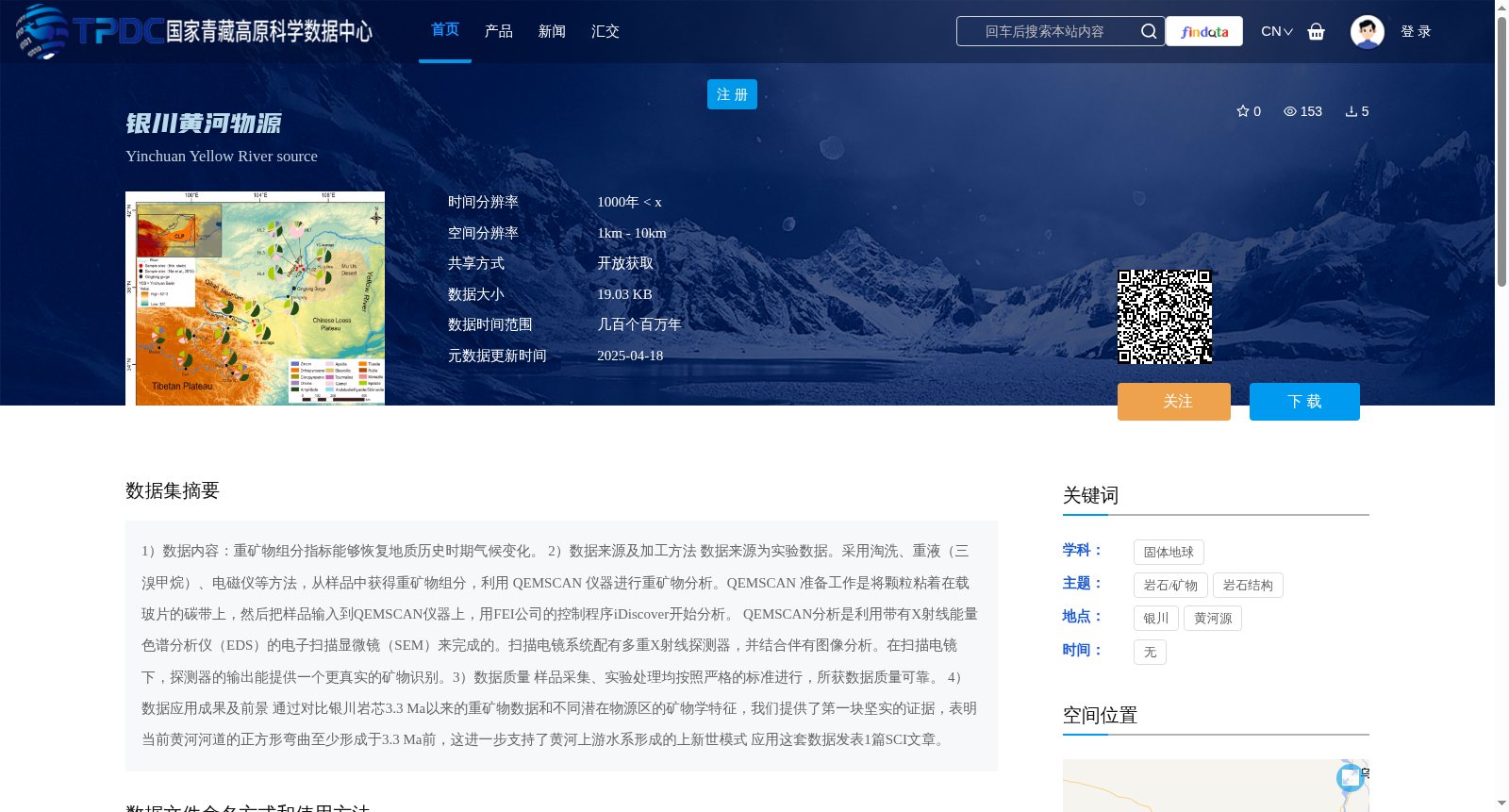
1)数据内容:重矿物组分指标能够恢复地质历史时期气候变化。 2)数据来源及加工方法 数据来源为实验数据。采用淘洗、重液(三溴甲烷)、电磁仪等方法,从样品中获得重矿物组分,利用 QEMSCAN 仪器进行重矿物分析。QEMSCAN 准备工作是将颗粒粘着在载玻片的碳带上,然后把样品输入到QEMSCAN仪器上,用FEI公司的控制程序iDiscover开始分析。 QEMSCAN分析是利用带有X射线能量色谱分析仪(EDS)的电子扫描显微镜(SEM)来完成的。扫描电镜系统配有多重X射线探测器,并结合伴有图像分析。在扫描电镜下,探测器的输出能提供一个更真实的矿物识别。3)数据质量 样品采集、实验处理均按照严格的标准进行,所获数据质量可靠。 4)数据应用成果及前景 通过对比银川岩芯3.3 Ma以来的重矿物数据和不同潜在物源区的矿物学特征,我们提供了第一块坚实的证据,表明当前黄河河道的正方形弯曲至少形成于3.3 Ma前,这进一步支持了黄河上游水系形成的上新世模式 应用这套数据发表1篇SCI文章。
1) Data Content: Heavy mineral composition indices can reconstruct paleoclimatic changes across geological history. 2) Data Source and Processing Methods: The data is sourced from laboratory experiments. Heavy mineral assemblages were extracted from samples via methods including elutriation, heavy liquid separation (using tribromomethane), and electromagnetic separation, followed by heavy mineral analysis using the QEMSCAN instrument. The preparation workflow for QEMSCAN analysis involves mounting mineral particles onto carbon tapes attached to glass slides, then loading the prepared samples onto the QEMSCAN system and starting analysis with FEI's iDiscover control software. QEMSCAN analysis is performed using a scanning electron microscope (SEM) equipped with an X-ray energy-dispersive spectrometer (EDS). The SEM system is fitted with multiple X-ray detectors and integrated with image analysis capabilities. Under the SEM, outputs from the detectors enable more accurate and reliable mineral identification. 3) Data Quality: Sample collection and experimental processing were conducted in strict adherence to standardized protocols, guaranteeing the reliability of the resulting dataset. 4) Data Application Achievements and Prospects: By comparing the heavy mineral data from the Yinchuan core spanning the past 3.3 Ma with the mineralogical characteristics of various potential source regions, we provided the first robust evidence that the current square-shaped bends of the Yellow River channel formed at least 3.3 Ma ago. This finding further supports the Pliocene model for the formation of the upper Yellow River drainage system. One peer-reviewed SCI journal paper has been published based on this dataset.