
中药材内生菌质量标志物数据
收藏浙江省数据知识产权登记平台2024-12-05 更新2024-12-06 收录
下载链接:
https://www.zjip.org.cn/home/announce/trends/96551
下载链接
链接失效反馈官方服务:
资源简介:
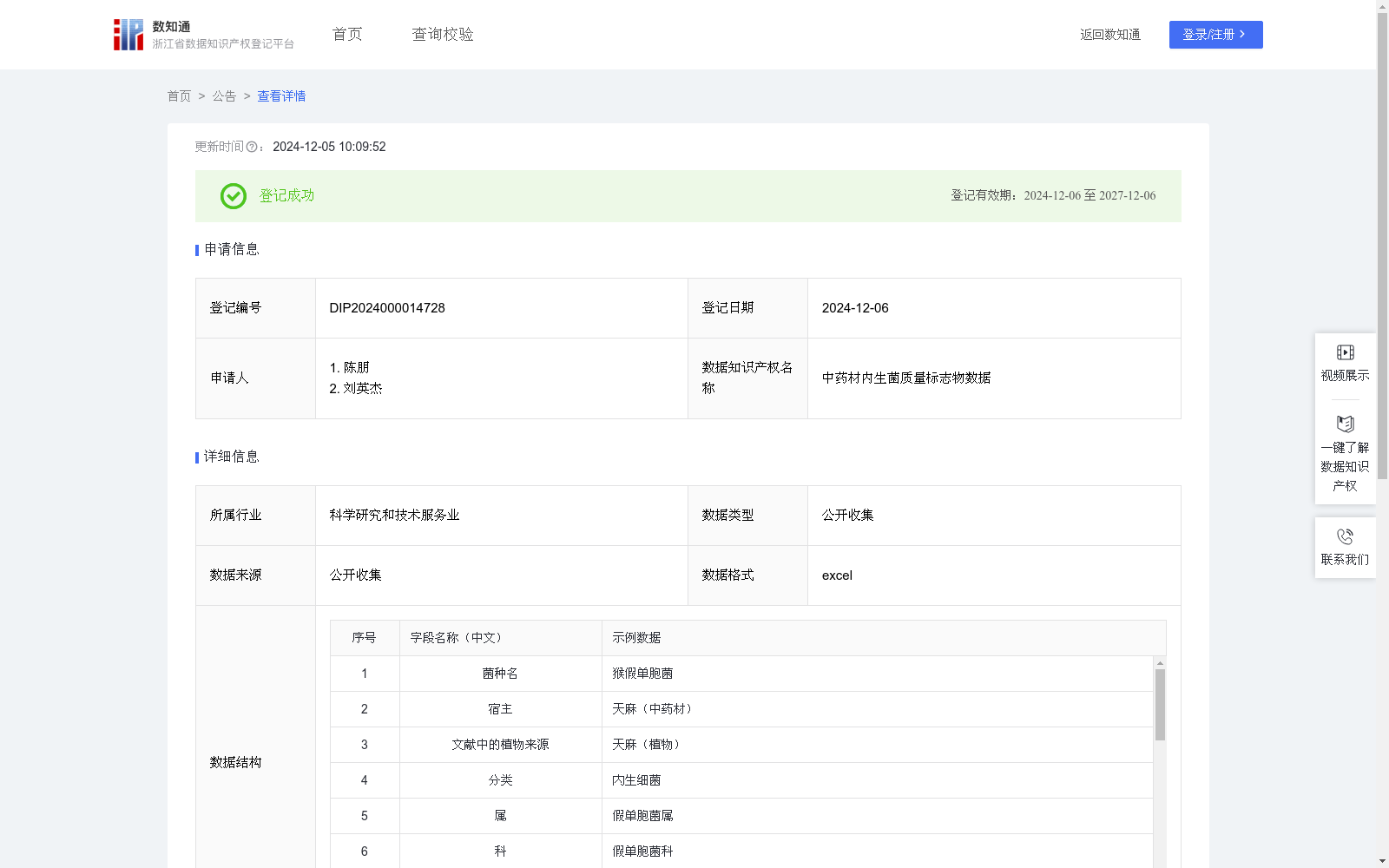
近年来随着国家对于中药材质量重视程度的增加,越来越多的新方法被用于评定中药材质量。由于中药材中含有丰富的内生菌,而内生菌与寄主植物的代谢过程和活性药用化合物的产生有着错综复杂的联系,因此内生菌直接影响中草药的质量和道地性。本数据集汇集天麻、黄芩、柴胡、黄精、肉苁蓉五种中药材内生菌的详细信息,从微生物角度出发为中药材质量标志物的筛选奠定基础,方便人们了解天麻、黄芩、柴胡、黄精、肉苁蓉内生菌的研究现状,并为中药材研究例如道地性分析提供可靠的数据来源。通过检索与天麻、黄芩、柴胡、黄精、肉苁蓉五种中药材内生菌相关的文献,从文献中筛选并获取了有关内生菌的详细信息,包括菌种名称、宿主植物、文献中的植物来源、分类、属、科、目、纲、门、功能/生物学作用、技术、16S rRNA/16S rDNA/ITS 序列长度、NCBI/GenBank参考序列号、参考文献、链接。此外,我们还添加了算法文件,对每个属的内生菌进行了统计分析,原始算法文件(名称:Endophytes analysis of QMD)可通过访问https://doi.org/10.57760/sciencedb.18208获得。其中,表1(Endophytes frequency)统计了每个宿主中所有属在文献中出现的总频率和对应不同文献的篇数,设定这两项指标之和即总频率大于2的属作为该宿主的高频内生菌,并突出显示。在表2(Statistic analysis)中,补充了表1中高频菌在其他四种宿主中对应的总频率,并计算了每种高频菌分别在五种宿主所有高频菌中所占的比例(高频内生菌总频率/宿主中的高频内生菌总频率之和)及标准差,原始算法文件中列出了详细的公式及计算过程供参考。
In recent years, with the increasing emphasis on the quality of traditional Chinese medicinal materials (TCMs) by the state, more and more new methods have been developed to evaluate their quality. Since TCMs harbor abundant endophytes, which are intricately linked to the metabolic processes of their host plants and the biosynthesis of bioactive medicinal compounds, endophytes directly affect the quality and geo-authenticity of Chinese herbal medicines.
This dataset compiles detailed information on endophytes associated with five types of TCMs, namely Gastrodia elata, Scutellaria baicalensis, Bupleurum chinense, Polygonatum sibiricum, and Cistanche deserticola. It lays a foundation for the screening of quality markers of TCMs from the microbial perspective, facilitates the understanding of the current research status of endophytes of these five medicinal materials, and provides a reliable data source for TCM research such as geo-authenticity analysis.
Relevant literatures related to endophytes of the above five TCM species were retrieved, and detailed information on endophytes was screened and extracted from these literatures, including strain name, host plant, plant source reported in the literature, taxonomy (genus, family, order, class, phylum), function/biological roles, experimental technologies, sequence length of 16S rRNA/16S rDNA/ITS, NCBI/GenBank accession numbers, references, and URLs.
In addition, we have added algorithm files for statistical analysis of endophytes at the genus level. The original algorithm file (named: Endophytes analysis of QMD) is available at https://doi.org/10.57760/sciencedb.18208.
Specifically, Table 1 (Endophytes frequency) counts the total frequency of all genera in each host that appear in the literatures and the number of corresponding literatures. Genera whose sum of these two indicators (i.e., total frequency) is greater than 2 are defined as high-frequency endophytes of the host and are highlighted.
Table 2 (Statistic analysis) supplements the total frequencies of the high-frequency endophytes from Table 1 in the other four hosts, and calculates the proportion of each high-frequency endophyte in all high-frequency endophytes of the five hosts (calculated as total frequency of the high-frequency endophyte / sum of total frequencies of high-frequency endophytes in the host) as well as the standard deviation. Detailed formulas and calculation procedures are provided in the original algorithm file for reference.
提供机构:
陈朋,刘英杰
创建时间:
2024-11-04
搜集汇总
数据集介绍
以上内容由遇见数据集搜集并总结生成


