Vision-OPD-6K
收藏资源简介:
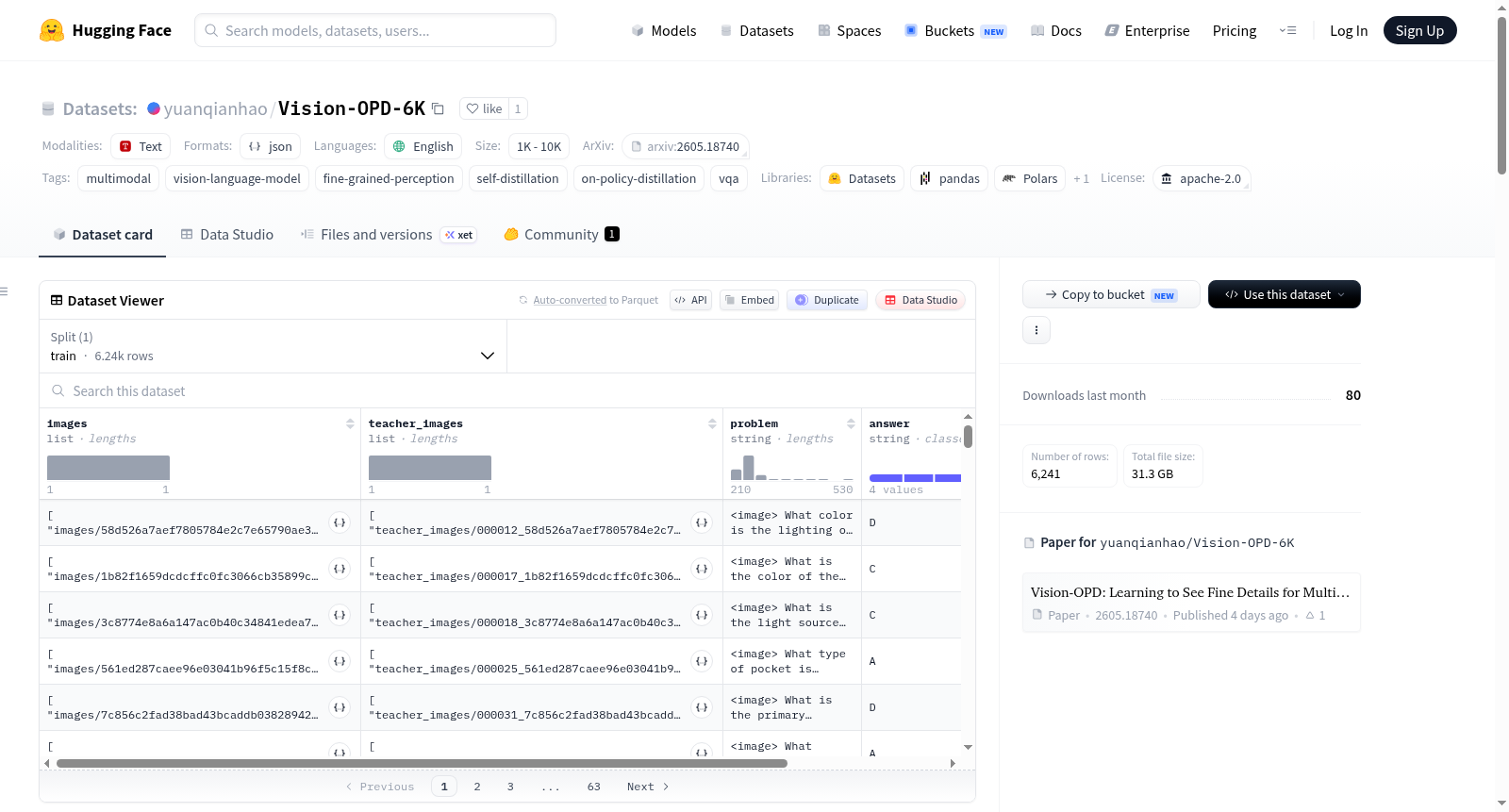
Vision-OPD-6K 是一个用于训练多模态大语言模型(MLLMs)细粒度视觉理解能力的数据集,包含6,241个细粒度视觉问答样本。该数据集是论文《Vision-OPD: Learning to See Fine Details for Multimodal LLMs via On-Policy Self-Distillation》的配套训练数据,旨在支持一种无需外部教师模型、真实标签、奖励验证器或推理时工具使用的区域到全局自蒸馏框架。每个数据样本包含两种图像输入:1) 带有红色边界框覆盖的全尺寸图像,作为学生策略(标准推理)的输入;2) 边界框内的裁剪区域图像,作为教师策略(特权输入)的输入。数据集以JSON Lines格式(train.jsonl)组织,每条记录包含图像路径、问题提示(含<image>占位符)、真实答案及额外信息。该数据集专门用于MLLMs的在线策略自蒸馏训练,以提升模型对图像细节的感知能力,并促进区域感知到全局感知的迁移研究。实验表明,使用该数据集训练的Vision-OPD模型在多项细粒度视觉评测基准上取得了具有竞争力的性能。
Vision-OPD-6K is a dataset for training fine-grained visual understanding capabilities of multimodal large language models (MLLMs), containing 6,241 fine-grained visual question-answering samples. This dataset accompanies the paper Vision-OPD: Learning to See Fine Details for Multimodal LLMs via On-Policy Self-Distillation and aims to support a region-to-global self-distillation framework that requires no external teacher models, ground-truth labels, reward verifiers, or inference-time tool usage. Each data sample includes two types of image inputs: 1) a full-size image with a red bounding box overlay, serving as input for the student policy (standard inference); 2) a cropped region image within the bounding box, serving as input for the teacher policy (privileged input). The dataset is organized in JSON Lines format (train.jsonl), with each record containing image paths, question prompts (including <image> placeholders), ground-truth answers, and additional information. It is specifically designed for on-policy self-distillation training of MLLMs to enhance the models perception of image details and facilitate research on region-aware to global-aware transfer. Experiments show that the Vision-OPD model trained with this dataset achieves competitive performance on multiple fine-grained visual evaluation benchmarks.
数据集概述:Vision-OPD-6K
Vision-OPD-6K 是用于训练 Vision-OPD 模型的多模态视觉语言数据集,其核心目标是通过在策略自蒸馏框架,提升模型对图像细节的感知能力,无需外部教师模型、真实标签或推理时工具调用。
核心方法
该数据集服务于一种区域到全局的自蒸馏方法:
- 教师策略:基于裁剪后的图像区域(包含详情的特权视角)进行推理。
- 学生策略:基于完整的图像(带边界框覆盖)进行推理,如同标准推理流程。
- 学生生成在策略的推理路径,教师则据此最小化与学生在下个token分布上的差异。
数据集规模与构成
| 属性 | 值 |
|---|---|
| 总样本数 | 6,241 |
| 图像类型 | 完整图像(带边界框覆盖,学生输入) + 裁剪区域图像(教师输入) |
| 任务类型 | 细粒度视觉问答(VQA) |
数据格式与结构
数据以 train.jsonl 文件存储,每条记录包含以下字段:
| 字段名 | 类型 | 描述 |
|---|---|---|
images |
list[str] |
学生输入图像(带边界框)的相对路径 |
teacher_images |
list[str] |
教师输入图像(裁剪区域)的相对路径 |
problem |
str |
带有 <image> 标记的问题提示 |
answer |
str |
标准答案 |
extra_info |
dict |
包含 answer 和 question(无 <image> 前缀)的额外信息 |
图像数据以压缩文件形式提供,需通过特定命令解压(详见README)。
训练效果
在多个细粒度感知基准测试(如V* Bench、ZoomBench、HR Bench等)上,使用该数据集训练的 Vision-OPD 模型(4B和9B参数)表现优异,平均得分超越了包括更大参数量的开源、闭源及“思考-图像”代理模型。
许可与引用
- 许可协议:Apache-2.0
- 相关论文:arXiv:2605.18740
- 代码仓库:GitHub: VisionOPD/Vision-OPD