
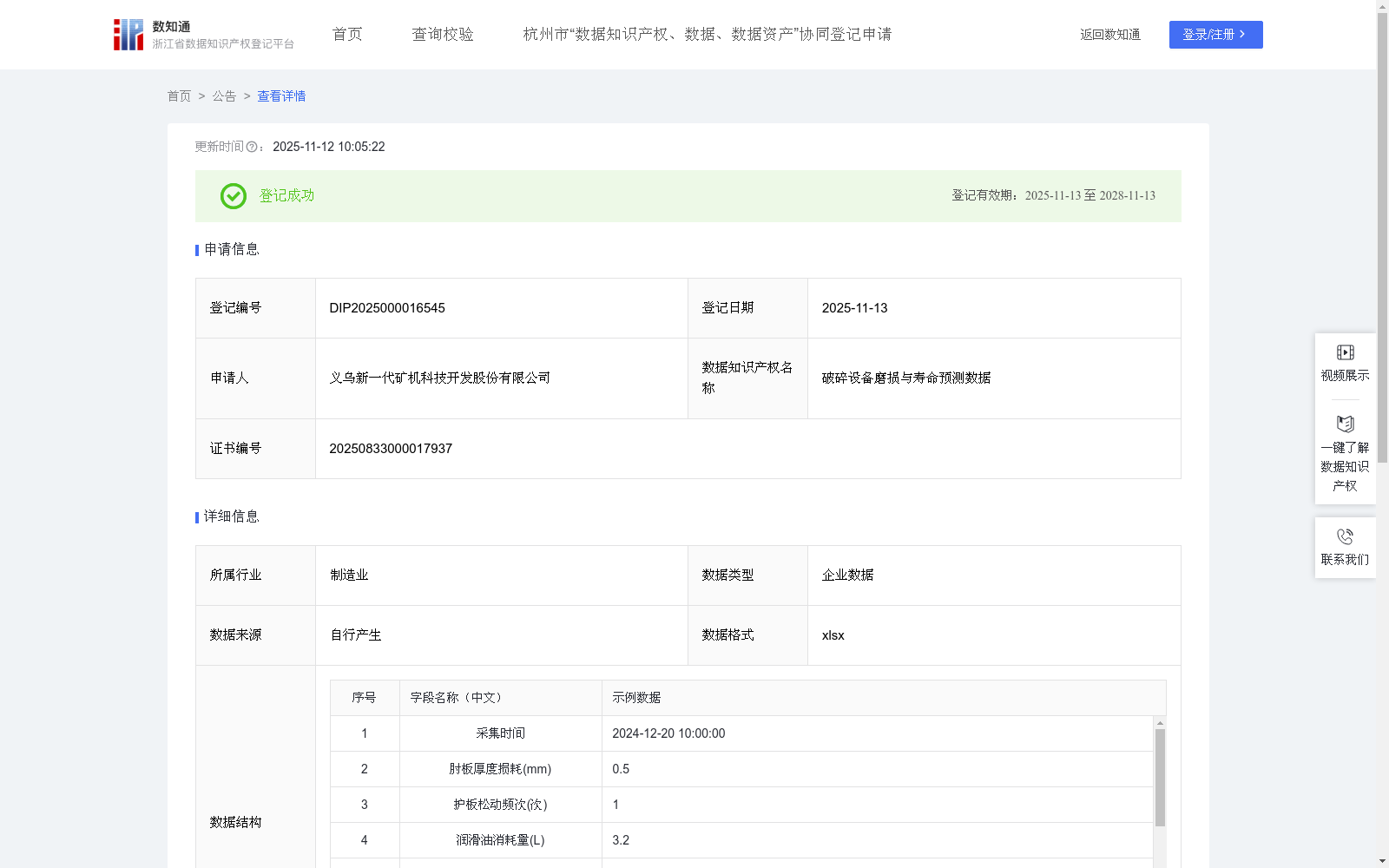
破碎设备磨损与寿命预测数据
收藏浙江省数据知识产权登记平台2025-11-12 更新2025-11-13 收录
下载链接:
https://www.zjip.org.cn/home/announce/trends/8397430
下载链接
链接失效反馈官方服务:
资源简介:
本数据聚焦于设备寿命预测和健康状态评估。对于制造企业而言,通过实时监控肘板磨损度、护板松动度、润滑异常度等关键指标,可以精准预判设备剩余使用寿命,制定前瞻性的维护保养计划,并合理安排备件库存和检修周期,避免出现设备突发故障或过度维护的情况,从而显著提升生产连续性和设备运营效率。
对设备维修服务商、备件供应商及润滑油提供商而言,本预测数据可作为其制定服务响应策略、库存配置方案和供货计划的重要参考依据。通过分析设备健康状态趋势和寿命等级分布,供应商能够提前布局维修资源和备件储备,优化服务半径内的技术人员配置,有助于避免备件短缺或服务响应滞后问题,提升客户满意度和市场竞争力。
此外,对于设备租赁公司和资产管理机构,该数据体系能够为设备残值评估、租赁定价策略和资产处置决策提供科学依据,通过量化的寿命指数实现精细化的资产全生命周期管理,最大化设备投资回报率。1、数据采集与处理
(1)采集参数:肘板厚度损耗/mm、护板松动频次/次、润滑油消耗量/L、轴承温升/℃。
(2)处理方式:按运行周期进行累计,滤除个别突发性异常值。
注:“护板松动频次(次)”为原始采集指标,表示单位时间内护板松动的平均频率;“松动次数(次)”为累计值,表示本运行周期内的总松动次数,是算法计算护板松动度的正式使用字段;“润滑油消耗量(L)”为采集自设备监测系统的原始数据;“实际耗油量(L)”为经周期累计、异常滤除后的有效油耗数据,用于润滑异常度计算。
2、磨损度转换计算
(1)肘板磨损度 = max(0, min(10, (累计磨损量/允许磨损量) × 10));
(2)护板松动度 = max(0, min(10, (松动次数/运行时长) × 10));
(3)润滑异常度 = max(0, min(10, (实际耗油量-标准耗油量)/标准耗油量 × 10))。
3、剩余寿命指数计算
寿命指数 = 10 - (肘板磨损度×0.5 + 护板松动度×0.3 + 润滑异常度×0.2)。
4、寿命等级划分
安全:寿命指数 ≥ 7分;关注:7 > 寿命指数 ≥ 5分;警告:5 > 寿命指数 ≥ 3分;失效:寿命指数 < 3分。
This dataset focuses on equipment remaining useful life prediction and health condition assessment. For manufacturing enterprises, real-time monitoring of key indicators including toggle plate wear, liner plate looseness, lubrication abnormality and other critical metrics enables accurate prediction of the equipment’s remaining useful life, formulation of proactive maintenance plans, and rational arrangement of spare parts inventory and maintenance cycles, thereby avoiding sudden equipment failures or over-maintenance, and significantly improving production continuity and equipment operational efficiency.
For equipment maintenance service providers, spare parts suppliers and lubricant providers, this prediction data can serve as an important reference for formulating service response strategies, inventory allocation plans and supply plans. By analyzing equipment health status trends and life level distribution, suppliers can proactively allocate maintenance resources and spare parts reserves, optimize the configuration of technical personnel within the service radius, help avoid spare parts shortages or delayed service responses, and improve customer satisfaction and market competitiveness.
In addition, for equipment leasing companies and asset management institutions, this data system can provide a scientific basis for equipment residual value assessment, leasing pricing strategies and asset disposal decisions, enabling refined full-life-cycle asset management through quantified life indexes and maximizing equipment return on investment.
1. Data Collection and Processing
(1) Collected parameters: toggle plate thickness loss/mm, liner plate looseness frequency/times, lubricant consumption/L, bearing temperature rise/℃.
(2) Processing method: Cumulate data according to operation cycles, and filter out individual sudden abnormal values.
Note: "Liner plate looseness frequency (times)" is the original collected indicator, representing the average frequency of liner plate looseness per unit time; "Looseness times (times)" is the cumulative value, representing the total number of looseness times within the current operation cycle, and it is the officially used field for calculating liner plate looseness; "Lubricant consumption (L)" is the original data collected from the equipment monitoring system; "Actual oil consumption (L)" is the effective oil consumption data after cycle accumulation and abnormal value filtering, which is used for lubrication abnormality calculation.
2. Wear Degree Conversion Calculation
(1) Toggle plate wear degree = max(0, min(10, (cumulative wear amount/allowable wear amount) × 10));
(2) Liner plate looseness degree = max(0, min(10, (looseness times/operation duration) × 10));
(3) Lubrication abnormality degree = max(0, min(10, (actual oil consumption - standard oil consumption)/standard oil consumption × 10)).
3. Remaining Life Index Calculation
Life index = 10 - (toggle plate wear degree × 0.5 + liner plate looseness degree × 0.3 + lubrication abnormality degree × 0.2).
4. Life Level Classification
Safe: Life index ≥ 7 points;
Attention: 7 > Life index ≥ 5 points;
Warning: 5 > Life index ≥ 3 points;
Failure: Life index < 3 points.
提供机构:
义乌新一代矿机科技开发股份有限公司
创建时间:
2025-08-20
搜集汇总
数据集介绍
背景与挑战
背景概述
该数据集包含554条记录,聚焦于破碎设备的磨损与寿命预测,通过采集肘板厚度损耗、护板松动频次等关键指标,结合算法计算寿命指数和等级划分,用于设备健康状态评估和维护计划制定。应用场景广泛,包括制造业企业优化运营、维修服务商资源配置等,支持数据驱动的决策和资产全生命周期管理。
以上内容由遇见数据集搜集并总结生成



