
DementiaBank-derived bilingual dataset
收藏资源简介:
该数据集是由雅典耀大学高级中学研究团队构建的首个用于痴呆症检测的菲律宾语-英语双语平行语料库,包含4000条对话转录文本,源自DementiaBank临床语料库。数据集内容涵盖英语原始转录及其人工翻译的菲律宾语版本,各语言均包含1000个痴呆症阳性样本和1000个健康对照样本,通过保留认知衰退的语篇标记(如重复、犹豫等)确保临床有效性。创建过程采用严格的人工翻译流程,避免机器翻译对语言不流畅特征的归一化处理,确保跨语言评估不受域不对称性干扰。该数据集主要应用于临床自然语言处理领域,旨在解决低资源环境下跨语言痴呆症检测的模型评估问题,为研究语言转换对认知诊断模型性能的影响提供标准化基准。
This dataset is the first bilingual parallel corpus of Tagalog (Filipino) and English for dementia detection, developed by the research team from the Senior High School of Ateneo de Manila University. It comprises 4000 dialogue transcriptions sourced from the DementiaBank clinical corpus. The dataset includes original English transcriptions and their manually translated Tagalog counterparts, with each language subset containing 1000 dementia-positive samples and 1000 healthy control samples. Clinical validity is maintained by retaining discourse markers associated with cognitive decline, such as repetitions and hesitations. The construction process employed a rigorous manual translation protocol to avoid the normalization of disfluent linguistic traits by machine translation, thereby eliminating domain asymmetry as a confounding factor in cross-language evaluations. This dataset is primarily applied in the field of clinical natural language processing, with the goal of addressing the challenge of model evaluation for cross-language dementia detection in low-resource settings, and providing a standardized benchmark for investigating the effect of language transfer on the performance of cognitive diagnostic models.
数据集概述
该数据集用于支持低资源场景下菲律宾语与英语双语会话中的痴呆症检测研究,相关论文已被 BioNLP @ ACL 2026 接收。
数据来源与规模
- 来源:所有转录文本源自 DementiaBank(Becker et al., 1994)。
- 规模:总计 4,000 份转录文本,包括 2,000 份英语和 2,000 份菲律宾语文本。
- 类别分布:每种语言包含 1,000 个痴呆症样本和 1,000 个健康对照样本。
- 构建方式:
- 英语样本直接来自 DementiaBank 的“饼干偷窃”图片描述任务。
- 菲律宾语样本由相同的英语转录文本经人工翻译而成,要求保留认知衰退的语篇标记(如重复、犹豫、错误起始和句法退化)。
- 明确避免使用机器翻译,因为神经机器翻译会规范化非流利语言,从而抹去区分痴呆症与健康语言的特征。
数据获取方式
- 因 DementiaBank 要求签署数据使用协议,该数据集不在此仓库中直接分发。
- 用户需通过 DementiaBank 官网 申请访问权限。
实验设置
- 数据划分:按 70%-15%-15% 分层划分为训练集、验证集和测试集。
- 评估方法:采用分层 10 折交叉验证,结果以均值±标准差报告。
- 文本处理:最大序列长度为 128 个 token;使用注意力掩码后的最终隐藏状态均值池化。
- 优化器:AdamW,线性预热与衰减,梯度裁剪为 1.0。
- 主要指标:宏平均 F1 分数,并单独报告痴呆症类别的召回率。
核心发现
- 双语微调消除跨语言性能退化:所有模型在双语训练后,宏平均 F1 收敛至 0.969–0.973,痴呆症召回率超过 0.93。
- 单语训练导致严重的跨语言迁移失败:英语训练的 BERT 在菲律宾语上 F1 从 0.952 降至 0.455;菲律宾语训练的 BERT 在英语上从 0.981 降至 0.705。
- 架构现代化本身无助于跨语言迁移:NeoBERT 在单语性能上与 BERT 相当,但跨语言方差最高。
- 语言覆盖度比模型规模或架构更关键:多语言模型(XLM-RoBERTa)与目标语言匹配模型(RoBERTa-Tagalog)在单语训练下跨语言迁移更稳定。
局限性
- 菲律宾语数据集由人工翻译生成,并非来自本土临床采集,反映的是英语源文档的会话结构和语义内容。
- 当前缺乏大规模的本土菲律宾语临床痴呆症语料库。
- 数据集规模(4000 样本)可能增加交叉验证的方差。
- 该研究仅基于文本,未纳入声学特征(如停顿时长、音高变化、发声率)。
- 多语言环境下的模型决策机制尚不透明,临床应用前需进行可解释性研究。
许可
- 该仓库代码遵循 MIT 许可。
- DementiaBank 数据集受其自身数据使用协议约束,不在此处重新分发。
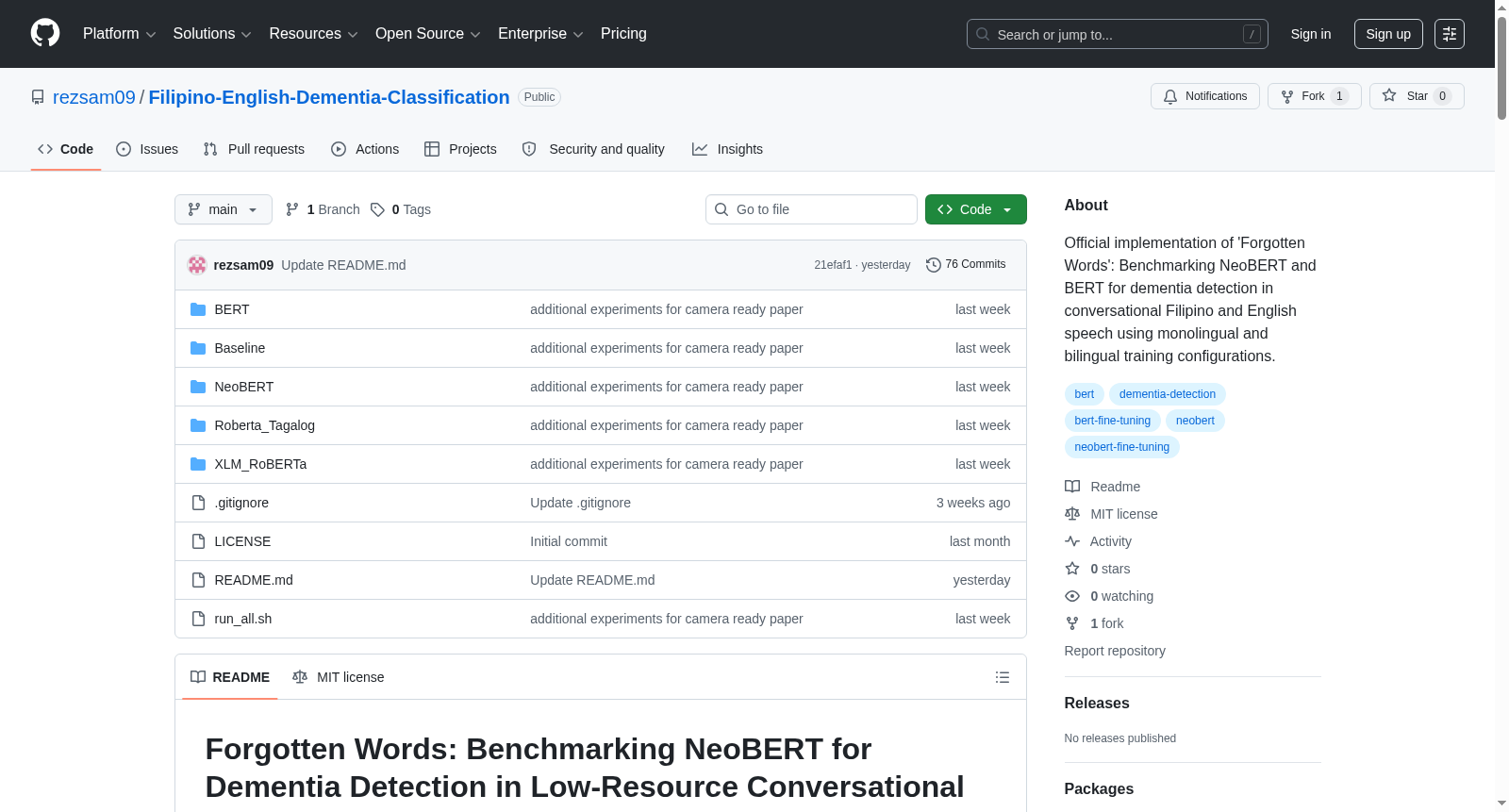
- 1Forgotten Words: Benchmarking NeoBERT for Dementia Detection in Low-Resource Conversational Filipino and English Speech雅典耀大学高级中学; 亚德诺半导体技术有限公司 · 2026年



