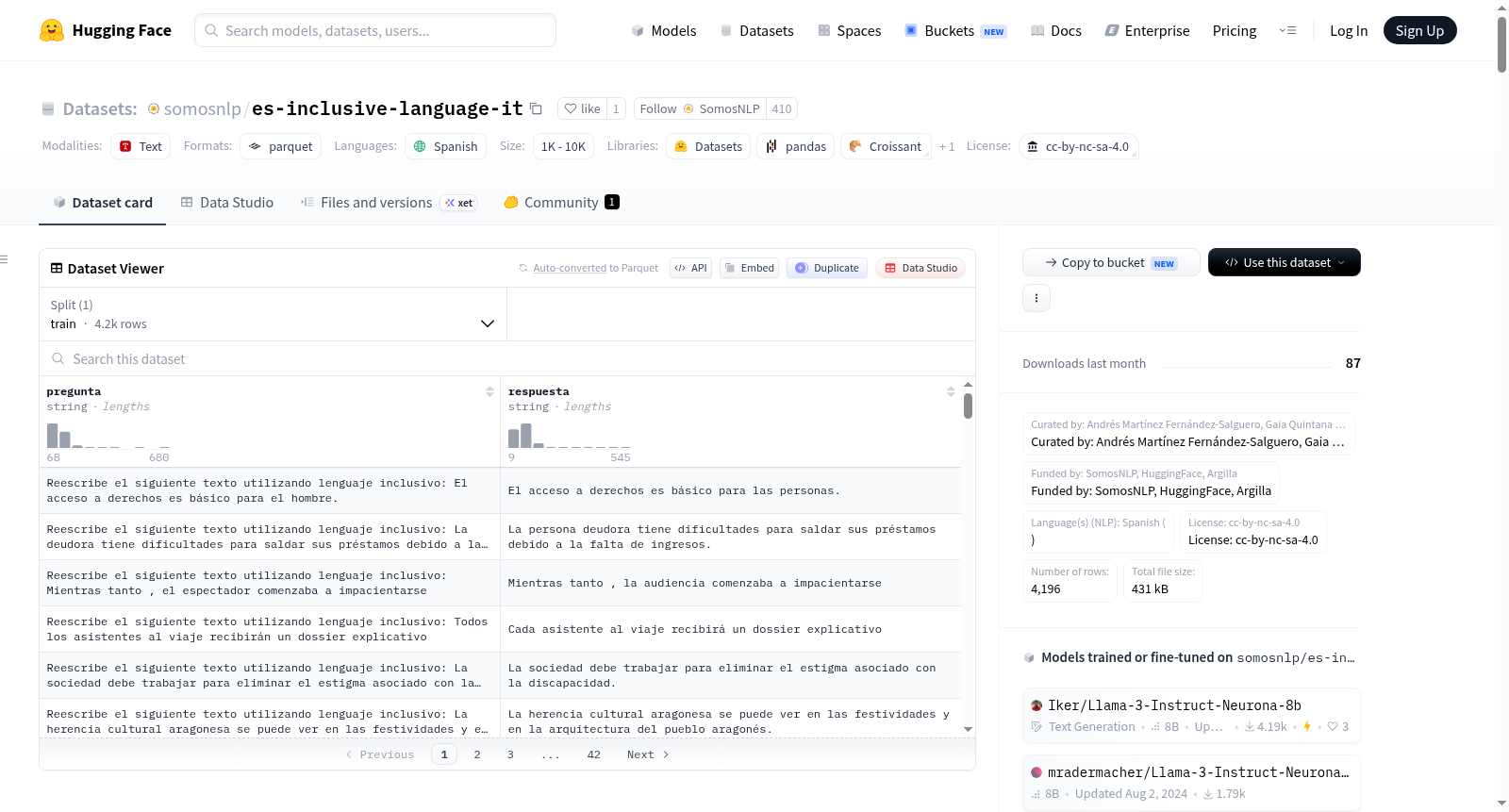
somosnlp/es-inclusive-language-it
收藏资源简介:
--- dataset_info: features: - name: pregunta dtype: string - name: respuesta dtype: string splits: - name: train num_bytes: 922215 num_examples: 4196 download_size: 404937 dataset_size: 922215 configs: - config_name: default data_files: - split: train path: data/train-* license: cc-by-nc-sa-4.0 language: - es --- # Dataset Card for Es-Inclusive-Language-it This dataset is the instructions version of the dataset [Es-Inclusive-Language](https://huggingface.co/datasets/somosnlp/es-inclusive-language). In this version there are two columns of data: `pregunta` y `respuesta`. The column `pregunta` contains the input as a prompt giving instructions to rewrite a piece of spanish text to the inclusive version of the same text. The expected output, i.e. the text in inclusive language, is given in the column `respuesta`. Find below the dataset card for es-inclusive-language dataset. # Dataset Card for Es-Inclusive-Language Languages are powerful tools to communicate ideas, but their use is not impartial. The selection of words carries inherent biases and reflects subjective perspectives. In some cases, language is wielded to enforce ideologies, marginalize certain groups, or promote specific political agendas. Spanish is not the exception to that. For instance, when we say “los alumnos” or “los ingenieros”, we are excluding women from those groups. Similarly, expressions such as “los gitanos” o “los musulmanes” perpetuate discrimination against these communities. In response to these linguistic challenges, this dataset offers neutral alternatives in accordance with official guidelines on inclusive language from various Spanish speaking countries. Its purpose is to provide grammatically correct and inclusive solutions to situations where our language choices might otherwise be exclusive. This dataset consists of pairs of texts with one entry featuring exclusive language and the other one its corresponding inclusive rewrite. All pairs are tagged with the origin (source) of the data and, in order to account for completeness of inclusive translation, also with labels for translation difficulty. This is a tool that contributes to the Sustainable Development Goals number five (_Achieve gender equality and empower all women and girls_) and ten (_Reduce inequality within and among countries_). ## Dataset Details ### Dataset Description - Curated by: Andrés Martínez Fernández-Salguero, Gaia Quintana Fleitas, Miguel López Pérez, Imanuel Rozenberg and Josué Sauca - Funded by: SomosNLP, HuggingFace, Argilla - Language(s) (NLP): Spanish (`es-ES`, `es-AR`, `es-MX`, `es-CR`, `es-CL`) - License: cc-by-nc-sa-4.0 ### Dataset Sources - Repository: https://github.com/Andresmfs/es-inclusive-language-dataset-creation - Video presentation: https://www.youtube.com/watch?v=7rrNGJIXEHU ## Uses ### Direct Use This dataset can be used to fine-tune LLMs to perform text2text generation tasks, specifically to train models that are able to rewrite Spanish texts using inclusive language. ### Out-of-Scope Use This dataset is specifically designed for translating Spanish texts to Spanish texts in inclusive language. Using the dataset for unrelated tasks is considered out of scope. This dataset can not be used with commercial purposes, it is intended for research or educational purposes only. ## Dataset Structure This dataset consists of pairs of texts with one entry featuring exclusive language and the other one its corresponding inclusive rewrite. All pairs are tagged with the origin (source) of the data and, in order to account for completeness of inclusive translation, also with labels for translation difficulty. The dataset has a total of 4196 rows and contains the following columns: - `gender_exclusive` (input): text in non inclusive language - `gender_inclusive` (target): text in inclusive language - `difficulty`: translation difficulty category. Descriptions and distribution below. - `origin`: data source. Descriptions and distribution below. ### Difficulty tags descriptions We used different labels, most of them gender related, and can be describe like this: | Tag | Description | Example | |-----------------------|---------------------------------------------------------------------------------------------------------------------------|---------------------------------------------------------------------------------------------------------------------------------------------------------------------------------------| | no_cambia | No changes are needed | "Los alumnos Carlos y Manuel son muy problemáticos" cannot be translated as "El alumnado Carlos y Manuel son muy problemáticos” | | plural_complejo | Plural words for which there is not a neutral term. There are different formulas that will vary according to the context. | "Los agricultores" -> "La comunidad agrícola", "Los y las agricultoras". “Las limpiadoras” -> “El equipo de limpieza”. More: "El grupo de...", "El sector de...", "El personal de..." | | plural_neutro | Change the plural for a generic noun. | "Los alumnos" -> "El alumnado" | | culturas | People and cultures | "Los andaluces" -> "El pueblo andaluz", "La comunidad andaluza" | | feminizar_profesiones | Professions with androcentric feminine forms | “La médico” -> "La médica". “La técnico de sonido” -> "La técnica de sonido" | | nombres_propios | Proper names | "Los alumnos Carlos y Manuel son muy problemáticos" cannot be translated as "El alumnado es muy problemático | | persona_generica | Reference to a generic person | "Nota al lector" -> "Nota a quien lee", "Nota a la persona que lee" | | dificultades_variadas | Mix of difficulties (to tag big chunks of diverse data) | | | plurales | Mix of neutral and complex plurals | | | falsa_concordancia | Androcentric agreement errors | "Estas siete parejas van a dar lo mejor de sí mismos" -> "Estas siete parejas van a dar lo mejor de sí mismas." | | omision | The subject or some pronouns are omitted, or the phrase is restructured with verboids. | "los participantes mantendrán un debate" -> "habrá un debate", "Si los científicos trabajan adecuadamente" -> "Trabajando adecuadamente, "los estudiantes" -> "estudiantes | | terminologia | Correction of terms with ableist, racist, or other types of discrimination bias. | | | parafrasis | Avoid words with generic connotations by reformulating the phrase | | | otros | Difficulties that don’t fit in the other labels | | <img src="https://cdn-uploads.huggingface.co/production/uploads/65d9bf5b41325e422e9fa704/BuwIZc3bOS0Seruz-zPce.png" alt="difficulties_distribution.JPG" width="1500"/> ### Origin tags descriptions Data quality can depend on their origin, so data are tagged with origin labels according to this table: | Tag | Description | Link to origin | |---------------------------|----------------------------------------------------------------------------------|------------------------------------------------------------------------------------------------------------------------------------------------------------------| | neutral_es | Curated and refined version of neutral-es dataset | https://huggingface.co/datasets/hackathon-pln-es/neutral-es | | GPT-3.5_fewshot | Chat GPT-3.5 generated with few shot technique | | | GPT-3.5_CaDi <sup>*</sup> | Data created based on the dataset used for developing CaDi project<sup>*</sup> | https://lenguaje-incluyente.ibero.mx/ | | GPT-3.5_fs_multiplication | Data multiplicated from GPT-3.5_fewshot using GPT-3.5 | | | guia_CCGG | Examples from Spanish General Courts language inclusive Guide | https://www.congreso.es/docu/igualdad/Recomendaciones_uso_no_sexista_lenguajeCC.GG..pdf | | guia_TAI | Examples from Trenes Argentinos' Guide to the use of inclusive language | https://www.argentina.gob.ar/sites/default/files/guia_para_uso_de_lenguaje_inclusivo_v1.pdf | | guia_CONICET | Examples from Guide to inclusive, non-sexist language (CONICET) | https://cenpat.conicet.gov.ar/wp-content/uploads/sites/91/2020/08/Guia-lenguaje-inclusivo-no-sexista-CENPAT_final-1.pdf | | guia_INAES | Examples of Guidelines for Inclusive Language Recommendations (INAES) | https://www.argentina.gob.ar/sites/default/files/2020/10/lenguaje_inclusivo_inaes_2021.pdf | | guia_CHRYSALLIS | Examples from Practical Guide to Inclusive Language (Chrysallis) | https://www.lgbtqiahealtheducation.org/wp-content/uploads/2020/04/Guia-practica-de-lenguaje-inclusivo-Chrysallis.pdf | | guia_ONU | Examples from Guidance for the use of gender-inclusive language (UN) | https://www.unwomen.org/sites/default/files/Headquarters/Attachments/Sections/Library/Gender-inclusive%20language/Guidelines-on-gender-inclusive-language-es.pdf | | guia_MX | Examples from Manual for the use of inclusive and gender-sensitive language (MX) | https://www.gob.mx/cms/uploads/attachment/file/183695/Manual_Lenguaje_Incluyente_con_perspectiva_de_g_nero-octubre-2016.pdf | | guia_CL | Examples from Gender Inclusive Language Guide of the Government of Chile | https://www.cultura.gob.cl/wp-content/uploads/2023/01/guia-de-lenguaje-inclusivo-de-genero.pdf | | guia_IEM | Examples from Uso del Lenguaje Inclusivo de Género | https://secretariagenero.poder-judicial.go.cr/images/Documentos/LenguajeInclusivo/Documentos/Uso-de-lenguaje-inclusivo-de-Genero-IEM-UNA.pdf | | human_combinatory | Combinatorics of text fragments generated with GPT3.5 | | | GPT-4_human | Chat GPT-4 generated and human revised | | | human | Human created data based on information from inclusive language guidelines | | <sup>*</sup>©Universidad Iberoamericana, A.C. , Ciudad de México, México <sup>*</sup>©Capitolina Díaz Martínez, Elvia María Guadalupe González del Pliego Dorantes, Marco Antonio López Hernández, Alberto López Medina, Héctor Celallos Avalos, Laura Mejía Hernández <img src="https://cdn-uploads.huggingface.co/production/uploads/65d9bf5b41325e422e9fa704/Y5BCoOYej06rpTK6kfm2k.png" alt="origins_distribution.JPG" width="600"/> ## Dataset Creation ### Curation Rationale The selection of words carries inherent biases and reflects subjective perspectives. In some cases, language is wielded to enforce ideologies, marginalize certain groups, or promote specific political agendas. In response to these linguistic challenges, this dataset offers neutral alternatives in accordance with official guidelines on inclusive language from various Spanish-speaking countries. Its purpose is to provide grammatically correct and inclusive solutions to situations where our language choices might otherwise be exclusive. This dataset has been created to train the model ["Traductor Inclusivo"](https://huggingface.co/somosnlp/es-inclusivo-translator) which aims to tackle this problem. ## Source Data ### Data Collection and Processing The data used for training the model has been sourced from various origins. The first and more important source was a curated and refined version of [es_neutral](https://huggingface.co/datasets/hackathon-pln-es/neutral-es) (link to the dataset curation notebook [here](https://github.com/Andresmfs/Neutral_es-Text-data-cleaning) ) In addition, we manually generated data based on Official Guidelines from different Spanish speaking countries. Finally, we augmented this data by experimenting with various prompts and Few-Shot learning techniques. We needed to be as explicit as possible, otherwise we wouldn’t get good results. You can see some examples below. Example 1: <img src="https://cdn-uploads.huggingface.co/production/uploads/65d9bf5b41325e422e9fa704/48ipmlxyEHgkNLxLvWnUp.jpeg" alt="foto1.JPG" width="600"/> Example 2: <img src="https://cdn-uploads.huggingface.co/production/uploads/65d9bf5b41325e422e9fa704/rwkDR3FrFyLLOMmofCMFI.jpeg" alt="foto2.JPG" width="600"/> Example 3: <img src="https://cdn-uploads.huggingface.co/production/uploads/65d9bf5b41325e422e9fa704/rHCV4UwitTbmQD0r2WS6V.jpeg" alt="foto3.JPG" width="700"/> We tried to be as inclusive as possible, paying close attention to the classification of difficulties that one could encounter in texts like these. Moreover, we took care to incorporate numerous counterexamples, recognizing that there are instances where neutrality is not required in a sentence. For instance, “Las arquitectas María Nuñez y Rosa Loria presentaron el proyecto” should not be rewritten as “El equipo de arquitectura María Nuñez y Rosa Loria presentó el proyecto”. It’s important to highlight that the Traductor Inclusivo not only promotes gender inclusivity but also addresses other forms of discrimination such as ableism, racism, xenophobia, and more. You can access scripts used during data creation [here](https://github.com/Andresmfs/es-inclusive-language-dataset-creation) ### Who are the source data producers? Data have been produced by different producers: - Official Spanish Inclusive Language Guidelines: - - [Recomendaciones para un uso no sexista del lenguaje en la Administracio n parlamentaria (España)](https://www.congreso.es/docu/igualdad/Recomendaciones_uso_no_sexista_lenguajeCC.GG..pdf) - [Guía para uso de lenguaje inclusivo (Argentina)](https://www.argentina.gob.ar/sites/default/files/guia_para_uso_de_lenguaje_inclusivo_v1.pdf) - [Guía de lenguaje inclusivo no sexista CCT CONICET-CENPAT (Argentina)](https://cenpat.conicet.gov.ar/wp-content/uploads/sites/91/2020/08/Guia-lenguaje-inclusivo-no-sexista-CENPAT_final-1.pdf) - [Guía de recomendaciones para lenguaje inclusivo (Argentina)](https://www.argentina.gob.ar/sites/default/files/2020/10/lenguaje_inclusivo_inaes_2021.pdf) - [Guía práctica de lenguaje inclusivo (España)](https://www.lgbtqiahealtheducation.org/wp-content/uploads/2020/04/Guia-practica-de-lenguaje-inclusivo-Chrysallis.pdf) - [Guía para el uso de un lenguaje inclusivo al género (ONU)](https://www.unwomen.org/sites/default/files/Headquarters/Attachments/Sections/Library/Gender-inclusive%20language/Guidelines-on-gender-inclusive-language-es.pdf) - [Manual para el uso de un lenguaje incluyente y con perspectiva de género (México)](https://www.gob.mx/cms/uploads/attachment/file/183695/Manual_Lenguaje_Incluyente_con_perspectiva_de_g_nero-octubre-2016.pdf) - [Guía de lenguaje inclusivo de Género (Chile)](https://www.cultura.gob.cl/wp-content/uploads/2023/01/guia-de-lenguaje-inclusivo-de-genero.pdf) - [Uso del Lenguaje Inclusivo de Género, IEM (Costa Rica)](https://secretariagenero.poder-judicial.go.cr/images/Documentos/LenguajeInclusivo/Documentos/Uso-de-lenguaje-inclusivo-de-Genero-IEM-UNA.pdf) - [Uso no sexista de la lengua, UOC (España)](https://www.uoc.edu/portal/es/servei-linguistic/redaccio/tractament-generes/index.html) - [neutral-es dataset](https://huggingface.co/datasets/hackathon-pln-es/neutral-es) - ChatGPT-3.5 based examples and structures from official guidelines and dataset used for developing [CaDi project](https://lenguaje-incluyente.ibero.mx/) - ChatGPT-4 ## Annotations ### Annotation process Most data were created using ChatGPT-3.5 based on examples and structures form Official Inclusive Language Guidelines and then supervised and corrected by the annotators always following the indications from the Official Guidelines. You can find more information about this process in the Data Collection and Processing section. Other data were created using pairs of words taken from CaDi project. Data taken from neutral-es dataset were not modified beyond correcting spelling or grammar mistakes. Regarding difficulty labels, we stablished different groups of data using the information from Official Spanish Inclusive Language Guidelines. We created a list of difficulties that could cover all kind of examples. The difficulties list can be found above together with their descriptions. Data from Official Guidelines were manually matched to the different difficulties according to the descriptions provided in the list and then we used those examples as a base to create more data using ChatGPT difficulty by difficulty, so new data would belong to a specific difficulty and therefore tagged with that difficulty. ### Who are the annotators? - [Gaia Quintana Fleitas](https://huggingface.co/gaiaquintana) - [Miguel López Pérez](https://huggingface.co/Wizmik12) - [Andrés Martínez Fernández-Salguero](https://huggingface.co/Andresmfs) ### Personal and Sensitive Information This dataset does not contain any personal or sensitive information. ## Bias, Risks, and Limitations - Data are based on the Spanish Inclusive Language Guidelines mentioned in the source section and they may inherit any bias comming from these guidelines and institutions behind them. These are official and updated guidelines that should not contain strong biases. Data from neutral-es are based as well on Official Spanish Inclusive Language Guidelines - Data based on CaDi may inherit biases from the institution behind it. It has been created by a group of specialists in the field from Universidad Iberoamericana - Dataset contains a significantly large amount of data related to workspace compared to other areas. - This dataset covers only difficulties that appear on the difficulties list - Dataset is composed mostly by sentences where the terms to be modified are at the beginning of the sentence. - Dataset does not contain long-complex texts. ### Recommendations Users should be made aware of the risks, biases and limitations of the dataset. ## License Creative Commons (cc-by-nc-sa-4.0) This kind of licensed is inherited from CaDi project dataset. ## Citation **BibTeX:** ``` @software{GAMIJ2024es-inclusive-language, author = {Gaia Quintana Fleitas, Andrés Martínez Fernández-Salguero, Miguel López Pérez, Imanuel Rozenberg, Josué Sauca}, title = {Traductor Inclusivo}, month = April, year = 2024, url = {https://huggingface.co/datasets/somosnlp/es-inclusive-language} } ``` ## More Information This project was developed during the [Hackathon #Somos600M](https://somosnlp.org/hackathon) organized by SomosNLP. The dataset was created using distilabel by Argilla and endpoints sponsored by HuggingFace. **Team**: - [**Gaia Quintana Fleitas**](https://huggingface.co/gaiaquintana) - [**Andrés Martínez Fernández-Salguero**](https://huggingface.co/Andresmfs) - **Imanuel Rozenberg** - [**Miguel López Pérez**](https://huggingface.co/Wizmik12) - **Josué Sauca** ## Contact - [**Gaia Quintana Fleitas**](https://www.linkedin.com/in/gaiaquintana/) (gaiaquintana11@gmail.com) - [**Andrés Martínez Fernández-Salguero**](www.linkedin.com/in/andrés-martínez-fernández-salguero-725674214) (andresmfs@gmail.com) - [**Miguel López Pérez**](https://www.linkedin.com/in/miguel-lopez-perezz/)
数据集概述
数据集名称
- Es-Inclusive-Language-it
数据集内容
- 特征:
- pregunta:输入提示,指导如何将西班牙语文本重写为包容性版本。
- respuesta:预期的输出,即包容性语言的文本。
数据集结构
- 列信息:
- gender_exclusive (输入): 非包容性语言的文本。
- gender_inclusive (目标): 包容性语言的文本。
- difficulty: 翻译难度类别。
- origin: 数据来源。
数据集大小
- 训练集:
- num_examples: 4196
- num_bytes: 922215
- download_size: 404937
- dataset_size: 922215
许可证
- cc-by-nc-sa-4.0
语言
- 西班牙语 (
es-ES,es-AR,es-MX,es-CR,es-CL)
数据来源
- Repository: https://github.com/Andresmfs/es-inclusive-language-dataset-creation
- Video presentation: https://www.youtube.com/watch?v=7rrNGJIXEHU
使用场景
- 直接使用:用于微调大型语言模型(LLMs)以执行文本到文本生成任务,特别是训练能够使用包容性语言重写西班牙语文本的模型。
- 超出范围的使用:该数据集专门设计用于将西班牙语文本翻译为包容性语言的西班牙语文本。使用该数据集进行无关任务被视为超出范围。该数据集不可用于商业目的,仅限于研究和教育用途。
数据集创建
- 数据收集和处理:
- 主要来源:es_neutral
- 手动生成数据,基于官方指南。
- 通过实验使用各种提示和少量学习技术增强数据。
源数据生产者
- 官方西班牙包容性语言指南。
- neutral-es 数据集。
- ChatGPT-3.5 基于官方指南的示例和结构。