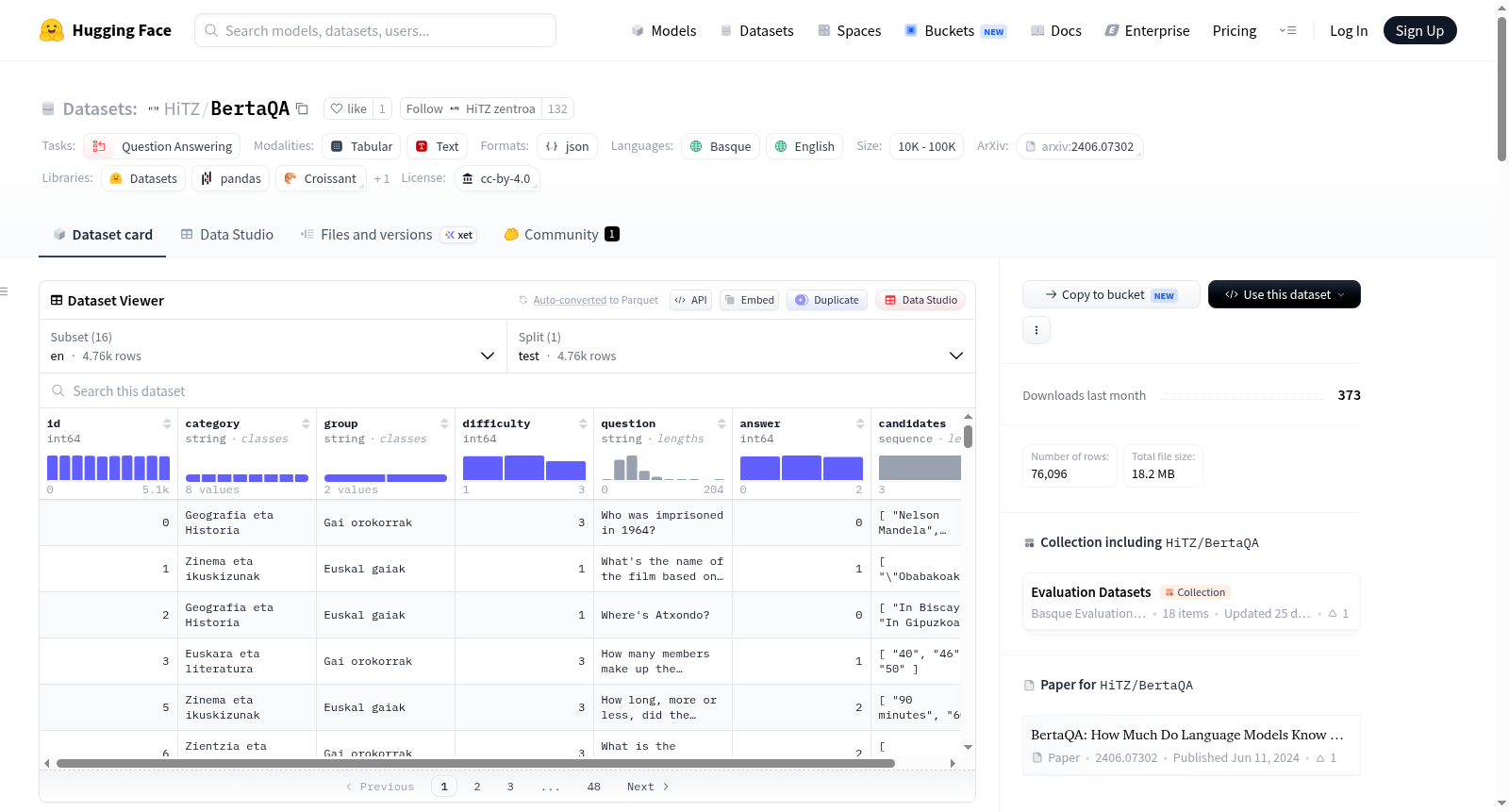
HiTZ/BertaQA
收藏资源简介:
--- task_categories: - question-answering language: - eu - en license: - cc-by-4.0 pretty_name: BertaQA size_categories: - 1K<n<10K configs: - config_name: eu data_files: - split: test path: "eustrivia_zuzenduta.jsonl" - config_name: en data_files: - split: test path: "eustrivia_elhuyar_zuzenduta.jsonl" - config_name: en_mt_nllb data_files: - split: test path: "eustrivia_nllb_zuzenduta.jsonl" - config_name: en_mt_madlad data_files: - split: test path: "eustrivia_madlad_zuzenduta.jsonl" - config_name: en_mt_hitz data_files: - split: test path: "eustrivia_hitz_zuzenduta.jsonl" - config_name: en_mt_itzuli data_files: - split: test path: "eustrivia_itzuli_zuzenduta.jsonl" - config_name: en_mt_latxa-7b-v1.1 data_files: - split: test path: "eustrivia_latxa-7b-v1.1_zuzenduta.jsonl" - config_name: en_mt_latxa-13b-v1.1 data_files: - split: test path: "eustrivia_latxa-13b-v1.1_zuzenduta.jsonl" - config_name: en_mt_latxa-70b-v1.1 data_files: - split: test path: "eustrivia_latxa-70b-v1.1_zuzenduta.jsonl" - config_name: en_mt_latxa-7b-v1 data_files: - split: test path: "eustrivia_latxa-7b-v1_zuzenduta.jsonl" - config_name: en_mt_latxa-13b-v1 data_files: - split: test path: "eustrivia_latxa-13b-v1_zuzenduta.jsonl" - config_name: en_mt_latxa-70b-v1 data_files: - split: test path: "eustrivia_latxa-70b-v1_zuzenduta.jsonl" - config_name: en_mt_llama-2-7b data_files: - split: test path: "eustrivia_llama-2-7b_zuzenduta.jsonl" - config_name: en_mt_llama-2-13b data_files: - split: test path: "eustrivia_llama-2-13b_zuzenduta.jsonl" - config_name: en_mt_llama-2-70b data_files: - split: test path: "eustrivia_llama-2-70b_zuzenduta.jsonl" - config_name: en_mt_gemma-7b data_files: - split: test path: "eustrivia_gemma-7b_zuzenduta.jsonl" --- # Dataset Card for BertaQA BertaQA is a trivia dataset comprising 4,756 multiple-choice trivia questions, with one single correct answer and 2 additional distractors. Crucially, questions are distributed between local and global topics. Whereas answering questions in the latter group requires general world knowledge, local questions require specific knowledge about the Basque Country and its culture. Additionally, questions are classified into eight categories, namely Basque and Literature, Geography and History, Society and Tradition, Sports and Leisure, Culture and Art, Music and Dance, Science and Technology, and Cinema and Shows. Questions also have three levels of difficulty: easy, medium or hard. ## Dataset Details ### Dataset Description <!-- Provide a longer summary of what this dataset is. --> BertaQA is a trivia dataset comprising 4,756 multiple-choice questions, with a single correct answer and 2 additional distractors. Crucially, questions are distributed between *local* and *global* topics. Local questions require specific knowledge about the Basque Country and its culture, while global questions require more general world knowledge. Additionally, questions are classified into eight categories: Basque and Literature, Geography and History, Society and Traditions, Sports and Leisure, Culture and Art, Music and Dance, Science and Technology, and Cinema and Shows. Questions are also labeled according to their difficulty as easy, medium or hard. The dataset was originally compiled in Basque by crawling public sources that are no longer available. Google does not return any result when searching for questions from the dataset verbatim. While this cannot categorically discard contamination, we believe that this, along with the nature of the raw data we crawled and the results from our experiments, makes it very unlikely that existing models were exposed to the same data during training. Starting from the original version in Basque, we also created an English version of BertaQA using a professional translation service. Translators were instructed to use a consistent format for all the questions and answers, and we refined our guidelines through multiple rounds. For named entities, Wikipedia was used as a reference when available. During the translation process, a few of the original questions in Basque were corrected, either because the original answer was incorrect or it became outdated. In addition, we discarded a few questions that required knowledge of Basque or English, and would lose their essence if translated. The resulting dataset is balanced regarding the number of questions per category and subset, with around 300 questions in each. The number of questions per difficulty is also balanced: most categories have around 110 easy and medium questions and 80 difficult questions in each subset. The average length of the questions and the candidates is around 50 and 13 characters, respectively. - **Curated by:** HiTZ Center -- Ixa, University of the Basque Country (UPV/EHU) - **Funded by [optional]:** [More Information Needed] - **Shared by [optional]:** [More Information Needed] - **Language(s) (NLP):** Basque (eu), English (en) - **License:** [More Information Needed] ### Dataset Sources [optional] <!-- Provide the basic links for the dataset. --> - **Repository:** https://github.com/juletx/BertaQA - **Paper:** https://arxiv.org/abs/2406.07302 - **Demo [optional]:** [More Information Needed] ## Uses <!-- Address questions around how the dataset is intended to be used. --> ### Direct Use <!-- This section describes suitable use cases for the dataset. --> [More Information Needed] ### Out-of-Scope Use <!-- This section addresses misuse, malicious use, and uses that the dataset will not work well for. --> [More Information Needed] ## Dataset Structure <!-- This section provides a description of the dataset fields, and additional information about the dataset structure such as criteria used to create the splits, relationships between data points, etc. --> [More Information Needed] ## Dataset Creation ### Curation Rationale <!-- Motivation for the creation of this dataset. --> [More Information Needed] ### Source Data <!-- This section describes the source data (e.g. news text and headlines, social media posts, translated sentences, ...). --> #### Data Collection and Processing <!-- This section describes the data collection and processing process such as data selection criteria, filtering and normalization methods, tools and libraries used, etc. --> [More Information Needed] #### Who are the source data producers? <!-- This section describes the people or systems who originally created the data. It should also include self-reported demographic or identity information for the source data creators if this information is available. --> [More Information Needed] ### Annotations [optional] <!-- If the dataset contains annotations which are not part of the initial data collection, use this section to describe them. --> #### Annotation process <!-- This section describes the annotation process such as annotation tools used in the process, the amount of data annotated, annotation guidelines provided to the annotators, interannotator statistics, annotation validation, etc. --> [More Information Needed] #### Who are the annotators? <!-- This section describes the people or systems who created the annotations. --> [More Information Needed] #### Personal and Sensitive Information <!-- State whether the dataset contains data that might be considered personal, sensitive, or private (e.g., data that reveals addresses, uniquely identifiable names or aliases, racial or ethnic origins, sexual orientations, religious beliefs, political opinions, financial or health data, etc.). If efforts were made to anonymize the data, describe the anonymization process. --> [More Information Needed] ## Bias, Risks, and Limitations <!-- This section is meant to convey both technical and sociotechnical limitations. --> [More Information Needed] ### Recommendations <!-- This section is meant to convey recommendations with respect to the bias, risk, and technical limitations. --> Users should be made aware of the risks, biases and limitations of the dataset. More information needed for further recommendations. ## Citation [optional] <!-- If there is a paper or blog post introducing the dataset, the APA and Bibtex information for that should go in this section. --> **BibTeX:** ```bibtex @misc{etxaniz2024bertaqa, title={BertaQA: How Much Do Language Models Know About Local Culture?}, author={Julen Etxaniz and Gorka Azkune and Aitor Soroa and Oier Lopez de Lacalle and Mikel Artetxe}, year={2024}, eprint={2406.07302}, archivePrefix={arXiv}, primaryClass={cs.CL} } ``` **APA:** [More Information Needed] ## Glossary [optional] <!-- If relevant, include terms and calculations in this section that can help readers understand the dataset or dataset card. --> [More Information Needed] ## More Information [optional] [More Information Needed] ## Dataset Card Authors [optional] [More Information Needed] ## Dataset Card Contact [More Information Needed]
数据集概述
数据集描述
BertaQA 是一个包含 4,756 个多项选择题的 trivia 数据集,每个问题有一个正确答案和两个干扰项。问题分为本地和全球主题,本地问题需要关于巴斯克地区及其文化的特定知识,而全球问题需要更广泛的世界知识。问题还分为八个类别:巴斯克和文学、地理和历史、社会和传统、体育和休闲、文化和艺术、音乐和舞蹈、科学和技术、电影和节目。问题的难度分为简单、中等和困难。
数据集最初是用巴斯克语编制的,通过抓取现已不可用的公共来源。从原始的巴斯克语版本开始,我们还使用专业翻译服务创建了 BertaQA 的英语版本。翻译人员被指示为所有问题和答案使用一致的格式,并通过多轮修订我们的指南。对于命名实体,当可用时,使用维基百科作为参考。在翻译过程中,一些原始的巴斯克语问题被修正,要么是因为原始答案不正确,要么是因为它已经过时。此外,我们丢弃了一些需要巴斯克语或英语知识的问题,如果翻译,它们会失去本质。
最终的数据集在每个类别和子集的问题数量上是平衡的,每个类别大约有 300 个问题。每个难度的问数量也是平衡的:大多数类别在每个子集中大约有 110 个简单和中等难度的问题,以及 80 个困难的问题。问题和候选答案的平均长度分别约为 50 和 13 个字符。
- 语言: 巴斯克语 (eu), 英语 (en)
- 许可证: cc-by-4.0
- 大小类别: 1K<n<10K
- 任务类别: 问答
数据集结构
配置
-
eu
- 分割:test
- 路径:
eustrivia_zuzenduta.jsonl
-
en
- 分割:test
- 路径:
eustrivia_elhuyar_zuzenduta.jsonl
-
en_mt_nllb
- 分割:test
- 路径:
eustrivia_nllb_zuzenduta.jsonl
-
en_mt_madlad
- 分割:test
- 路径:
eustrivia_madlad_zuzenduta.jsonl
-
en_mt_hitz
- 分割:test
- 路径:
eustrivia_hitz_zuzenduta.jsonl
-
en_mt_itzuli
- 分割:test
- 路径:
eustrivia_itzuli_zuzenduta.jsonl
-
en_mt_latxa-7b-v1.1
- 分割:test
- 路径:
eustrivia_latxa-7b-v1.1_zuzenduta.jsonl
-
en_mt_latxa-13b-v1.1
- 分割:test
- 路径:
eustrivia_latxa-13b-v1.1_zuzenduta.jsonl
-
en_mt_latxa-70b-v1.1
- 分割:test
- 路径:
eustrivia_latxa-70b-v1.1_zuzenduta.jsonl
-
en_mt_latxa-7b-v1
- 分割:test
- 路径:
eustrivia_latxa-7b-v1_zuzenduta.jsonl
-
en_mt_latxa-13b-v1
- 分割:test
- 路径:
eustrivia_latxa-13b-v1_zuzenduta.jsonl
-
en_mt_latxa-70b-v1
- 分割:test
- 路径:
eustrivia_latxa-70b-v1_zuzenduta.jsonl
-
en_mt_llama-2-7b
- 分割:test
- 路径:
eustrivia_llama-2-7b_zuzenduta.jsonl
-
en_mt_llama-2-13b
- 分割:test
- 路径:
eustrivia_llama-2-13b_zuzenduta.jsonl
-
en_mt_llama-2-70b
- 分割:test
- 路径:
eustrivia_llama-2-70b_zuzenduta.jsonl
-
en_mt_gemma-7b
- 分割:test
- 路径:
eustrivia_gemma-7b_zuzenduta.jsonl