
Dataset for Non-contact Ultrasonic Stress Measurement using Lamb Waves
收藏DataCite Commons2025-05-14 更新2025-05-18 收录
下载链接:
https://tudatalib.ulb.tu-darmstadt.de/handle/tudatalib/4444
下载链接
链接失效反馈官方服务:
资源简介:
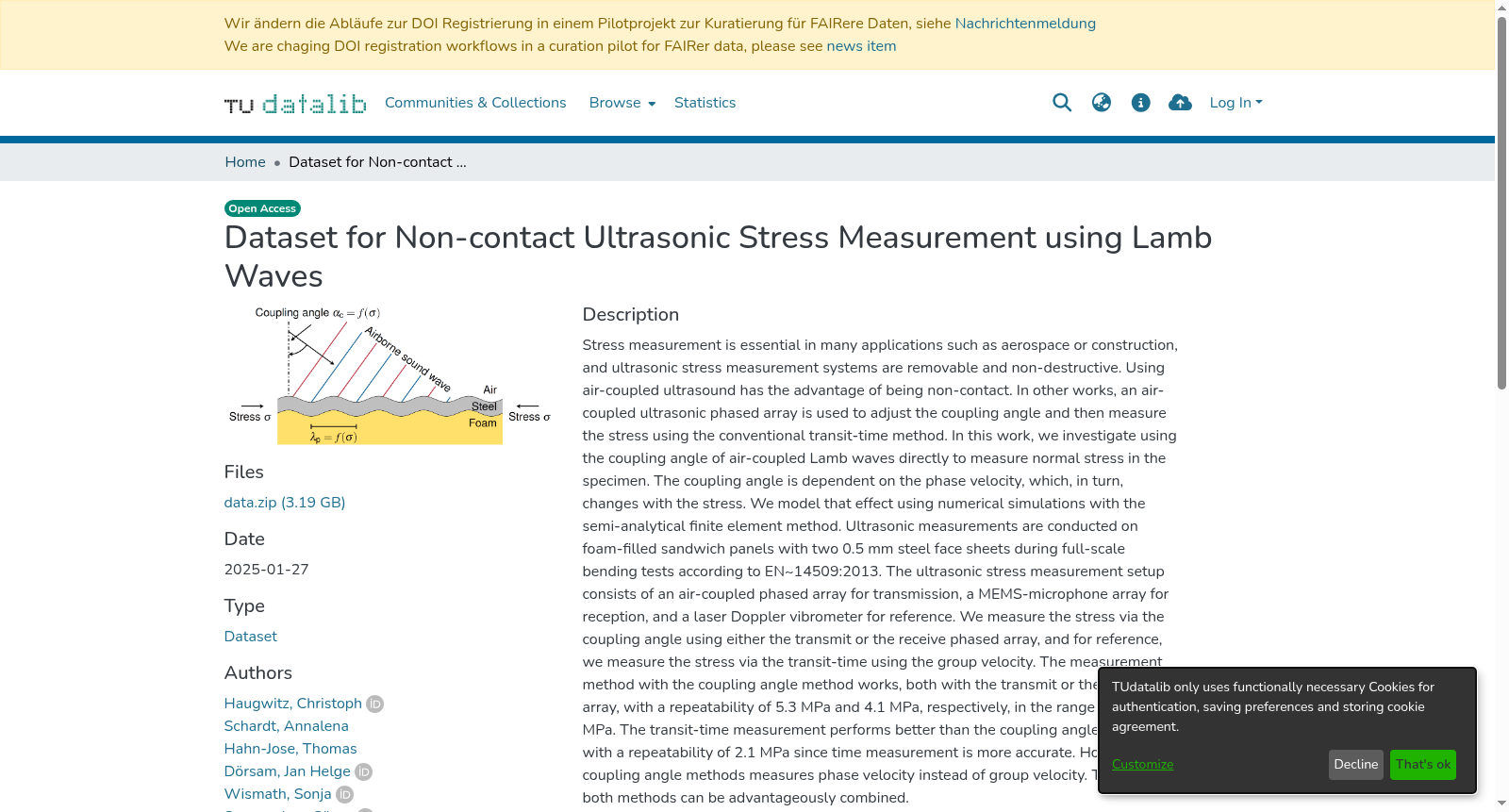
Stress measurement is essential in many applications such as aerospace or construction, and ultrasonic stress measurement systems are removable and non-destructive. Using air-coupled ultrasound has the advantage of being non-contact. In other works, an air-coupled ultrasonic phased array is used to adjust the coupling angle and then measure the stress using the conventional transit-time method. In this work, we investigate using the coupling angle of air-coupled Lamb waves directly to measure normal stress in the specimen. The coupling angle is dependent on the phase velocity, which, in turn, changes with the stress. We model that effect using numerical simulations with the semi-analytical finite element method. Ultrasonic measurements are conducted on foam-filled sandwich panels with two 0.5 mm steel face sheets during full-scale bending tests according to EN~14509:2013. The ultrasonic stress measurement setup consists of an air-coupled phased array for transmission, a MEMS-microphone array for reception, and a laser Doppler vibrometer for reference. We measure the stress via the coupling angle using either the transmit or the receive phased array, and for reference, we measure the stress via the transit-time using the group velocity. The measurement method with the coupling angle method works, both with the transmit or the receive array, with a repeatability of 5.3 MPa and 4.1 MPa, respectively, in the range of 0 to 150 MPa. The transit-time measurement performs better than the coupling angle method with a repeatability of 2.1 MPa since time measurement is more accurate. However, the coupling angle methods measures phase velocity instead of group velocity. Therefore, both methods can be advantageously combined.
应力检测在航空航天、建筑工程等诸多领域中均具有重要应用价值,而超声应力检测系统兼具便携部署与无损检测的双重优势。采用空气耦合超声技术的核心优势在于可实现非接触式检测。
既往研究中,研究者借助空气耦合超声相控阵调整耦合角度,随后通过传统渡越时间法完成应力检测。
本研究旨在探索直接利用空气耦合兰姆波(Lamb waves)的耦合角度,实现试样法向应力检测的方法。耦合角度与相速度直接相关,而相速度又会随应力水平发生变化。本研究采用半解析有限元法(semi-analytical finite element method)开展数值模拟,对上述效应进行建模分析。
本研究依据EN 14509:2013标准开展全尺寸弯曲试验,以覆有两层0.5mm厚钢板的泡沫填充夹芯板为测试对象,同步开展超声检测。超声应力检测系统由发射端空气耦合相控阵、接收端MEMS麦克风阵列(MEMS-microphone array),以及用于基准测量的激光多普勒测振仪(laser Doppler vibrometer)组成。
本研究分别利用发射相控阵与接收相控阵,通过耦合角度实现应力检测;同时采用基于群速度的渡越时间法完成基准应力测量。
基于耦合角度的检测方法切实可行:无论是采用发射相控阵还是接收相控阵,在0~150MPa的应力区间内均能实现有效检测,二者的检测重复性分别为5.3MPa与4.1MPa。由于时间测量的精度更高,基于渡越时间的检测方法重复性可达2.1MPa,性能优于耦合角度法。但耦合角度法检测的是相速度而非群速度,因此可将两种方法优势互补,联合使用。
提供机构:
Technical University of Darmstadt
创建时间:
2025-05-14
搜集汇总
数据集介绍
背景与挑战
背景概述
该数据集包含用于非接触式超声波应力测量的实验数据,重点研究利用空气耦合Lamb波的耦合角测量法。数据集支持应力测量在航空航天和建筑等领域的应用,提供了高重复性的测量结果,并与传统的传输时间方法进行了比较。
以上内容由遇见数据集搜集并总结生成



