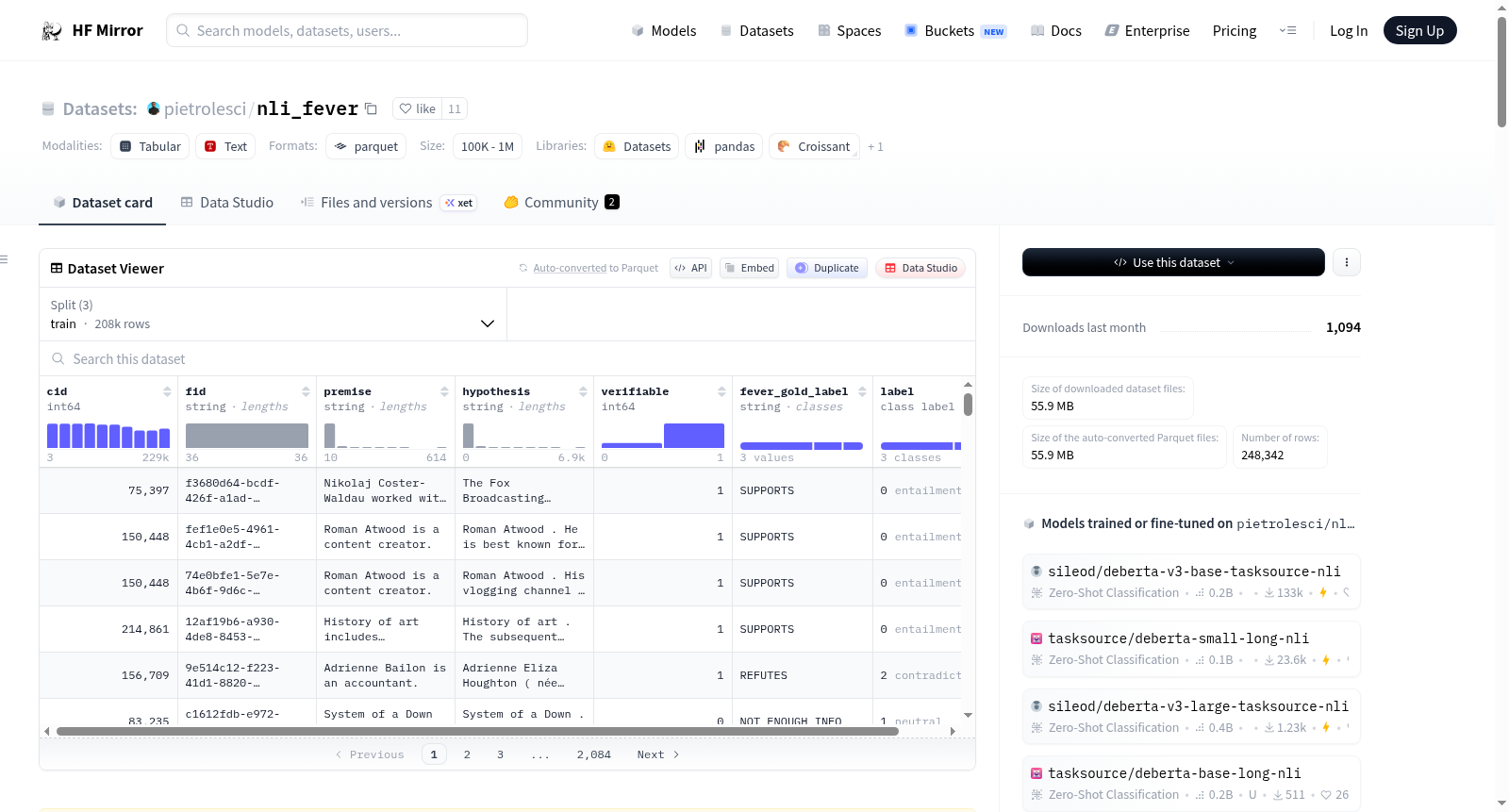
## Overview
The original dataset can be found [here](https://www.dropbox.com/s/hylbuaovqwo2zav/nli_fever.zip?dl=0)
while the Github repo is [here](https://github.com/easonnie/combine-FEVER-NSMN/blob/master/other_resources/nli_fever.md).
This dataset has been proposed in [Combining fact extraction and verification with neural semantic matching networks](https://dl.acm.org/doi/abs/10.1609/aaai.v33i01.33016859). This dataset has been created as a modification
of FEVER.
In the original FEVER setting, the input is a claim from Wikipedia and the expected output is a label.
However, this is different from the standard NLI formalization which is basically a *pair-of-sequence to label* problem.
To facilitate NLI-related research to take advantage of the FEVER dataset, the authors pair the claims in the FEVER dataset
with the textual evidence and make it a *pair-of-sequence to label* formatted dataset.
## Dataset curation
The label mapping follows the paper and is the following
```python
mapping = {
"SUPPORTS": 0, # entailment
"NOT ENOUGH INFO": 1, # neutral
"REFUTES": 2, # contradiction
}
```
Also, the "verifiable" column has been encoded as follows
```python
mapping = {"NOT VERIFIABLE": 0, "VERIFIABLE": 1}
```
Finally, a consistency check with the labels reported in the original FEVER dataset is performed.
NOTE: no label is available for the "test" split.
NOTE: there are 3 instances in common between `dev` and `train` splits.
## Code to generate the dataset
```python
import pandas as pd
from datasets import Dataset, ClassLabel, load_dataset, Value, Features, DatasetDict
import json
# download data from https://www.dropbox.com/s/hylbuaovqwo2zav/nli_fever.zip?dl=0
paths = {
"train": "<some_path>/nli_fever/train_fitems.jsonl",
"validation": "<some_path>/nli_fever/dev_fitems.jsonl",
"test": "<some_path>/nli_fever/test_fitems.jsonl",
}
# parsing code from https://github.com/facebookresearch/anli/blob/main/src/utils/common.py
registered_jsonabl_classes = {}
def register_class(cls):
global registered_jsonabl_classes
if cls not in registered_jsonabl_classes:
registered_jsonabl_classes.update({cls.__name__: cls})
def unserialize_JsonableObject(d):
global registered_jsonabl_classes
classname = d.pop("_jcls_", None)
if classname:
cls = registered_jsonabl_classes[classname]
obj = cls.__new__(cls) # Make instance without calling __init__
for key, value in d.items():
setattr(obj, key, value)
return obj
else:
return d
def load_jsonl(filename, debug_num=None):
d_list = []
with open(filename, encoding="utf-8", mode="r") as in_f:
print("Load Jsonl:", filename)
for line in in_f:
item = json.loads(line.strip(), object_hook=unserialize_JsonableObject)
d_list.append(item)
if debug_num is not None and 0 < debug_num == len(d_list):
break
return d_list
def get_original_fever() -> pd.DataFrame:
"""Get original fever datasets."""
fever_v1 = load_dataset("fever", "v1.0")
fever_v2 = load_dataset("fever", "v2.0")
columns = ["id", "label"]
splits = ["paper_test", "paper_dev", "labelled_dev", "train"]
list_dfs = [fever_v1[split].to_pandas()[columns] for split in splits]
list_dfs.append(fever_v2["validation"].to_pandas()[columns])
dfs = pd.concat(list_dfs, ignore_index=False)
dfs = dfs.drop_duplicates()
dfs = dfs.rename(columns={"label": "fever_gold_label"})
return dfs
def load_and_process(path: str, fever_df: pd.DataFrame) -> pd.DataFrame:
"""Load data split and merge with fever."""
df = pd.DataFrame(load_jsonl(path))
df = df.rename(columns={"query": "premise", "context": "hypothesis"})
# adjust dtype
df["cid"] = df["cid"].astype(int)
# merge with original fever to get labels
df = pd.merge(df, fever_df, left_on="cid", right_on="id", how="inner").drop_duplicates()
return df
def encode_labels(df: pd.DataFrame) -> pd.DataFrame:
"""Encode labels using the mapping used in SNLI and MultiNLI"""
mapping = {
"SUPPORTS": 0, # entailment
"NOT ENOUGH INFO": 1, # neutral
"REFUTES": 2, # contradiction
}
df["label"] = df["fever_gold_label"].map(mapping)
# verifiable
df["verifiable"] = df["verifiable"].map({"NOT VERIFIABLE": 0, "VERIFIABLE": 1})
return df
if __name__ == "__main__":
fever_df = get_original_fever()
dataset_splits = {}
for split, path in paths.items():
# from json to dataframe and merge with fever
df = load_and_process(path, fever_df)
if not len(df) > 0:
print(f"Split `{split}` has no matches")
continue
if split == "train":
# train must have same labels
assert sum(df["fever_gold_label"] != df["label"]) == 0
# encode labels using the default mapping used by other nli datasets
# i.e, entailment: 0, neutral: 1, contradiction: 2
df = df.drop(columns=["label"])
df = encode_labels(df)
# cast to dataset
features = Features(
{
"cid": Value(dtype="int64", id=None),
"fid": Value(dtype="string", id=None),
"id": Value(dtype="int32", id=None),
"premise": Value(dtype="string", id=None),
"hypothesis": Value(dtype="string", id=None),
"verifiable": Value(dtype="int64", id=None),
"fever_gold_label": Value(dtype="string", id=None),
"label": ClassLabel(num_classes=3, names=["entailment", "neutral", "contradiction"]),
}
)
if "test" in path:
# no features for test set
df["label"] = -1
df["verifiable"] = -1
df["fever_gold_label"] = "not available"
dataset = Dataset.from_pandas(df, features=features)
dataset_splits[split] = dataset
nli_fever = DatasetDict(dataset_splits)
nli_fever.push_to_hub("pietrolesci/nli_fever", token="<your token>")
# check overlap between splits
from itertools import combinations
for i, j in combinations(dataset_splits.keys(), 2):
print(
f"{i} - {j}: ",
pd.merge(
dataset_splits[i].to_pandas(),
dataset_splits[j].to_pandas(),
on=["premise", "hypothesis", "label"],
how="inner",
).shape[0],
)
#> train - dev: 3
#> train - test: 0
#> dev - test: 0
```