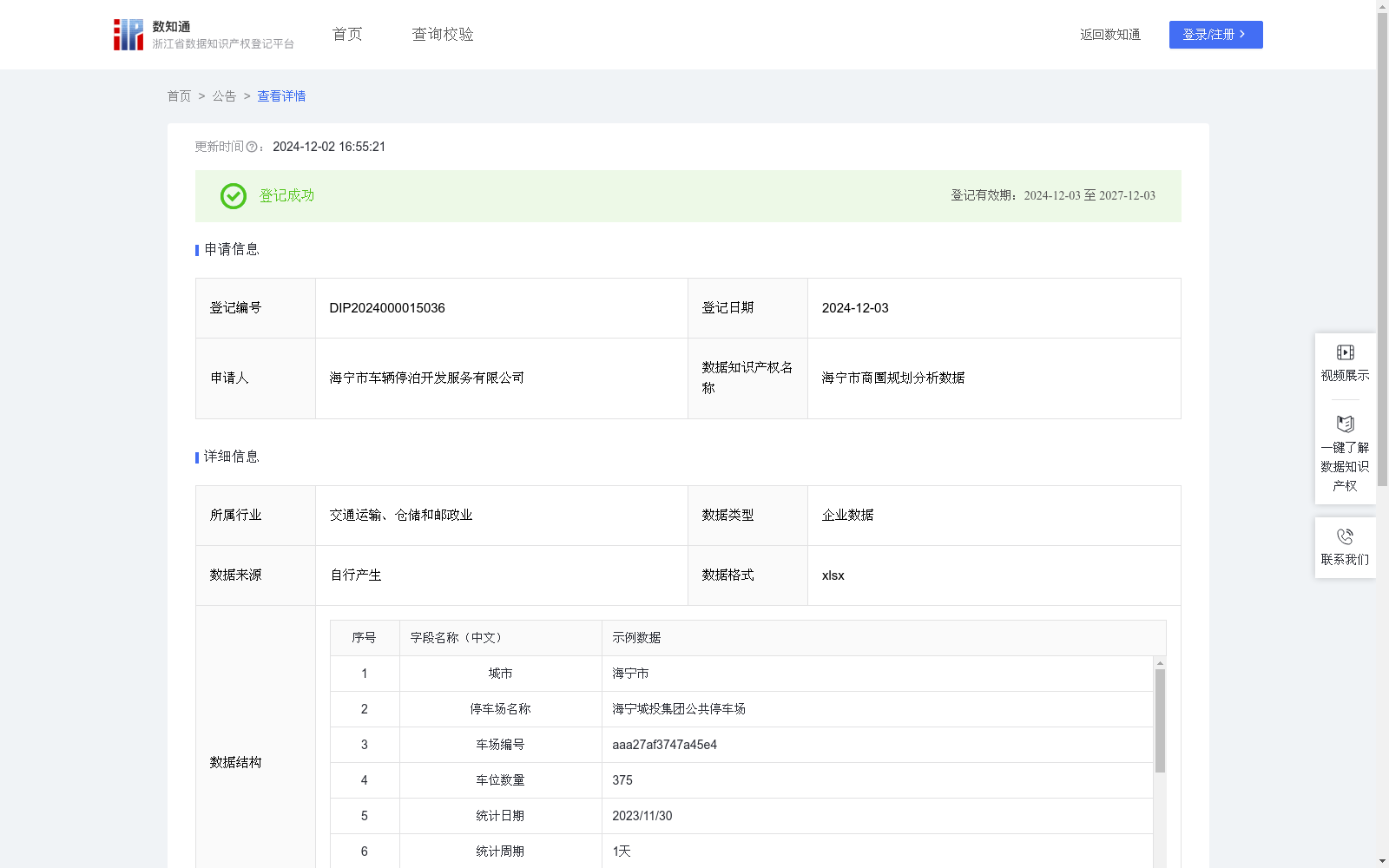
海宁市商圈规划分析数据
收藏资源简介:
通过对停车场数据的分析,市政规划部门可以识别出某一周期内各个停车场的平均停车时长、停车流动率等,从而推测出不同区域的人员分布情况和潜在消费力水平。如果某停车场车场饱和度高、流动率大且停车时间较长,则该停车场附近人员分布较密集,消费潜力也较强。这种分析可以应用于商业综合体选址优化,通过精准匹配商业综合体和目标消费人群,提升商业综合体的人流量和消费能力;还可以用于市政基础设施规划,通过分析停车数据,优化公共设施和服务的布局,提升城市整体的便利性和吸引力;同时,这种分析还可以用于商业推广策略制定,通过了解不同区域的消费人群特征,调整商业推广策略,提高商业活动的效果和影响力。最终,这些应用场景能够提升市政规划的科学性和精准性,促进商业综合体的发展和城市的繁荣。数据收集:从停车场管理系统中获取相关数据,包括城市、停车场名称、停车场编号、车位总数、停车订单总数等信息。 平均停车时长=停车场总订单总时长÷停车场总订单数。顾客在某区域停车停留时间越长,其在周边商圈进行消费的可能性和消费金额可能相对越高,可作为衡量商圈消费潜力的一个参考指标。 车场饱和度=停车场总订单数÷车位数量。停车场饱和度越高,说明该停车场区域活动人员多,消费潜力强。 停车场流动率=(∑(各类停留时长的停车订单数量×对应停留时长权重)÷车位数量)。将停车订单按照停留时长进行分类,分为短停留(0-1小时)、中停留(1-3小时)、长停留(3小时以上),分别统计每类订单次数,并设定相应权重(停留时间越短,周转更快,权重越高,短停留权重设为 0.5,中停留权重设为 0.3,长停留权重设为 0.2)。 当平均停车时长大于等于2小时,且车场饱和度大于等于1,且停车场流动率大于等于40%时,认定为适宜商圈选址,反之则为不适宜。
By analyzing parking lot data, municipal planning departments can identify the average parking duration, parking turnover rate, and other metrics of each parking lot within a specific cycle, thereby inferring the population distribution and potential consumption power in different areas. If a parking lot has high saturation, high turnover rate, and long parking duration, it indicates a dense nearby population and strong consumption potential. This analysis can be applied to the optimization of commercial complex site selection: by accurately matching commercial complexes with their target consumer groups, the foot traffic and consumption capacity of commercial complexes can be improved. It can also be used for municipal infrastructure planning: by analyzing parking data to optimize the layout of public facilities and services, and enhance the overall convenience and attractiveness of the city. Additionally, it can be used to formulate commercial promotion strategies: by understanding the characteristics of consumer groups in different regions, adjust commercial promotion strategies to improve the effectiveness and influence of commercial activities. Ultimately, these application scenarios can improve the scientificity and accuracy of municipal planning, and promote the development of commercial complexes and urban prosperity. Data Collection: Relevant data is obtained from the parking management system, including city, parking lot name, parking lot number, total number of parking spaces, total number of parking orders, and other information. Average Parking Duration = Total Duration of All Parking Orders at the Parking Lot ÷ Total Number of Parking Orders at the Parking Lot. The longer a customer parks in a certain area, the higher the possibility and amount of consumption in the surrounding business district, which can be used as a reference indicator for measuring the consumption potential of the business district. Parking Saturation Ratio = Total Number of Parking Orders at the Parking Lot ÷ Number of Parking Spaces. The higher the parking saturation ratio, the more active people in the parking lot area, and the stronger the consumption potential. Parking Turnover Rate = (∑(Number of Parking Orders for Each Stay Duration × Corresponding Stay Duration Weight)) ÷ Number of Parking Spaces. Parking orders are classified according to stay duration into short stay (0-1 hour), medium stay (1-3 hours), and long stay (over 3 hours). The number of orders for each category is counted separately, and corresponding weights are set (the shorter the stay time, the faster the turnover, so the higher the weight; the short stay weight is set to 0.5, medium stay to 0.3, and long stay to 0.2). When the average parking duration is ≥ 2 hours, the parking saturation ratio ≥ 1, and the parking turnover rate ≥ 40%, it is identified as suitable for business district site selection; otherwise, it is unsuitable.