
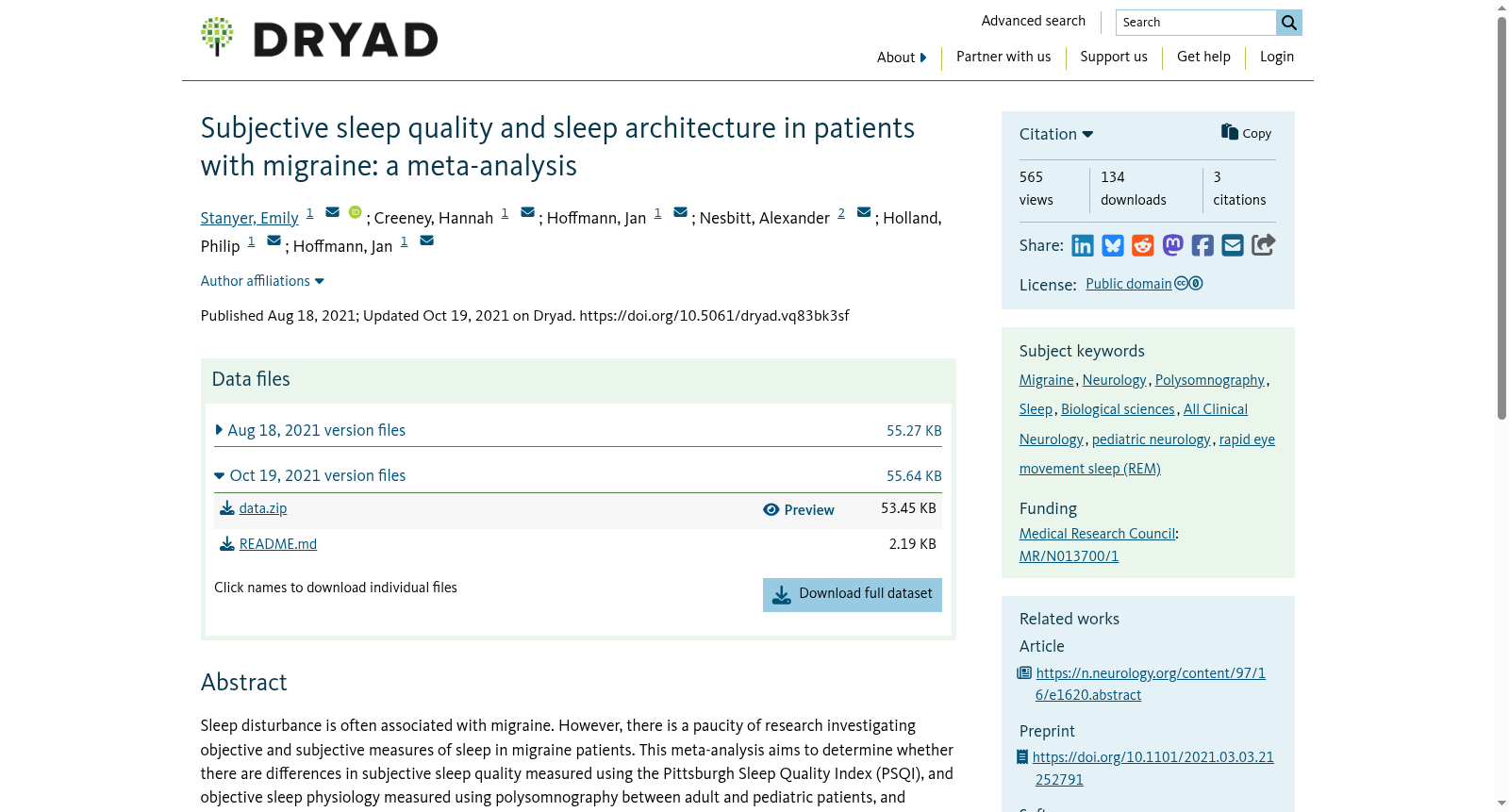
Subjective sleep quality and sleep architecture in patients with migraine: a meta-analysis
收藏DataCite Commons2025-06-01 更新2025-06-15 收录
下载链接:
https://datadryad.org/dataset/doi:10.5061/dryad.vq83bk3sf
下载链接
链接失效反馈官方服务:
资源简介:
Sleep disturbance is often associated with migraine. However, there is a
paucity of research investigating objective and subjective measures of
sleep in migraine patients. This meta-analysis aims to determine whether
there are differences in subjective sleep quality measured using the
Pittsburgh Sleep Quality Index (PSQI), and objective sleep physiology
measured using polysomnography between adult and pediatric patients, and
healthy controls. This review was pre-registered on PROSPERO
(CRD42020209325). A systematic search of five databases (Embase, MEDLINE®,
Global Health, APA PsycINFO, APA PsycArticles, last searched: 12/17/2020)
was conducted to find case-controlled studies that measured
polysomnography and/or PSQI in patients with migraine. Pregnant
participants and those with other headache disorders were excluded. Effect
sizes (Hedges’ g) were entered into a random effects model meta-analysis.
Study quality was evaluated with the Newcastle Ottawa Scale and
publication bias with Egger’s regression test. 32 studies were
eligible, of which 21 measured PSQI and/or MIDAS in adults, 6 measured PSG
in adults, and 5 in children. The overall mean study quality score was
5/9, and this did not moderate any of the results, and there was no risk
of publication bias. Overall, adults with migraine had higher PSQI scores
than healthy controls (g=0.75, p < .001, 95% confidence interval
[95% CI]: 0.54 - 0.96). This effect was larger in those with chronic
rather than episodic conditions (g=1.03, p < .001, 95% CI: 0.37 -
1.01, g = 0.63, p < .001, 95% CI: 0.38 - 0.88
respectively). For polysomnographic studies, adults and children with
migraine displayed a lower percentage of REM sleep (g=-0.22, p = 0.017,
95% CI: -0.41 - -0.04, g = -0.71, p = 0.025, 95% CI: -1.34 -
-0.10 respectively) than controls. Pediatric patients displayed less total
sleep time (g=-1.37, p = 0.039, 95% CI: -2.66 - -0.10), more wake (g=0.52,
p < .001, 95% CI: 0.08 – 0.79) and shorter sleep onset latency
(g=-0.37, p < .001, 95% CI: -0.54 - -0.21) than
controls. People with migraines have significantly poorer
subjective sleep quality and altered sleep physiology compared to healthy
individuals. Further longitudinal empirical studies are required to
enhance our understanding of this relationship.
提供机构:
Dryad
创建时间:
2021-08-19
搜集汇总
数据集介绍
背景与挑战
背景概述
该数据集是一个关于偏头痛患者睡眠质量的元分析数据集,包含从32项研究中提取的匹兹堡睡眠质量指数(PSQI)和多导睡眠图(PSG)参数数据,数据格式为CSV,涵盖成人、儿童患者和健康对照的均值、标准差等统计信息。数据集用于分析偏头痛患者与对照在主观睡眠质量和客观睡眠结构上的差异,例如偏头痛患者PSQI评分更高、REM睡眠百分比更低。
以上内容由遇见数据集搜集并总结生成


