
A dataset of EEG recordings from: Alzheimer's disease, Frontotemporal dementia and Healthy subjects
收藏OpenNeuro2023-02-17 更新2026-03-21 收录
下载链接:
https://openneuro.org/datasets/ds004504
下载链接
链接失效反馈官方服务:
资源简介:
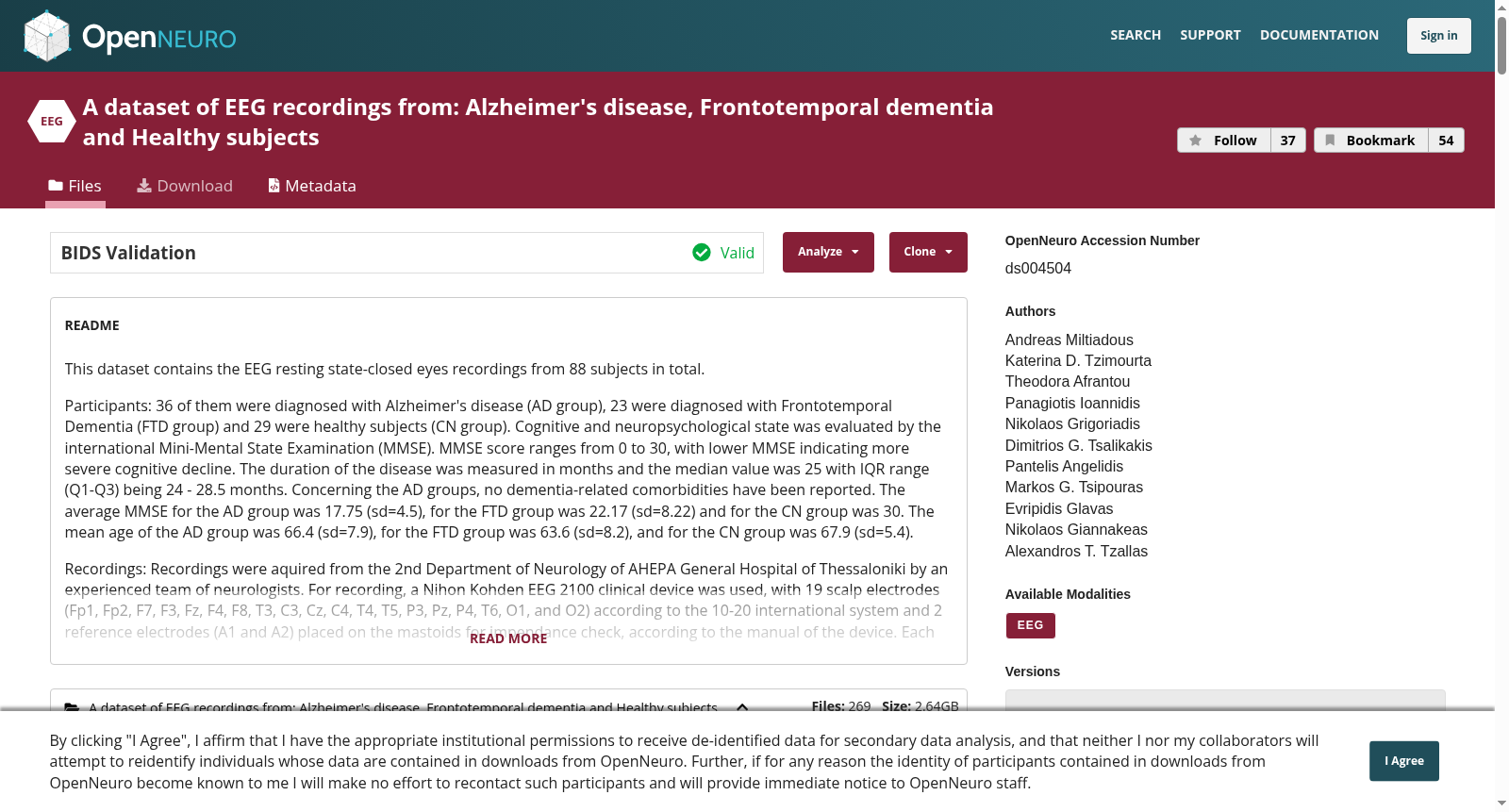
This dataset contains the EEG resting state-closed eyes recordings from 88 subjects in total.
Participants: 36 of them were diagnosed with Alzheimer's disease (AD group), 23 were diagnosed with Frontotemporal Dementia (FTD group) and 29 were healthy subjects (CN group).
Cognitive and neuropsychological state was evaluated by the international Mini-Mental State Examination (MMSE). MMSE score ranges from 0 to 30, with lower MMSE indicating more severe cognitive decline.
The duration of the disease was measured in months and the median value was 25 with IQR range (Q1-Q3) being 24 - 28.5 months.
Concerning the AD groups, no dementia-related comorbidities have been reported. The average MMSE for the AD group was 17.75 (sd=4.5), for the FTD group was 22.17 (sd=8.22) and for the CN group was 30.
The mean age of the AD group was 66.4 (sd=7.9), for the FTD group was 63.6 (sd=8.2), and for the CN group was 67.9 (sd=5.4).
Recordings: Recordings were aquired from the 2nd Department of Neurology of AHEPA General Hospital of Thessaloniki by an experienced team of neurologists. For recording, a Nihon Kohden EEG 2100 clinical device was used,
with 19 scalp electrodes (Fp1, Fp2, F7, F3, Fz, F4, F8, T3, C3, Cz, C4, T4, T5, P3, Pz, P4, T6, O1, and O2) according to the 10-20 international system and 2 reference electrodes (A1 and A2) placed on the mastoids for impendance check, according to the manual of the device. Each recording was performed according to the clinical protocol with participants being in a sitting position having their eyes closed.
Before the initialization of each recording, the skin impedance value was ensured to be below 5k?. The sampling rate was 500 Hz with 10uV/mm resolution.
The recording montages were anterior-posterior bipolar and referential montage using Cz as the common reference. The referential montage was included in this dataset.
The recordings were received under the range of the following parameters of the amplifier: Sensitivity: 10uV/mm, time constant: 0.3s, and high frequency filter at 70 Hz.
Each recording lasted approximately 13.5 minutes for AD group (min=5.1, max=21.3), 12 minutes for FTD group (min=7.9, max=16.9) and 13.8 for CN group (min=12.5, max=16.5).
In total, 485.5 minutes of AD, 276.5 minutes of FTD and 402 minutes of CN recordings were collected and are included in the dataset.
Preprocessing: The EEG recordings were exported in .eeg format and are transformed to BIDS accepted .set format for the inclusion in the dataset.
Automatic annotations of the Nihon Kohden EEG device marking artifacts (muscle activity, blinking, swallowing) have not been included for language compatibility purposes
(If this is an issue, please use the preprocessed dataset in Folder: derivatives).
The unprocessed EEG recordings are included in folders named: sub-0XX. Folders named sub-0XX in the subfolder derivatives contain the preprocessed and denoised EEG recordings.
The preprocessing pipeline of the EEG signals is as follows. First, a Butterworth band-pass filter 0.5-45 Hz was applied and the signals were re-referenced to A1-A2.
Then, the Artifact Subspace Reconstruction routine (ASR) which is an EEG artifact correction method included in the EEGLab Matlab software was applied to the signals,
removing bad data periods which exceeded the max acceptable 0.5 second window standard deviation of 17, which is considered a conservative window.
Next, the Independent Component Analysis (ICA) method (RunICA algorithm) was performed, transforming the 19 EEG signals to 19 ICA components.
ICA components that were classified as “eye artifacts” or “jaw artifacts” by the automatic classification routine “ICLabel” in the EEGLAB platform were automatically rejected.
It should be noted that, even though the recording was performed in a resting state, eyes-closed condition, eye artifacts of eye movement were still found at some EEG recordings.
A complete analysis of this dataset can be found in the published Data Descriptor paper "A Dataset of Scalp EEG Recordings of Alzheimer’s Disease, Frontotemporal Dementia and Healthy Subjects from Routine EEG", https://doi.org/10.3390/data8060095
本数据集共收录88名受试者的静息态闭眼脑电图(Electroencephalogram, EEG)记录。
受试者分组:其中36例被诊断为阿尔茨海默病(Alzheimer's disease, AD)组,23例被诊断为额颞叶痴呆(Frontotemporal Dementia, FTD)组,剩余29例为健康对照(Cognitive Normal, CN)组。
认知与神经心理状态采用国际通用的简易精神状态检查表(Mini-Mental State Examination, MMSE)进行评估。MMSE评分范围为0至30分,评分越低代表认知衰退程度越严重。
疾病病程以月为单位统计,中位数为25,四分位距(Interquartile Range, IQR)Q1-Q3为24~28.5个月。
针对AD组,无痴呆相关合并症的报道。AD组的平均MMSE得分为17.75(标准差sd=4.5),FTD组为22.17(sd=8.22),CN组为30。
年龄方面,AD组平均年龄为66.4岁(sd=7.9),FTD组为63.6岁(sd=8.2),CN组为67.9岁(sd=5.4)。
数据采集由塞萨洛尼基AHEPA综合医院神经内科第二科室的经验丰富的神经内科团队完成。采集设备采用日本光电(Nihon Kohden)EEG 2100型临床脑电图仪,按照国际10-20系统布设19个头皮电极(Fp1、Fp2、F7、F3、Fz、F4、F8、T3、C3、Cz、C4、T4、T5、P3、Pz、P4、T6、O1、O2),并在乳突部位放置2个参考电极(A1、A2)用于阻抗检测,操作严格遵循设备手册。所有记录均遵循临床方案进行,受试者取坐位并保持闭眼状态。
每次记录开始前,需确保皮肤阻抗低于5千欧(kΩ)。采样率为500Hz,分辨率为10μV/mm。
记录导联方式包含前后双极导联以及以Cz为公共参考的参考导联,本数据集包含参考导联数据。放大器参数设置如下:灵敏度10μV/mm,时间常数0.3s,高频滤波器截止频率为70Hz。
AD组单次记录时长约13.5分钟(最短5.1分钟,最长21.3分钟),FTD组约12分钟(最短7.9分钟,最长16.9分钟),CN组约13.8分钟(最短12.5分钟,最长16.5分钟)。最终共收集到AD组总记录时长485.5分钟、FTD组276.5分钟、CN组402分钟,全部纳入本数据集。
预处理部分:
原始EEG记录以.eeg格式导出,并转换为脑成像数据结构(Brain Imaging Data Structure, BIDS)兼容的.set格式,以纳入数据集。
出于语言兼容性考虑,日本光电脑电图仪自带的肌电活动、眨眼、吞咽等伪迹自动标注功能未被包含在内(若有相关需求,请使用derivatives文件夹中的预处理数据集)。
未预处理的EEG记录存储在名为sub-0XX的文件夹中;derivatives子文件夹下的sub-0XX文件夹则包含预处理并去噪后的EEG记录。
EEG信号的预处理流程如下:首先应用巴特沃斯(Butterworth)带通滤波器(0.5~45Hz)对信号进行滤波,并将信号重参考至A1-A2。随后使用Matlab的EEGLab软件中集成的伪迹子空间重构(Artifact Subspace Reconstruction, ASR)算法,移除超出保守阈值的坏数据段——即超过0.5秒窗口标准差17的时段。接下来采用独立成分分析(Independent Component Analysis, ICA)的RunICA算法,将19路EEG信号转换为19个ICA成分。通过EEGLAB平台的自动分类工具"ICLabel",将标记为"眼伪迹"或"下颌伪迹"的ICA成分自动剔除。
需注意的是,尽管本次记录为静息态闭眼状态,部分EEG记录中仍检测到眼动相关的眼伪迹。
本数据集的完整分析可参见已发表的数据描述论文"A Dataset of Scalp EEG Recordings of Alzheimer’s Disease, Frontotemporal Dementia and Healthy Subjects from Routine EEG",DOI: 10.3390/data8060095
创建时间:
2023-02-17
搜集汇总
数据集介绍
背景与挑战
背景概述
该数据集包含88名受试者(36名阿尔茨海默病患者、23名额颞叶痴呆患者和29名健康对照)的静息态闭眼EEG记录,数据经过专业采集和预处理,适用于神经退行性疾病的EEG研究。
以上内容由遇见数据集搜集并总结生成


