
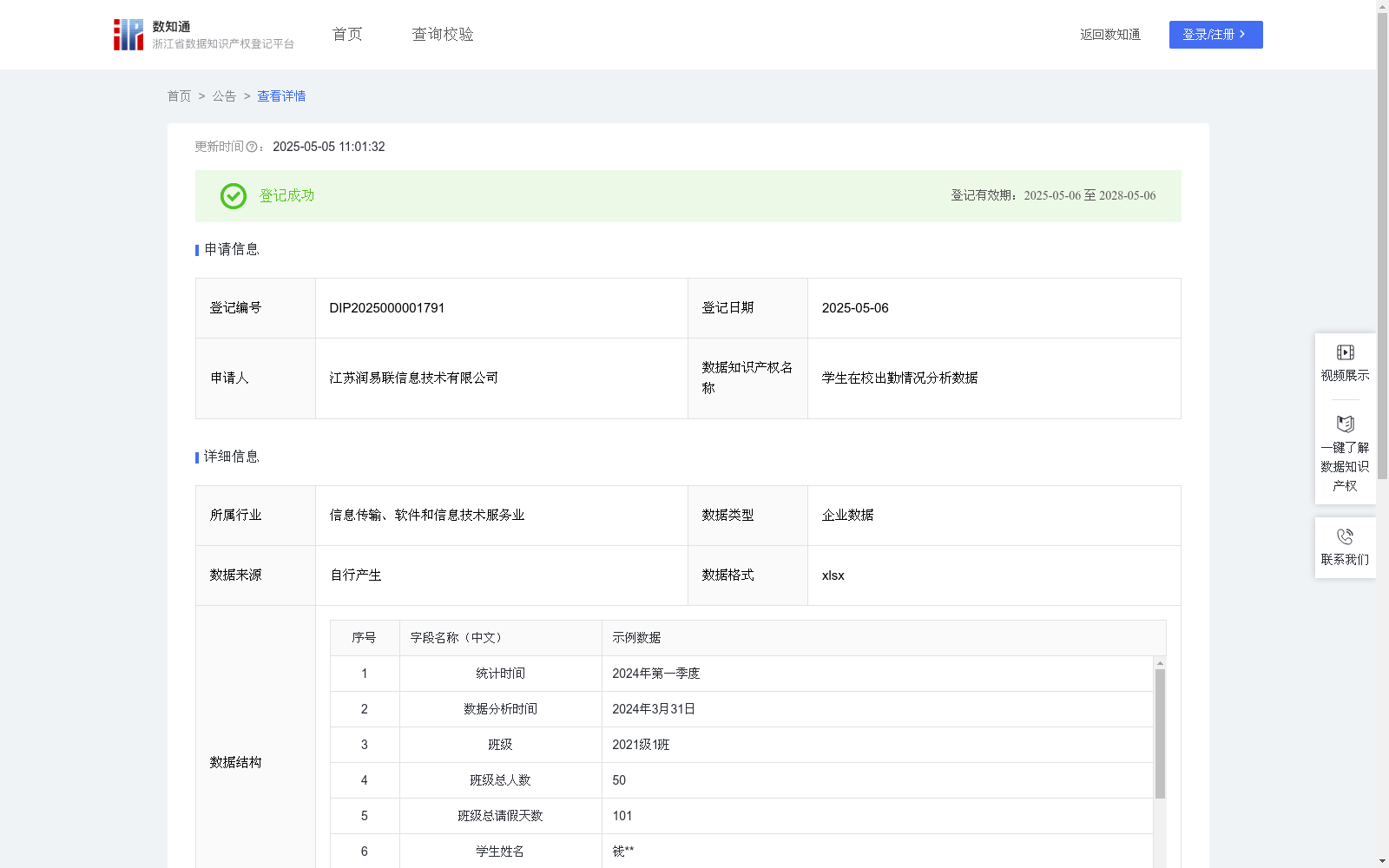
学生在校出勤情况分析数据
收藏浙江省数据知识产权登记平台2025-05-05 更新2025-05-06 收录
下载链接:
https://www.zjip.org.cn/home/announce/trends/127364
下载链接
链接失效反馈官方服务:
资源简介:
通过润易联开发的数字校园小程序对学校班级学生的出勤情况进行采集和统计,小程序对班级每天的出勤情况进行周统计、月统计以及季度统计,方便学校对学生的出勤情况进行查看和了解,同时也为教育管理人员预警各班级学生的个人出勤情况提供决策数据支撑。通过该数据可以更好地了解学生的动态,方便对学生身心健康进行评估,必要时可及时进行干预,有利于学生健康管理发展,助力学生健康成长。该数据适用于小学生、中学生及高校学生,也适用于需要对学生进行适当管理的教培机构。1、数据采集:用户通过我司提供的小程序记录班级信息及学生考勤情况,小程序统计学生姓名、请假天数、班级总人数,汇总班级总请假天数方便记录和识别问题 2、数据清洗:对收集到的数据需要进行清洗以确保数据的质量和准确性。清洗过程包括去除空格、转换数据格式、验证数据完整性,以及处理缺失或错误的值,同时将每天的请假信息按季度进行汇总。 3、算法规则:①先根据班级总请假天数计算人均请假天数,平均请假天数=班级总请假天数/班级总人数;②计算样本方差公式计算总体方差,方差=∑(学生个人请假总天数-平均请假天数)²/(班级总人数-1);③通过总体方差计算出标准差,进而用标准差求Z分数,Z分数=(学生个人请假总天数-平均请假天数)/标准差。当Z分数<1时,则该学生请假次数属于正常范围,无需处理;当1≤Z分数<2时,则该学生请假次数中等,需对该学生进行观察;当Z分数≥2时,则该学生请假次数过于频繁,需要采取一定措施,如对该学生进行深入沟通了解请假原因,根据请假原因判断是否需要进一步介入。
This dataset collects and tallies the attendance status of students in school classes via the digital campus mini-program developed by Runyilian. The mini-program generates weekly, monthly and quarterly statistics on the daily attendance of each class, enabling schools to conveniently view and understand students' attendance situations. It also provides decision-making data support for educational administrators to issue early warnings regarding individual attendance status of students across different classes.
This data can help gain a better understanding of students' dynamics, facilitate the assessment of students' physical and mental health, allow timely intervention when necessary, contribute to the development of students' health management, and support the healthy growth of students. This dataset is applicable to primary school students, secondary school students, college students, as well as teaching and training institutions that need to properly manage their students.
1. Data Collection: Users record class information and student attendance details through the mini-program provided by Runyilian. The mini-program tallies student names, individual leave days of each student, total class size, and aggregates the total leave days of the entire class for easy record-keeping and issue identification.
2. Data Cleaning: The collected data must be cleaned to ensure its quality and accuracy. The cleaning process includes removing whitespace, converting data formats, verifying data integrity, handling missing or erroneous values, and aggregating daily leave information by quarter.
3. Algorithm Rules:
① First, calculate the per-capita leave days based on the total class leave days: Average Leave Days = Total Class Leave Days / Total Class Size;
② Calculate the population variance using the sample variance formula: Variance = ∑(Total Personal Leave Days of a Single Student - Average Leave Days)² / (Total Class Size - 1);
③ Calculate the standard deviation from the population variance, then derive the Z-score: Z-score = (Total Personal Leave Days of a Single Student - Average Leave Days) / Standard Deviation.
- When Z-score < 1: The student's leave frequency is within the normal range, and no action is required;
- When 1 ≤ Z-score < 2: The student's leave frequency is moderate, and the student should be monitored;
- When Z-score ≥ 2: The student's leave frequency is excessively high, and corresponding measures should be taken, such as conducting in-depth communication with the student to understand the reasons for their leave, and determining whether further intervention is needed based on the specific reasons.
提供机构:
江苏润易联信息技术有限公司
创建时间:
2025-04-01
搜集汇总
数据集介绍
背景与挑战
背景概述
该数据集记录了学生在校出勤情况,包括班级总请假天数、个人请假总天数等指标,通过算法计算平均请假天数、方差、标准差和Z分数,用于评估学生出勤情况并采取相应措施。数据规模为1231条,每日更新,适用于各类学校和教育机构,旨在助力学生健康管理发展。
以上内容由遇见数据集搜集并总结生成



