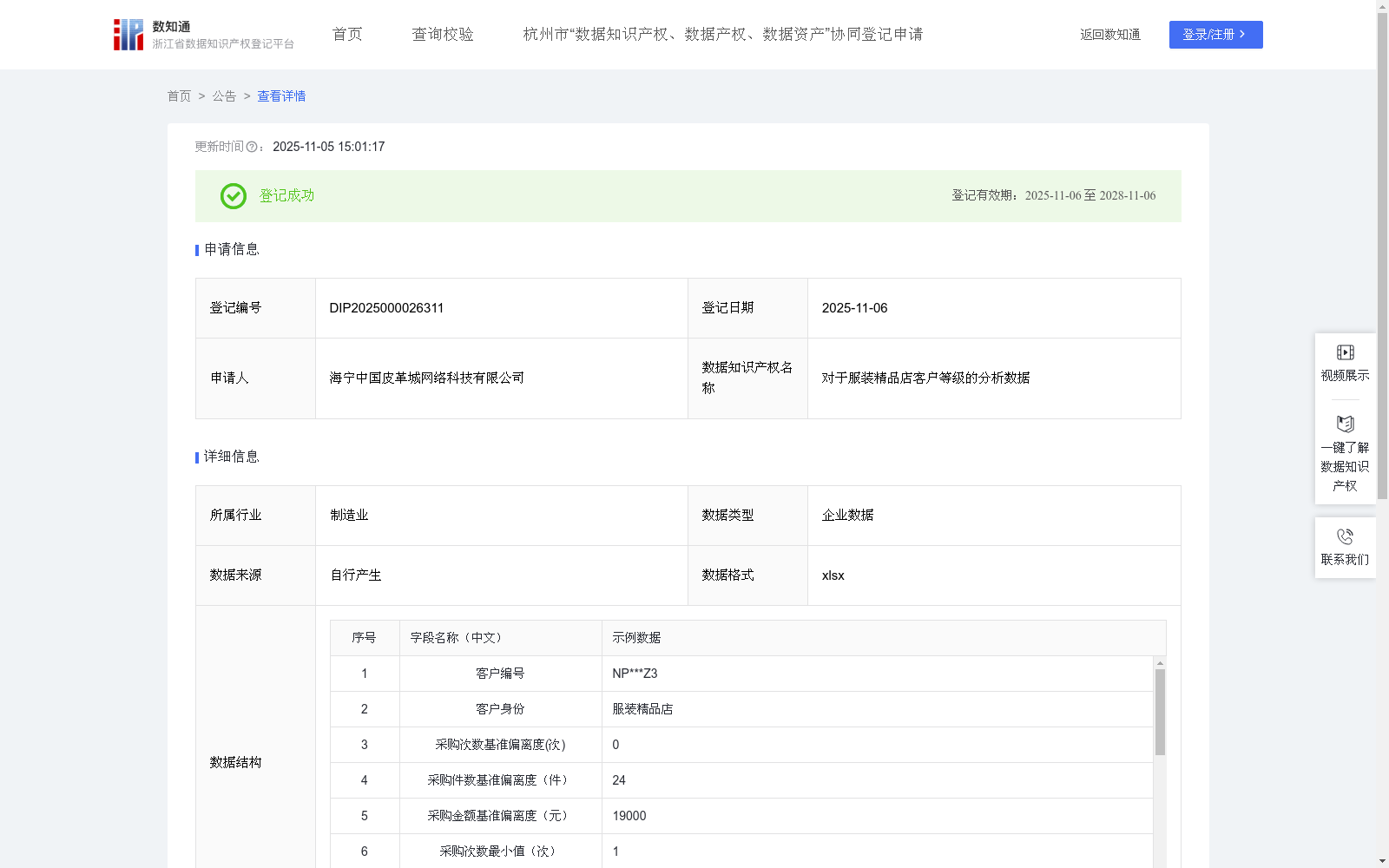
对于服装精品店客户等级的分析数据
收藏资源简介:
通过收集和分析服装精品店客户对皮革服装采购的相关数据,了解客户的购买力水平和采购偏好,一是可以为本行业的所有企业制定生产策略提供依据,二是市场管理方可以制定更精准的生产营销策略,为企业提供个性化的商品和服务。对于S级客户每月进行市场信息精准推送,对于A等级客户每季度进行市场信息精准推送,对于B等级每半年进行市场信息精准推送,对于C等级客户每年进行市场信息精准推送,对于D等级客户每两年进行市场信息精准推送。1、数据处理:对采集到的数据进行降噪、清洗、脱敏、聚集、分析。 2.数据加工:客户评分=0.25*(采购次数基准偏离度/采购次数极差)+0.25*(采购件数基准偏离度/采购件数极差)+0.3*(采购金额基准偏离度/采购金额极差)+0.2*身份权重,对结果进行四舍五入。其中采购次数基准偏离度=该客商采购总次数-采购次数最小值;采购件数基准偏离度=该客商采购总件数-采购次数最小值;采购金额基准偏离度=该客商采购总金额-采购金额最小值;采购次数最小值、采购次数最小值、采购金额最小值分别来源于所有客商的采购数据中取最小的数值。3.客户等级:客户评分>=0.3,为S级客户;0.2<=客户评分<0.3,为A级客户;0.1<=客户评分<0.2,为B级客户;0.05<=客户评分<0.1,为C级客户;客户评分<0.05,为D级客户。客户评分分数越高越好,根据评级安排更精准的生产营销策略。
This dataset is developed by collecting and analyzing relevant data on leather garment purchases from customers of clothing boutiques, with the goal of understanding customers' purchasing power and purchasing preferences. The analysis outcomes support two key applications: firstly, providing an evidence-based basis for all enterprises in the apparel industry to formulate production strategies; secondly, enabling market management authorities to develop more precise production and marketing strategies to deliver personalized products and services for these enterprises. Precise market information dissemination will be conducted monthly for S-level customers, quarterly for A-level customers, semi-annually for B-level customers, annually for C-level customers, and biennially for D-level customers. 1. Data Processing: Denoise, clean, anonymize, aggregate and analyze the collected raw data. 2. Data Calculation: The Customer Score is calculated using the following formula, and the result is rounded to an integer: Customer Score = 0.25 × (Baseline Deviation of Purchase Times / Range of Purchase Times) + 0.25 × (Baseline Deviation of Purchase Quantity / Range of Purchase Quantity) + 0.3 × (Baseline Deviation of Purchase Amount / Range of Purchase Amount) + 0.2 × Identity Weight The definitions of each component are as follows: - Baseline Deviation of Purchase Times = Total purchase times of the customer - Minimum purchase times - Baseline Deviation of Purchase Quantity = Total purchase quantity of the customer - Minimum purchase times - Baseline Deviation of Purchase Amount = Total purchase amount of the customer - Minimum purchase amount - The minimum purchase times, minimum purchase times and minimum purchase amount are all extracted as the minimum values from the purchase data of all customers. 3. Customer Tiering: Customers are classified into tiers based on their Customer Score: - S-level: Customer Score ≥ 0.3 - A-level: 0.2 ≤ Customer Score < 0.3 - B-level: 0.1 ≤ Customer Score < 0.2 - C-level: 0.05 ≤ Customer Score < 0.1 - D-level: Customer Score < 0.05 A higher Customer Score corresponds to better customer performance, and more precise production and marketing strategies will be formulated according to the customer tier.