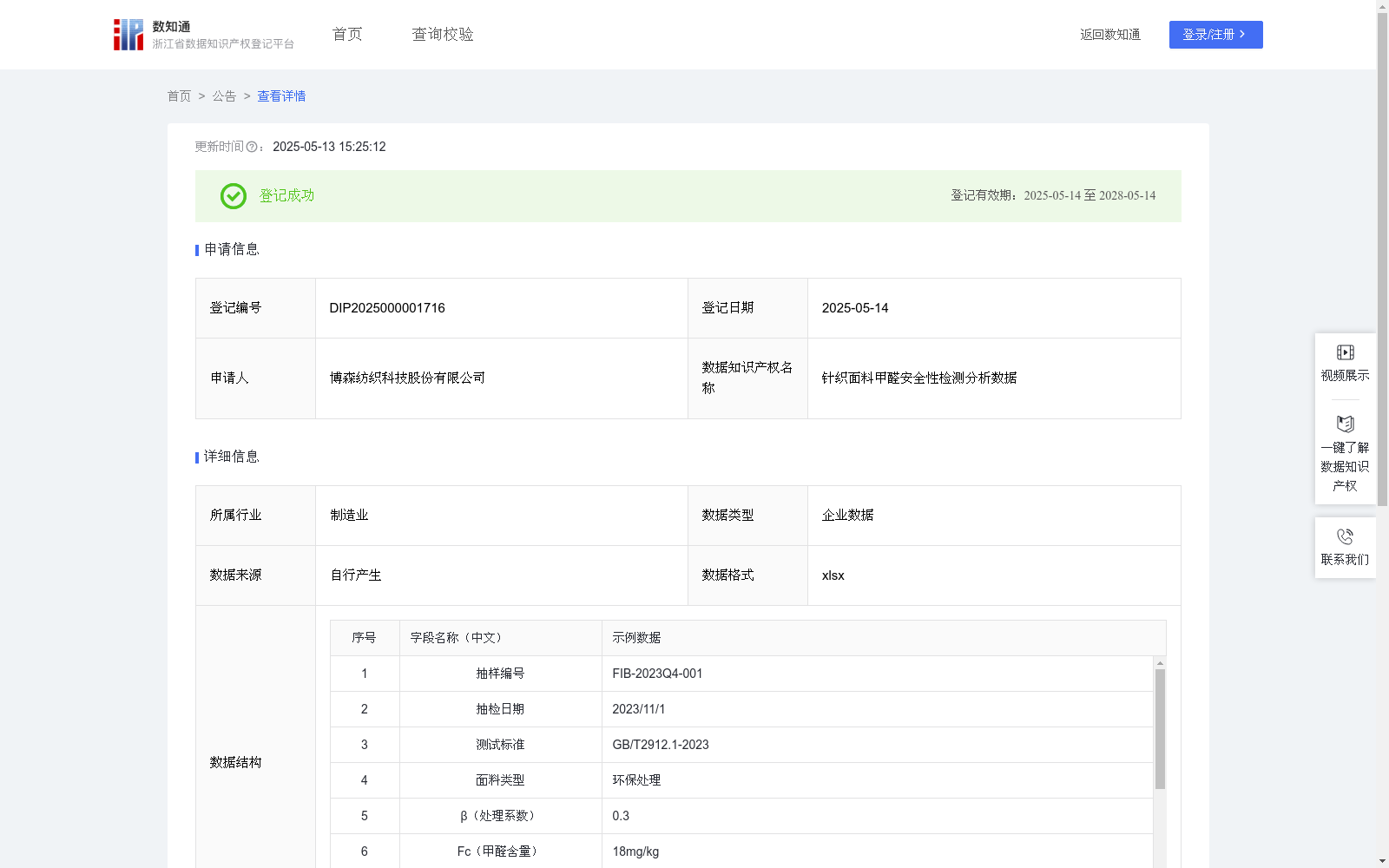
针织面料甲醛安全性检测分析数据
收藏资源简介:
生产端,企业以优质安全区间下限为标杆,通过改进生产工艺,降低甲醛含量与释放率,使产品Fd值趋近区间下限,满足高端市场环保需求。采购端:采购商根据Fd值对供应商分级,优先选择Fd值低且稳定的供应商,并通过差异化采购策略平衡成本与安全性能。监管端:动态更新行业均值μ和标准差σ,推动标准升级,并通过认证与激励政策引导企业向高性能、可持续方向发展,最终实现全链条的质量提升与市场规范化。一、数据采集:1、采集抽检日期、面料类型、Fc(甲醛含量)、Fr(甲醛释放率)等参数。2、利用公式计算Fd, Fd = [0.6×(Fc/(F基准×(1+β)))+ 0.4×(Fr/(Fr基准×(1+β)))]×10,处理系数β:环保处理β=0.3,普通处理β=0.1,未处理β=0。 二、数据处理:1、收集全行业Fd值,计算μ(均值)、σ(标准差)。2、区间修正,设定优质安全区间: [μ−2σ, μ−0.5σ]。 三、数据应用:行业内企业可根据本公司面料产品甲醛安全性检测数据,对照上述优质甲醛控制参考区间,确定本公司产品该性能行业内横向比较质量控制水平,若企业产品Fd值稳定位于优质区间内(即≤μ−0.5σ且≥μ−2σ),表明符合基础安全标准。若Fd值持续低于区间下限(即<μ−2σ),则判定为行业卓越水平,进而为企业制定质量管理控制和绩效考核目标提供依据。
On the production side, enterprises take the lower bound of the high-quality safety interval as the benchmark, optimize production processes to reduce formaldehyde content (Fc) and formaldehyde emission rate (Fr), so that the product's Fd value approaches the lower bound of the interval to meet the environmental protection demands of the high-end market. On the procurement side, purchasers grade suppliers based on their Fd values, prioritize suppliers with low and stable Fd values, and balance cost and safety performance via differentiated procurement strategies. On the supervision side, the industry mean μ and standard deviation σ are dynamically updated to promote standard upgrades, and enterprises are guided towards high-performance and sustainable development through certification and incentive policies, ultimately realizing full-chain quality improvement and market standardization. 1. Data Collection: 1. Collect parameters including sampling date, fabric type, Fc (formaldehyde content), Fr (formaldehyde emission rate), etc. 2. Calculate the Fd value using the following formula: Fd = [0.6×(Fc/(F_baseline × (1+β))) + 0.4×(Fr/(Fr_baseline × (1+β)))] × 10 where the processing coefficient β is set as 0.3 for environmentally friendly treatment, 0.1 for regular treatment, and 0 for untreated products. 2. Data Processing: 1. Collect industry-wide Fd values and calculate μ (mean) and σ (standard deviation). 2. Conduct interval correction, and set the high-quality safety interval as [μ−2σ, μ−0.5σ]. 3. Data Application: Enterprises within the industry can refer to the above high-quality formaldehyde control reference interval based on the formaldehyde safety test data of their own fabric products to determine the horizontal quality control level of their products in the industry. If an enterprise's product Fd value stably falls within the high-quality interval (i.e., ≤μ−0.5σ and ≥μ−2σ), it indicates compliance with the basic safety standards. If the Fd value continues to be lower than the lower bound of the interval (i.e., <μ−2σ), it is judged as an industry-leading excellence level, which provides a basis for enterprises to formulate quality management control and performance assessment objectives.