
Raw ADC Data of 2D-MIMO MMWave radar for Carry Object Detection
收藏Mendeley Data2024-01-31 更新2024-06-27 收录
下载链接:
https://ieee-dataport.org/documents/raw-adc-data-2d-mimo-mmwave-radar-carry-object-detection
下载链接
链接失效反馈官方服务:
资源简介:
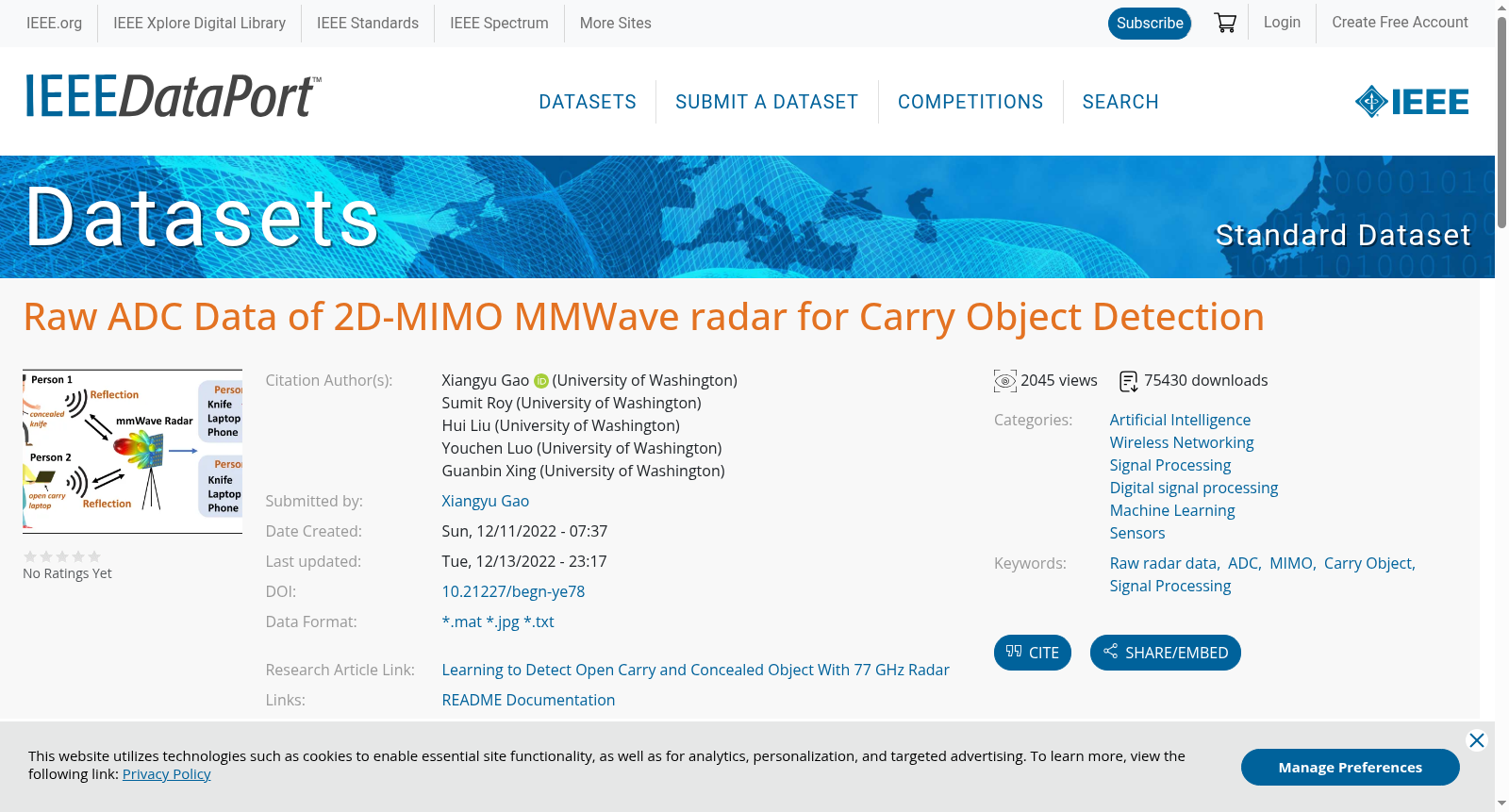
Four main object groups were used during the data collection process: phones, laptops, knives (include metallic butter knives and cutting knives), and others (e.g., keys, no object). Phones, laptops, and keys were selected as they are common objects carried by many people in their daily lives. Since the purpose of the system is safety and security and we were not able to perform data collection with other dangerous objects (e.g. firearms), knives were used as the dangerous item to be detected. The objects that were used varied in weight, size, and shape, as shown in Fig. 9. Different laptops, phones, and keys were used throughout the data collection process to increase the variability of the data set. Three subjects were involved in the data collection process, which was done in the building lobby and laboratory room with different device placement locations every time. A single data collection run consisted of a subject holding one of the four object groups listed above, and the subject would walk at a normal pace on a random path for 10 seconds in front of the testbed while either concealing or openly carrying the objects. The testbed would capture 300 frames of camera images and radar raw ADC data at 30 frames per second. To add variability to the data, the walking pattern of subjects was always randomized. Additionally, the location of where the objects were concealed or how the objects were openly carried was always changed. The data consisted of single object being openly carried and single object being concealed. The subjects performed the data runs with different clothing types - low, medium, and heavy - which corresponds to the thickness of the clothing. For example, a t-shirt would be considered low, while a jacket on top of another layer would be heavy. A total of 196500 frames (lasting 1.82 hours) were collected for a subject with single object, 99300 of those were open carry and 97200 were concealed. The detailed class distribution and location distribution for the collected dataset are described in Fig. 10. A sample dataset would be made publicly available to encourage future works The experiment test-bed (Fig. 7 left) was assembled with a TIDEP-01012 77 GHz mmWave radar [37] and binocular FLIR cameras. The binocular cameras and radar are connected to the same laptop which uses the timestamp to keep inter-sensor synchronization. The synchronization between the two cameras is achieved by joining them together with an additional cable and using the same trigger clock. The radar data collection pipeline is implemented by combining MATLAB scripts and TI software development kits (SDK) while the camera pipeline is implemented by Python scripts and FLIR SDK. Note that collected camera images are not incorporated into the system processing chain and only used for providing the visualization for experiment scenarios. The adopted mmWave radar is a 4-chip cascaded evaluation board with 12 TX antennas and 16 RX antennas (Fig. 7 right). With time-division multiplexing (TDM) on TXs, it can form a large 2D-MIMO virtual array (Fig. 8) with 192 elements via the spatial convolution of all TX and RX, resulting in fine azimuth resolution (1.35°) and additional elevation resolution (19°). The configuration of this radar is presented in Table. I. Based on those parameters and the calculation equations in [21] we can give out the capability of this radar in terms of range resolution ( c 2B = 0.06 m), max detectable range ( fsc 2S = 15 m), Doppler velocity resolution ( λ 2NcTc = 0.072 m/s), and max operating velocity ( λ 4Tc = 1.80 m/s).
创建时间:
2024-01-31
搜集汇总
数据集介绍
背景与挑战
背景概述
该数据集提供77GHz毫米波雷达的原始ADC数据,用于检测个人携带物体(如手机、笔记本电脑、刀具),包括公开和隐蔽携带场景。数据包含约3000帧雷达数据、同步相机图像和标签,采用2D-MIMO虚拟阵列技术,具有高分辨率,适用于信号处理和机器学习研究。
以上内容由遇见数据集搜集并总结生成



