The conserved clinical variation visualization tool
收藏资源简介:
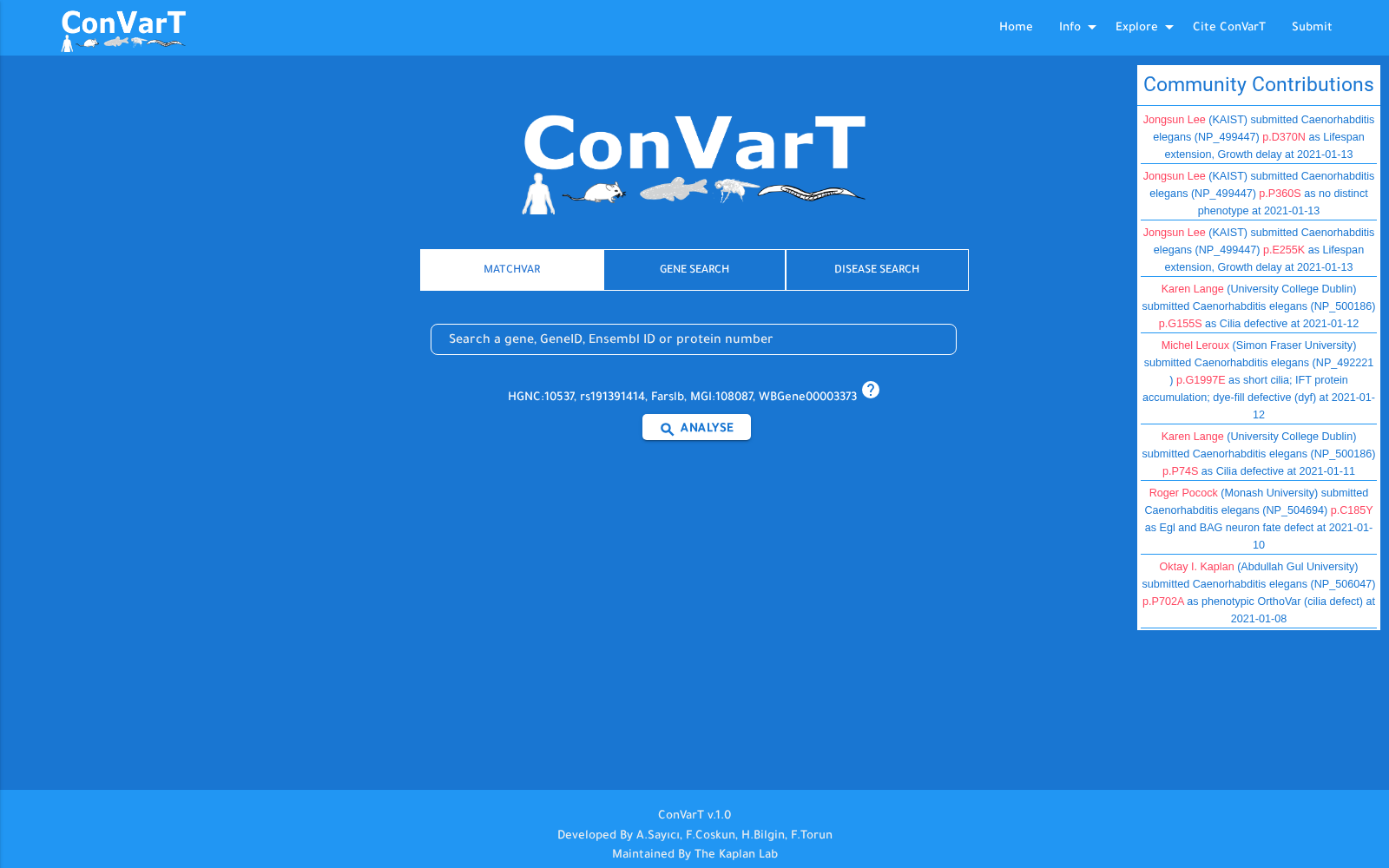
The availability of genetic variants, together with phenotypic annotations from model organisms, facilitates comparing these variants with equivalent variants in humans. However, existing databases and search tools do not make it easy to scan for equivalent variants, namely “orthologous variants,” between humans and other organisms. Therefore, we developed an integrated search engine called ConVarT (http://www.convart.org/) for orthologous variants between humans, mice, and C. elegans. ConVarT incorporates annotations (including phenotypic and pathogenic) into variants, and these previously unexploited phenotypic OrthoVars from mice and C. elegans can give clues about the functional consequence of human genetic variants. Our analysis shows that many phenotypic variants in different genes from mice and C. elegans, so far, have no counterparts in humans, and thus, can be useful resources when evaluating a relationship between a new human mutation and a disease.
现有遗传变异资源与模式生物表型注释的结合,为开展人类同源变异的比对工作提供了便利。然而,现有数据库与搜索工具难以便捷地检索人类与其他物种间的同源变异(orthologous variants)。为此,我们开发了一款集成化搜索引擎ConVarT(访问网址:http://www.convart.org/),用于检索人类、小鼠与秀丽隐杆线虫(C. elegans)之间的同源变异。ConVarT将各类注释信息(包括表型注释与致病性注释)整合至变异数据中;此前未被充分挖掘的小鼠与秀丽隐杆线虫表型同源变异数据,可为解析人类遗传变异的功能效应提供重要线索。我们的分析表明,目前小鼠与秀丽隐杆线虫中多数基因的表型变异在人类中尚无对应同源变异,因此在评估新型人类突变与疾病的关联时,这类数据可作为极具价值的参考资源。