全球典型海洋漂浮物全谱段辐亮度与信噪比源始数据与图示
收藏资源简介:
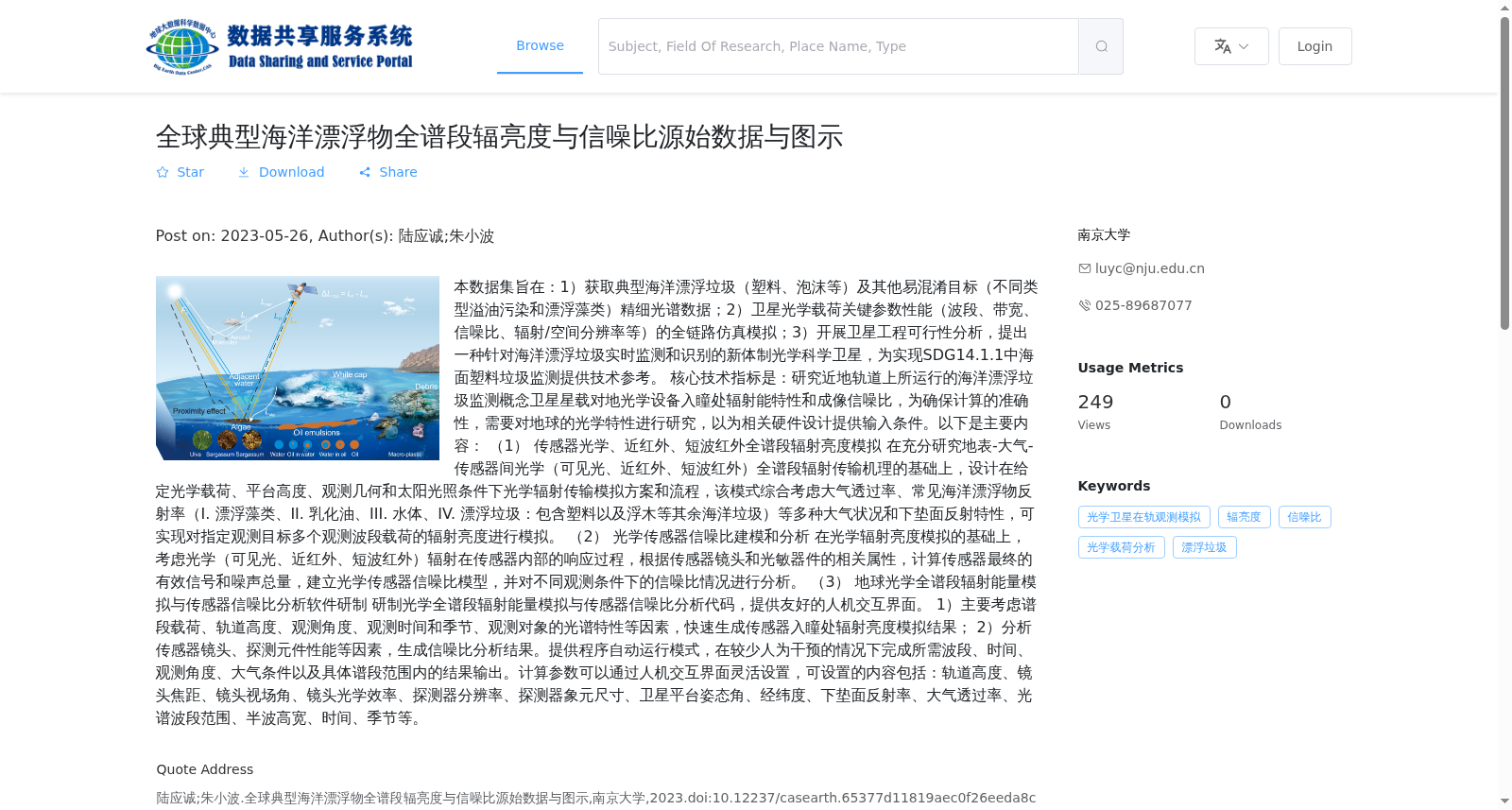
本数据集旨在:1)获取典型海洋漂浮垃圾(塑料、泡沫等)及其他易混淆目标(不同类型溢油污染和漂浮藻类)精细光谱数据;2)卫星光学载荷关键参数性能(波段、带宽、信噪比、辐射/空间分辨率等)的全链路仿真模拟;3)开展卫星工程可行性分析,提出一种针对海洋漂浮垃圾实时监测和识别的新体制光学科学卫星,为实现SDG14.1.1中海面塑料垃圾监测提供技术参考。 核心技术指标是:研究近地轨道上所运行的海洋漂浮垃圾监测概念卫星星载对地光学设备入瞳处辐射能特性和成像信噪比,为确保计算的准确性,需要对地球的光学特性进行研究,以为相关硬件设计提供输入条件。以下是主要内容: (1) 传感器光学、近红外、短波红外全谱段辐射亮度模拟 在充分研究地表-大气-传感器间光学(可见光、近红外、短波红外)全谱段辐射传输机理的基础上,设计在给定光学载荷、平台高度、观测几何和太阳光照条件下光学辐射传输模拟方案和流程,该模式综合考虑大气透过率、常见海洋漂浮物反射率(I. 漂浮藻类、II. 乳化油、III. 水体、IV. 漂浮垃圾:包含塑料以及浮木等其余海洋垃圾)等多种大气状况和下垫面反射特性,可实现对指定观测目标多个观测波段载荷的辐射亮度进行模拟。 (2) 光学传感器信噪比建模和分析 在光学辐射亮度模拟的基础上,考虑光学(可见光、近红外、短波红外)辐射在传感器内部的响应过程,根据传感器镜头和光敏器件的相关属性,计算传感器最终的有效信号和噪声总量,建立光学传感器信噪比模型,并对不同观测条件下的信噪比情况进行分析。 (3) 地球光学全谱段辐射能量模拟与传感器信噪比分析软件研制 研制光学全谱段辐射能量模拟与传感器信噪比分析代码,提供友好的人机交互界面。 1)主要考虑谱段载荷、轨道高度、观测角度、观测时间和季节、观测对象的光谱特性等因素,快速生成传感器入瞳处辐射亮度模拟结果; 2)分析传感器镜头、探测元件性能等因素,生成信噪比分析结果。提供程序自动运行模式,在较少人为干预的情况下完成所需波段、时间、观测角度、大气条件以及具体谱段范围内的结果输出。计算参数可以通过人机交互界面灵活设置,可设置的内容包括:轨道高度、镜头焦距、镜头视场角、镜头光学效率、探测器分辨率、探测器象元尺寸、卫星平台姿态角、经纬度、下垫面反射率、大气透过率、光谱波段范围、半波高宽、时间、季节等。
This dataset aims to: 1) Acquire high-precision spectral data of typical marine floating debris (plastic, foam, etc.) and other easily confused targets (various types of oil spill pollution and floating algae); 2) Perform full-link simulation of key performance parameters of satellite optical payloads (including bands, bandwidth, signal-to-noise ratio (SNR), radiometric and spatial resolution, etc.); 3) Conduct satellite engineering feasibility analysis, and propose a new-concept optical scientific satellite for real-time monitoring and identification of marine floating debris, providing technical references for realizing the monitoring of sea surface plastic waste specified in SDG14.1.1. The core technical indicators are: Study the radiant energy characteristics at the entrance pupil of the on-board earth-facing optical equipment of the conceptual marine floating debris monitoring satellite operating in Low Earth Orbit (LEO) and its imaging SNR. To ensure the accuracy of calculations, it is necessary to research the optical characteristics of the Earth, so as to provide input conditions for the design of relevant hardware. The main contents are as follows: 1. Full-spectral-range radiance simulation for sensor optical, near-infrared, and short-wave infrared bands Based on in-depth research on the full-spectral-range (visible light, near-infrared, short-wave infrared) radiative transfer mechanism between the Earth's surface, atmosphere and sensor, design a radiative transfer simulation scheme and process for optical payloads under given conditions including payload parameters, platform altitude, observation geometry and solar illumination conditions. This model comprehensively considers multiple atmospheric conditions and underlying surface reflection characteristics such as atmospheric transmittance, reflectance of common marine floating objects (I. floating algae, II. emulsified oil, III. water body, IV. floating debris including plastic, driftwood and other marine waste), and can realize the radiance simulation of payloads in multiple observation bands for specified target objects. 2. Optical sensor SNR modeling and analysis Based on the optical radiance simulation, consider the response process of optical (visible, near-infrared, short-wave infrared) radiation inside the sensor, calculate the total effective signal and noise of the sensor according to the relevant attributes of the sensor lens and photosensitive devices, establish an optical sensor SNR model, and analyze the SNR performance under different observation conditions. 3. Development of software for Earth full-spectral-range radiative energy simulation and sensor SNR analysis Develop the code for optical full-spectral-range radiative energy simulation and sensor SNR analysis, and provide a user-friendly human-computer interaction (HCI) interface. 1) Mainly consider factors such as payload spectral range, orbit altitude, observation angle, observation time and season, and spectral characteristics of observation objects, and quickly generate radiance simulation results at the sensor entrance pupil; 2) Analyze factors such as sensor lens and detector element performance to generate SNR analysis results. Provide an automatic program operation mode to complete the output of results within the required bands, time, observation angle, atmospheric conditions and specific spectral ranges with minimal human intervention. Calculation parameters can be flexibly set through the HCI interface, including: orbit altitude, lens focal length, lens field of view (FOV), lens optical efficiency, detector resolution, detector pixel size, satellite platform attitude angle, latitude and longitude, underlying surface reflectance, atmospheric transmittance, spectral band range, full width at half maximum (FWHM), time, season, etc.