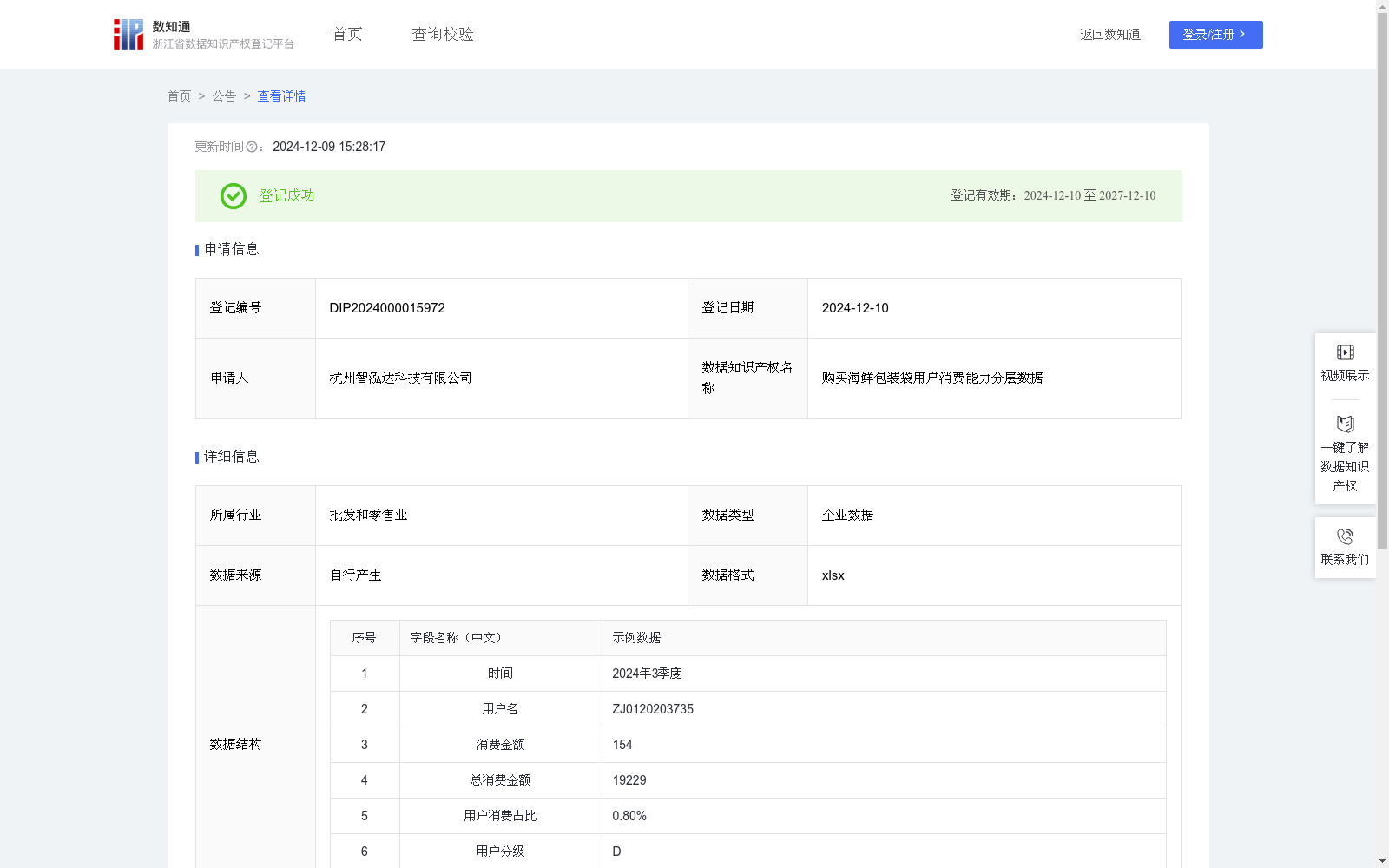
购买海鲜包装袋用户消费能力分层数据
收藏资源简介:
统计分析海鲜包装袋消费数据,通过对历史下单用户画像建立,对用户进行标签制定,定位用户消费级别,可以为不同区域产品周转仓的设立以及消费者广告营销策略提供数据支持。1、采集各季度各个用户购买海鲜包装袋的金额等数据。2、数据加工:当季总消费金额为各个用户购买海鲜包装袋的金额之和,用户消费占比(%)=消费金额/总消费金额*100%。3、用户消费能力运用ABCDEF分类法,对消费占比≥3%的,给予“A”用户分级;消费占比≥2%不足3%的,给予“B”用户分级;消费占比≥1%不足2%区间的,给予“C”用户分级;消费占比≥0.5%不足1%区间的,给予“D”用户分级;消费占比≥0.1%不足0.5%区间的,给予“E”用户分级;消费占比<0.1%的,给予“F”用户分级。
This dataset conducts statistical analysis on consumption data for seafood packaging bags. By establishing user profiles of historical purchasers, labeling users and classifying their consumption tiers, it provides data support for the setup of regional product turnover warehouses and the development of consumer advertising and marketing strategies. 1. Data Collection: Collect data including the purchase amount of seafood packaging bags per user in each quarter. 2. Data Processing: The total quarterly consumption amount is the sum of the purchase amounts of seafood packaging bags made by all users. The user's consumption share (%) = (consumption amount / total quarterly consumption amount) × 100%. 3. Consumption Capability Classification: Adopt the ABCDEF classification framework. Users with a consumption share of ≥ 3% are categorized as Level A; those with a consumption share ≥ 2% but less than 3% are categorized as Level B; those with a consumption share ≥ 1% but less than 2% are categorized as Level C; those with a consumption share ≥ 0.5% but less than 1% are categorized as Level D; those with a consumption share ≥ 0.1% but less than 0.5% are categorized as Level E; and those with a consumption share less than 0.1% are categorized as Level F.