
achinthani/emotions-new
收藏Hugging Face2024-03-14 更新2024-06-11 收录
下载链接:
https://hf-mirror.com/datasets/achinthani/emotions-new
下载链接
链接失效反馈官方服务:
资源简介:
---
size_categories: n<1K
tags:
- rlfh
- argilla
- human-feedback
---
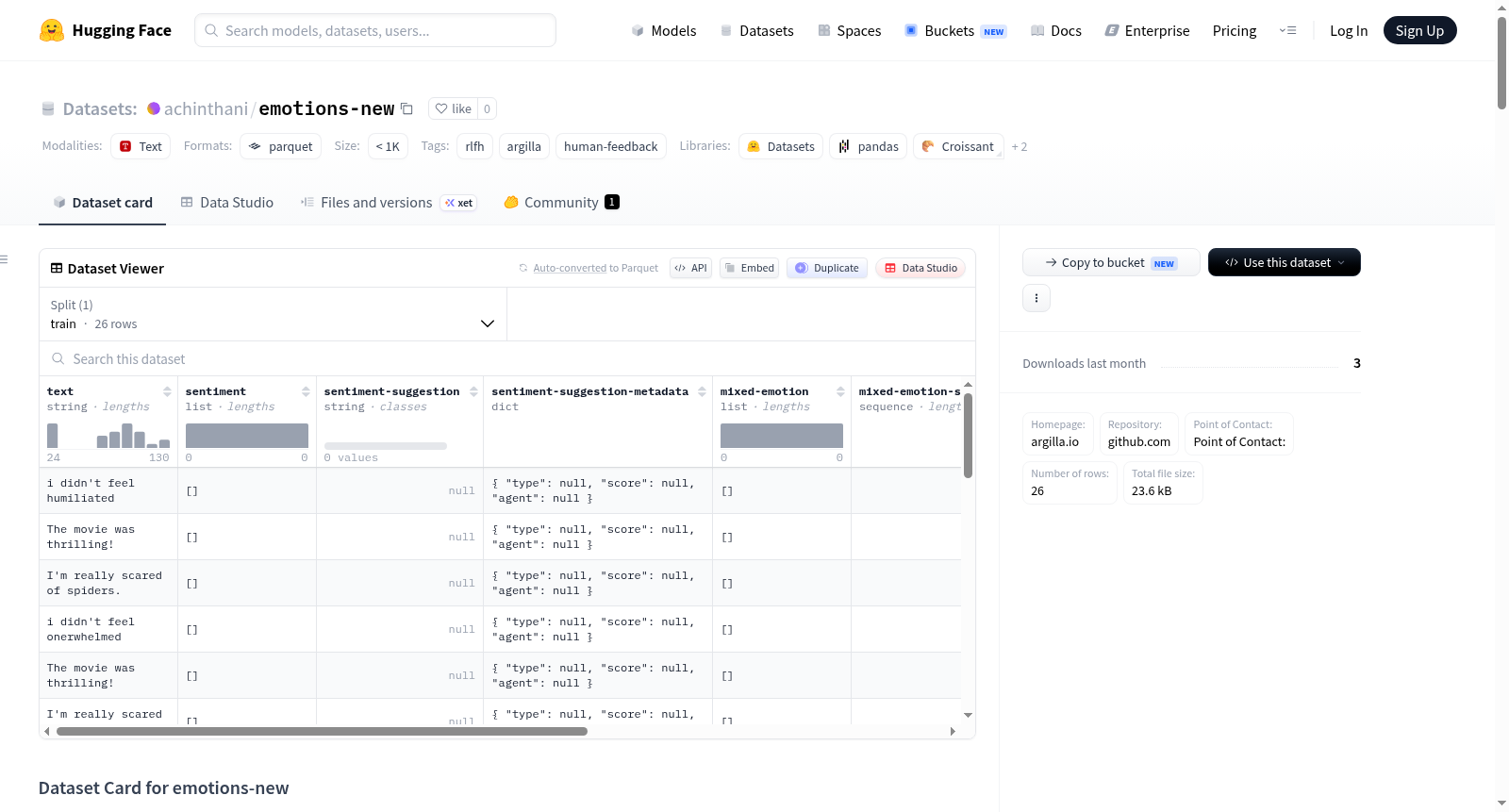
# Dataset Card for emotions-new
This dataset has been created with [Argilla](https://docs.argilla.io).
As shown in the sections below, this dataset can be loaded into Argilla as explained in [Load with Argilla](#load-with-argilla), or used directly with the `datasets` library in [Load with `datasets`](#load-with-datasets).
## Dataset Description
- **Homepage:** https://argilla.io
- **Repository:** https://github.com/argilla-io/argilla
- **Paper:**
- **Leaderboard:**
- **Point of Contact:**
### Dataset Summary
This dataset contains:
* A dataset configuration file conforming to the Argilla dataset format named `argilla.yaml`. This configuration file will be used to configure the dataset when using the `FeedbackDataset.from_huggingface` method in Argilla.
* Dataset records in a format compatible with HuggingFace `datasets`. These records will be loaded automatically when using `FeedbackDataset.from_huggingface` and can be loaded independently using the `datasets` library via `load_dataset`.
* The [annotation guidelines](#annotation-guidelines) that have been used for building and curating the dataset, if they've been defined in Argilla.
### Load with Argilla
To load with Argilla, you'll just need to install Argilla as `pip install argilla --upgrade` and then use the following code:
```python
import argilla as rg
ds = rg.FeedbackDataset.from_huggingface("achinthani/emotions-new")
```
### Load with `datasets`
To load this dataset with `datasets`, you'll just need to install `datasets` as `pip install datasets --upgrade` and then use the following code:
```python
from datasets import load_dataset
ds = load_dataset("achinthani/emotions-new")
```
### Supported Tasks and Leaderboards
This dataset can contain [multiple fields, questions and responses](https://docs.argilla.io/en/latest/conceptual_guides/data_model.html#feedback-dataset) so it can be used for different NLP tasks, depending on the configuration. The dataset structure is described in the [Dataset Structure section](#dataset-structure).
There are no leaderboards associated with this dataset.
### Languages
[More Information Needed]
## Dataset Structure
### Data in Argilla
The dataset is created in Argilla with: **fields**, **questions**, **suggestions**, **metadata**, **vectors**, and **guidelines**.
The **fields** are the dataset records themselves, for the moment just text fields are supported. These are the ones that will be used to provide responses to the questions.
| Field Name | Title | Type | Required | Markdown |
| ---------- | ----- | ---- | -------- | -------- |
| text | Text | text | True | False |
The **questions** are the questions that will be asked to the annotators. They can be of different types, such as rating, text, label_selection, multi_label_selection, or ranking.
| Question Name | Title | Type | Required | Description | Values/Labels |
| ------------- | ----- | ---- | -------- | ----------- | ------------- |
| sentiment | Sentiment | label_selection | True | N/A | ['positive', 'neutral', 'negative'] |
| mixed-emotion | Mixed-emotion | multi_label_selection | True | N/A | ['joy', 'anger', 'sadness', 'fear', 'surprise', 'love'] |
The **suggestions** are human or machine generated recommendations for each question to assist the annotator during the annotation process, so those are always linked to the existing questions, and named appending "-suggestion" and "-suggestion-metadata" to those, containing the value/s of the suggestion and its metadata, respectively. So on, the possible values are the same as in the table above, but the column name is appended with "-suggestion" and the metadata is appended with "-suggestion-metadata".
The **metadata** is a dictionary that can be used to provide additional information about the dataset record. This can be useful to provide additional context to the annotators, or to provide additional information about the dataset record itself. For example, you can use this to provide a link to the original source of the dataset record, or to provide additional information about the dataset record itself, such as the author, the date, or the source. The metadata is always optional, and can be potentially linked to the `metadata_properties` defined in the dataset configuration file in `argilla.yaml`.
| Metadata Name | Title | Type | Values | Visible for Annotators |
| ------------- | ----- | ---- | ------ | ---------------------- |
The **guidelines**, are optional as well, and are just a plain string that can be used to provide instructions to the annotators. Find those in the [annotation guidelines](#annotation-guidelines) section.
### Data Instances
An example of a dataset instance in Argilla looks as follows:
```json
{
"external_id": null,
"fields": {
"text": "i didn\u0027t feel humiliated"
},
"metadata": {},
"responses": [],
"suggestions": [],
"vectors": {}
}
```
While the same record in HuggingFace `datasets` looks as follows:
```json
{
"external_id": null,
"metadata": "{}",
"mixed-emotion": [],
"mixed-emotion-suggestion": null,
"mixed-emotion-suggestion-metadata": {
"agent": null,
"score": null,
"type": null
},
"sentiment": [],
"sentiment-suggestion": null,
"sentiment-suggestion-metadata": {
"agent": null,
"score": null,
"type": null
},
"text": "i didn\u0027t feel humiliated"
}
```
### Data Fields
Among the dataset fields, we differentiate between the following:
* **Fields:** These are the dataset records themselves, for the moment just text fields are supported. These are the ones that will be used to provide responses to the questions.
* **text** is of type `text`.
* **Questions:** These are the questions that will be asked to the annotators. They can be of different types, such as `RatingQuestion`, `TextQuestion`, `LabelQuestion`, `MultiLabelQuestion`, and `RankingQuestion`.
* **sentiment** is of type `label_selection` with the following allowed values ['positive', 'neutral', 'negative'].
* **mixed-emotion** is of type `multi_label_selection` with the following allowed values ['joy', 'anger', 'sadness', 'fear', 'surprise', 'love'].
* **Suggestions:** As of Argilla 1.13.0, the suggestions have been included to provide the annotators with suggestions to ease or assist during the annotation process. Suggestions are linked to the existing questions, are always optional, and contain not just the suggestion itself, but also the metadata linked to it, if applicable.
* (optional) **sentiment-suggestion** is of type `label_selection` with the following allowed values ['positive', 'neutral', 'negative'].
* (optional) **mixed-emotion-suggestion** is of type `multi_label_selection` with the following allowed values ['joy', 'anger', 'sadness', 'fear', 'surprise', 'love'].
Additionally, we also have two more fields that are optional and are the following:
* **metadata:** This is an optional field that can be used to provide additional information about the dataset record. This can be useful to provide additional context to the annotators, or to provide additional information about the dataset record itself. For example, you can use this to provide a link to the original source of the dataset record, or to provide additional information about the dataset record itself, such as the author, the date, or the source. The metadata is always optional, and can be potentially linked to the `metadata_properties` defined in the dataset configuration file in `argilla.yaml`.
* **external_id:** This is an optional field that can be used to provide an external ID for the dataset record. This can be useful if you want to link the dataset record to an external resource, such as a database or a file.
### Data Splits
The dataset contains a single split, which is `train`.
## Dataset Creation
### Curation Rationale
[More Information Needed]
### Source Data
#### Initial Data Collection and Normalization
[More Information Needed]
#### Who are the source language producers?
[More Information Needed]
### Annotations
#### Annotation guidelines
Emotion is a dataset of English Twitter messages with six basic emotions: anger, fear, joy, love, sadness, and surprise.
#### Annotation process
[More Information Needed]
#### Who are the annotators?
[More Information Needed]
### Personal and Sensitive Information
[More Information Needed]
## Considerations for Using the Data
### Social Impact of Dataset
[More Information Needed]
### Discussion of Biases
[More Information Needed]
### Other Known Limitations
[More Information Needed]
## Additional Information
### Dataset Curators
[More Information Needed]
### Licensing Information
[More Information Needed]
### Citation Information
[More Information Needed]
### Contributions
[More Information Needed]
提供机构:
achinthani原始信息汇总
数据集概述
数据集名称
- 名称: emotions-new
数据集描述
- 配置文件: 包含一个名为
argilla.yaml的配置文件,符合Argilla数据集格式。 - 记录格式: 数据集记录与HuggingFace
datasets兼容,可通过FeedbackDataset.from_huggingface方法自动加载。 - 标注指南: 提供标注指南,用于构建和整理数据集。
数据集加载
-
使用Argilla加载: python import argilla as rg ds = rg.FeedbackDataset.from_huggingface("achinthani/emotions-new")
-
使用
datasets加载: python from datasets import load_dataset ds = load_dataset("achinthani/emotions-new")
数据集结构
- 字段: 仅支持文本字段。
- text:文本类型,必填。
- 问题: 用于标注者回答的问题,包括不同类型。
- sentiment:标签选择类型,必填,允许值为[positive, neutral, negative]。
- mixed-emotion:多标签选择类型,必填,允许值为[joy, anger, sadness, fear, surprise, love]。
- 建议: 提供给标注者的建议,与问题关联。
- sentiment-suggestion:可选,标签选择类型,允许值同sentiment。
- mixed-emotion-suggestion:可选,多标签选择类型,允许值同mixed-emotion。
- 元数据: 提供额外信息,如数据来源等,可选。
- 外部ID: 提供外部ID,可选。
数据集实例
- Argilla格式实例: 包含文本字段和元数据。
- HuggingFace
datasets格式实例: 包含文本字段、元数据和问题响应。
数据集使用
- 支持任务: 可用于多种NLP任务,具体取决于配置。
- 语言: 待补充信息。
- 数据分割: 包含单一分割,即
train。
搜集汇总
数据集介绍
构建方式
该数据集基于Argilla平台构建,旨在为情感分析任务提供高质量的人工反馈数据。其构建过程遵循Argilla的FeedbackDataset格式,通过定义字段(fields)、问题(questions)和可选的建议(suggestions)来组织数据。字段部分仅包含文本类型,用于记录情感表达;问题部分则设计了两个维度:一是单标签的‘情感倾向’(sentiment),涵盖积极、中立和消极三类;二是多标签的‘混合情绪’(mixed-emotion),涵盖喜悦、愤怒、悲伤、恐惧、惊讶和爱六种基本情绪。此外,数据集还整合了元数据(metadata)和外部标识(external_id),以增强记录的上下文信息。最终,数据以HuggingFace datasets兼容的格式存储,便于直接加载使用。
特点
该数据集的核心特点在于其灵活的双层情感标注体系,既捕捉宏观的情感极性(积极、中立、消极),又深入挖掘微观的混合情绪成分,从而实现对情感表达的精细化理解。数据规模虽小(不足1000条),但每条记录均支持可选的建议字段,可引入人工或机器生成的标注建议,辅助标注流程并提升一致性。此外,数据集与Argilla平台深度集成,允许用户通过简单的API调用直接加载并配置标注界面,同时保留了独立的HuggingFace datasets加载方式,兼顾了专业标注工具的使用便捷性与通用数据集库的兼容性。
使用方法
使用者可通过两种途径加载该数据集。若需借助Argilla平台进行交互式标注或审查,可安装Argilla库后调用`rg.FeedbackDataset.from_huggingface('achinthani/emotions-new')`,此时数据集将自动加载其配置文件(argilla.yaml)及记录,并直接映射至Argilla的标注界面中。若仅需将数据用于模型训练或分析,则可使用HuggingFace datasets库,通过`load_dataset('achinthani/emotions-new')`加载,返回的数据集包含单一训练集(train),每条记录包含文本字段、情感与混合情绪的空响应列表以及可选的建议字段,便于后续根据任务需求进行数据提取与处理。
背景与挑战
背景概述
情感分析作为自然语言处理领域的核心任务,长久以来致力于从文本中精准捕捉人类复杂的情感状态。在此背景下,由Argilla团队创建的achinthani/emotions-new数据集于近期发布,旨在为细粒度情感识别提供高质量的标注资源。该数据集聚焦于英文社交媒体文本,特别是Twitter消息,涵盖了六种基本情感类别:愤怒、恐惧、喜悦、爱、悲伤与惊讶,并进一步区分了积极、中性和消极三种宏观情感倾向。通过引入Argilla平台的人类反馈机制,数据集不仅提供了多标签情感标注,还融入了注释指南与建议机制,显著提升了标注的可靠性与可扩展性。其设计支持多种自然语言处理任务,为情感分析、多标签分类及人机协同标注研究提供了新的基准,对推动情感计算领域的发展具有重要价值。
当前挑战
该数据集面临的核心挑战之一在于情感分类的固有模糊性,例如‘爱’与‘喜悦’在语义上存在重叠,多标签标注中难以精确界定边界,可能导致标注不一致。构建过程中,由于数据来源于Twitter,文本长度短、上下文缺失、网络用语及表情符号的频繁使用,增加了情感解读的难度。此外,数据集的规模较小(少于1000条记录),限制了模型训练的充分性与泛化能力,容易引发过拟合问题。注释过程依赖人工反馈,但缺乏对注释者间一致性的系统评估,可能引入主观偏差。同时,数据集未明确处理文化差异与情感表达的多样性,例如同一词语在不同社群中可能承载迥异的情感色彩,这对跨领域应用构成了潜在障碍。
常用场景
经典使用场景
在自然语言处理的情感计算领域,achinthani/emotions-new数据集被广泛用于细粒度情绪分类任务。其独特的双层标注架构——既包含粗粒度的情感倾向(积极、中性、消极)又涵盖六种基本情绪的多元标签——使得研究者能够同时探索情绪的极性维度和离散类别维度。该数据集特别适用于构建多标签情绪识别模型,以及验证从文本中同时捕捉显性情感倾向与隐性混合情绪(如悲喜交加)的算法有效性。其通过Argilla平台收集的人类反馈标注,确保了标签质量,为情绪分析提供了可靠的基准测试资源。
实际应用
在实际应用中,该数据集支撑着多个关键场景的算法开发。社交媒体舆情监控系统可借助其标注框架,同时识别用户帖子的整体情感倾向和具体情绪类型(如愤怒、恐惧),从而更精准地发现危机信号。智能客服系统利用混合情绪标注能力,可理解用户投诉中夹杂的失望与愤怒交织的复杂情感,进而优化回应策略。此外,心理健康监测应用可通过分析用户文本中的情绪组合(如喜悦中隐含悲伤),辅助早期情绪障碍的筛查与干预。
衍生相关工作
该数据集衍生出多项具有影响力的研究工作。在模型架构方面,研究者提出了基于注意力机制的多任务学习框架,同时预测情感极性和多标签情绪,实现了特征共享与任务协同优化。在标注策略层面,基于该数据集的反馈数据,催生了利用主动学习减少人工标注成本的方法,以及通过一致性正则化融合人工与机器建议的半监督学习范式。此外,该数据集还推动了情绪标签层次化建模的研究,例如构建情感极性与情绪类别的层次分类树,提升了模型对模糊情感样本的判别能力。
以上内容由遇见数据集搜集并总结生成


