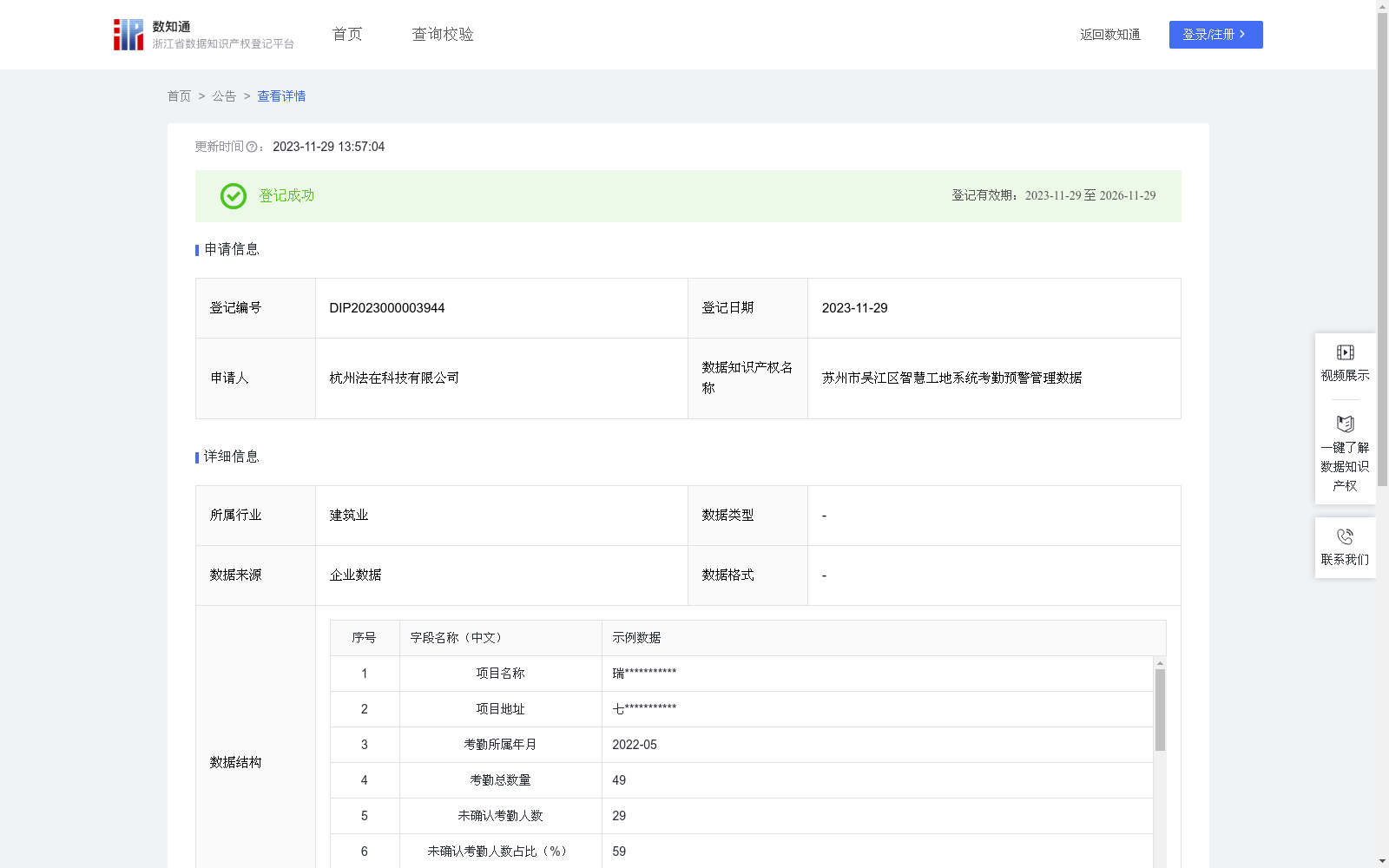
苏州市吴江区智慧工地系统考勤预警管理数据
收藏资源简介:
采集苏州市吴江区范围内考勤信息线下通过设备和手动录入的方式采集数据到数据库作为原始数据源。最后通过BI工具,按区域工种进行分类统计,利用折线图体现每个地区工种的考勤风险走势情况。推送给班组长、企业、劳务公司、监管部门。(1)数据采集:采集苏州市吴江区范围内考勤信息线下通过设备和手动录入的方式采集数据到数据库作为原始数据源。(2)数据处理:首先对采集的考勤数据进行清洗,包括考勤数量为0的或者为null的。然后对数据在时间维度按日,项目维度按企业,区域维度按区域,进行最细级别粒度的聚合。计算得到各工地的考勤确认总数量为X,未确认考勤人数/X=未确认人数在总考勤数中的占比, 待处理数为已经采集且并未介入处理数, 已处理数为已经开始处理的数量,已完成数为已经确认考勤的数量,超时未处理数为超时未处理数指超过1天未处理数,缺勤考勤人数/X=缺勤考勤人数在总考勤数中的占比,补卡考勤人数/X=补卡考勤人数在总考勤数中的占比。(3)数据分析: 低危风险数=企业待处理数低于总比10%且超时未处理数低于5%,中危风险数=企业待处理数低于总比20%且超时未处理数低于10%,高危风险数=企业待处理数低于总比30%且超时未处理数低于15%。
This dataset is constructed as follows: The original data source is obtained by collecting attendance information within Wujiang District, Suzhou City, via on-site device recording and manual entry, which are then stored in a database. Subsequently, business intelligence (BI) tools are used to conduct classified statistics based on regions and job types, and line charts are employed to visualize the attendance risk trends of job types in each region. The analysis results are delivered to team leaders, enterprises, labor service companies, and regulatory authorities. 1. Data Collection: Attendance information within Wujiang District, Suzhou City, is collected through on-site device recording and manual entry, then stored in a database as the original data source. 2. Data Processing: First, clean the collected attendance data, including removing or validating records with zero or null attendance counts. Next, perform granular aggregation at the finest level: by day in the time dimension, by enterprise in the project dimension, and by region in the regional dimension. Calculate the following core metrics: - Total confirmed attendance count for each construction site, denoted as X; - Proportion of unconfirmed attendance personnel in total attendance: (unconfirmed attendance personnel / X); - Pending processing count: number of collected records that have not yet entered the processing workflow; - Processed count: number of records that have initiated the processing procedure; - Completed count: number of records with confirmed attendance status; - Overdue unprocessed count: records that have not been processed for more than 1 consecutive day; - Proportion of absent attendance personnel in total attendance: (absent attendance personnel / X); - Proportion of reissued attendance personnel in total attendance: (reissued attendance personnel / X); 3. Data Analysis: Classify enterprises into three risk tiers based on the above metrics: - Low-risk enterprises: Enterprises where the proportion of pending processing records in the total is less than 10%, and the proportion of overdue unprocessed records in the total is less than 5%; - Medium-risk enterprises: Enterprises where the proportion of pending processing records in the total is less than 20%, and the proportion of overdue unprocessed records in the total is less than 10%; - High-risk enterprises: Enterprises where the proportion of pending processing records in the total is less than 30%, and the proportion of overdue unprocessed records in the total is less than 15%;