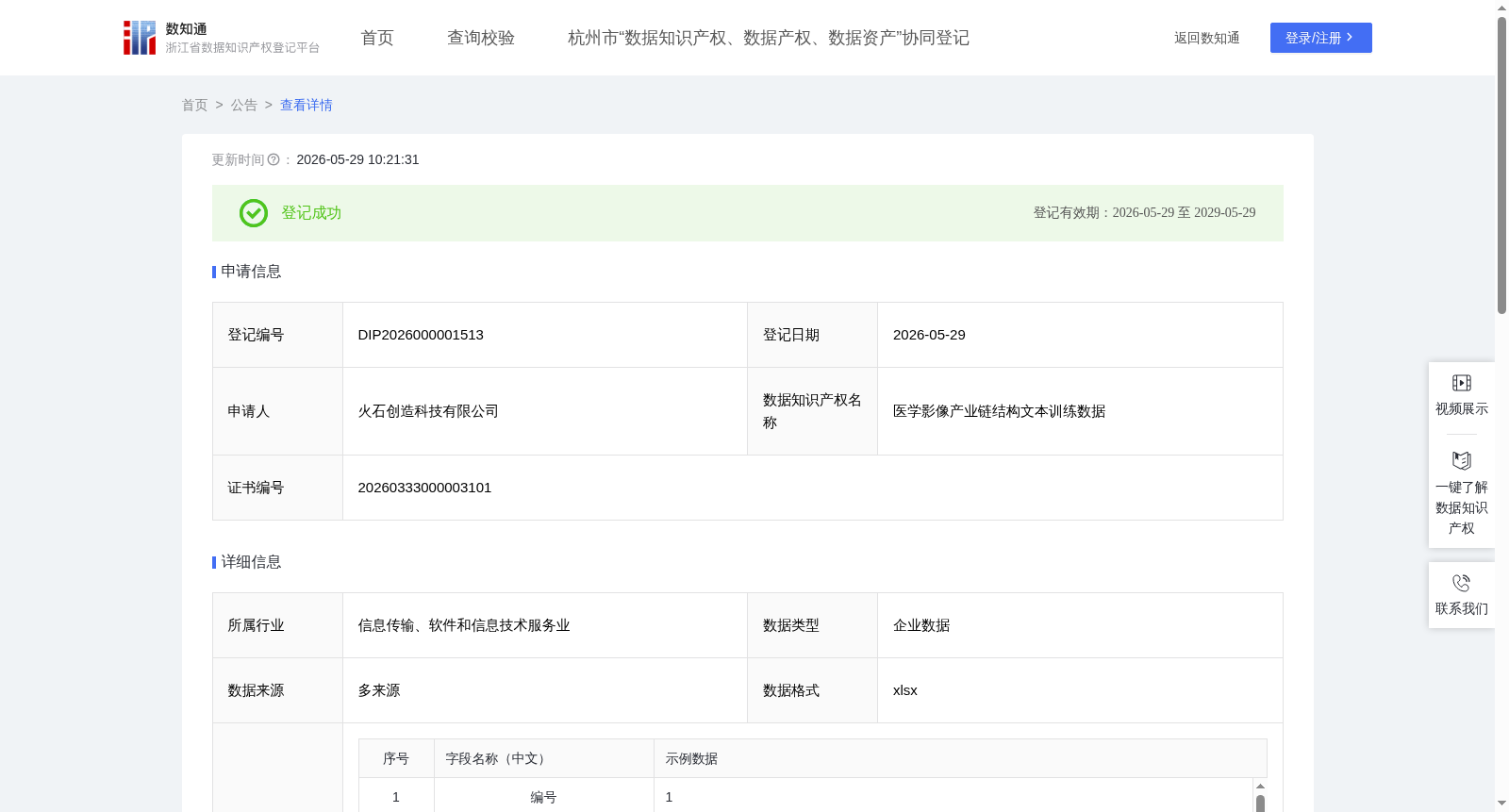
医学影像产业链结构文本训练数据
收藏资源简介:
本数据集服务于医学影像产业链智能分类与产业图谱构建模型的训练与开发,通过关联企业文本与影像设备分类标签,为医疗设备产业分析提供核心数据工具。其主要应用于:设备采购与供应商管理:赋能医院、影像中心及医疗集团,精准识别与匹配X射线、超声、内窥镜、核素成像等各类影像设备的研发制造商、代理商及服务商,优化采购决策与供应链管理。产业布局与技术监测:辅助政府与产业研究机构,分析区域在高端影像设备(如CT、MRI、PET)、超声诊断、内窥镜等细分领域的研发布局、技术集中度与产业链完整性。 投资价值与竞争分析:支持投资机构与行业分析师,对不同技术路线(如光学内窥镜vs电子内窥镜、移动式X线机vs固定式)的企业分布、市场份额及研发动态进行量化跟踪。一、加工前数据说明 本数据集旨在构建用于医学影像产业链智能分析的人工智能模型训练语料。在加工前,数据已进行严格的匿名化与去标识化处理。原始企业名称被统一替换为不可逆的规范标识符,并彻底移除所有的个人及商业敏感信息,确保数据完全符合隐私保护与安全合规要求,为模型训练提供了洁净、可靠的输入基础。 二、数据处理规则 数据处理严格遵循 “体系先行、业务匹配、特征抽取” 的核心规则,形成了一套从分类框架构建到最终标签生成的完整流程:1.首先,依据国家《医疗器械分类目录》及医学影像专业分类标准,预先定义了从“医学影像”(一级节点)出发,按成像原理划分为“医用X射线”、“超声”、“内窥镜”、“放射性核素成像”等二级节点,并进一步细分为“诊断X射线机”、“超声诊断设备”、“光学内窥镜”等产品类型(三级节点)及“摄影X射线机”、“超声耦合剂”等具体品类(四级节点)的树状分类体系,为数据加工提供了专业、严谨的结构化框架。2.业务匹配:采用“自动化规则匹配与人工校验相结合”的策略。首先,依托Spark大数据处理框架,对海量企业简介文本进行分布式清洗、分词与关键词匹配,通过预构建的医学影像产业语义规则库自动计算并推荐初步分类节点。随后,由具备医疗行业知识的标注专家进行审核与最终判定,确保企业归入最贴切的影像设备类型与产业链节点。3.特征抽取:在完成业务匹配的同时,从同一段企业简介文本中,系统性地抽取代表其核心产品与技术的关键术语与名词性短语,经过去重与标准化格式化,组合成“正向词”特征串,作为对分类标签的语义补充。 三、加工后数据内容 加工后的数据集为一条条结构化的“文本-标签”数据。每条数据均包含经过脱敏处理的原始企业描述文本,以及与之对应、经人工校验的完整分类标签(一至四级节点)、精准提炼的业务特征词(正向词)与产业标签。数据内容全面覆盖了X射线诊断设备、超声影像设备、内窥镜系统、核医学成像设备等医学影像核心领域,形成了一个分类体系专业、技术指向明确、可直接用于医学影像设备分类、供应商能力评估、技术路线分析等模型训练与评估的高质量专用数据集。
This dataset serves the training and development of intelligent classification and industrial knowledge graph construction models for the medical imaging industry chain, providing a core data tool for medical equipment industry analysis by associating enterprise texts with imaging equipment classification labels. Its main applications are as follows: 1. Equipment Procurement and Supplier Management: Empower hospitals, imaging centers and medical groups to accurately identify and match R&D manufacturers, agents and service providers of various imaging equipment such as X-ray, ultrasound, endoscopy, radionuclide imaging, etc., so as to optimize procurement decision-making and supply chain management. 2. Industrial Layout and Technology Monitoring: Assist governments and industrial research institutions in analyzing the R&D layout, technology concentration and industrial chain integrity of regions in segmented fields such as high-end imaging equipment (e.g., CT, MRI, PET), ultrasound diagnosis, endoscopy, etc. 3. Investment Value and Competitive Analysis: Support investment institutions and industry analysts to quantitatively track the enterprise distribution, market share and R&D dynamics of enterprises with different technical routes (e.g., optical endoscopy vs. electronic endoscopy, mobile X-ray machine vs. fixed X-ray machine). I. Pre-processing Data Description This dataset is intended to build AI model training corpora for intelligent analysis of the medical imaging industry chain. Before processing, the data has undergone strict anonymization and de-identification processing. Original enterprise names are uniformly replaced with irreversible standardized identifiers, and all personal and commercial sensitive information is completely removed, ensuring that the data fully complies with privacy protection and security compliance requirements, providing a clean and reliable input basis for model training. II. Data Processing Rules The data processing strictly follows the core rules of "system first, business matching, feature extraction", forming a complete process from classification framework construction to final label generation: 1. First, based on the National Medical Device Classification Catalogue and professional medical imaging classification standards, a tree-like classification system is pre-defined, starting from "Medical Imaging" (first-level node), divided into second-level nodes such as "Medical X-ray", "Ultrasound", "Endoscopy", "Radionuclide Imaging" according to imaging principles, and further subdivided into product types (third-level nodes) such as "Diagnostic X-ray Machine", "Ultrasound Diagnostic Equipment", "Optical Endoscopy", and specific categories (fourth-level nodes) such as "Radiographic X-ray Machine", "Ultrasound Coupling Agent", providing a professional and rigorous structured framework for data processing. 2. Business Matching: Adopt a strategy combining "automated rule matching and manual verification". First, relying on the Spark big data processing framework, perform distributed cleaning, word segmentation and keyword matching on massive enterprise profile texts, and automatically calculate and recommend preliminary classification nodes through the pre-built semantic rule base of the medical imaging industry. Subsequently, annotation experts with medical industry knowledge conduct review and final determination to ensure that enterprises are classified into the most appropriate imaging equipment types and industrial chain nodes. 3. Feature Extraction: While completing business matching, systematically extract key terms and noun phrases representing their core products and technologies from the same enterprise profile text, and combine them into "positive word" feature strings after deduplication and standardized formatting, as semantic supplements to the classification labels. III. Post-processing Data Content The processed dataset is structured "text-label" data entries. Each entry includes the desensitized original enterprise description text, as well as the corresponding manually verified complete classification labels (first to fourth-level nodes), accurately extracted business feature words (positive words) and industrial labels. The data content comprehensively covers core medical imaging fields such as X-ray diagnostic equipment, ultrasound imaging equipment, endoscopy systems, nuclear medicine imaging equipment, forming a high-quality dedicated dataset with professional classification system, clear technical orientation, which can be directly used for model training and evaluation such as medical imaging equipment classification, supplier capability assessment, technical route analysis, etc.