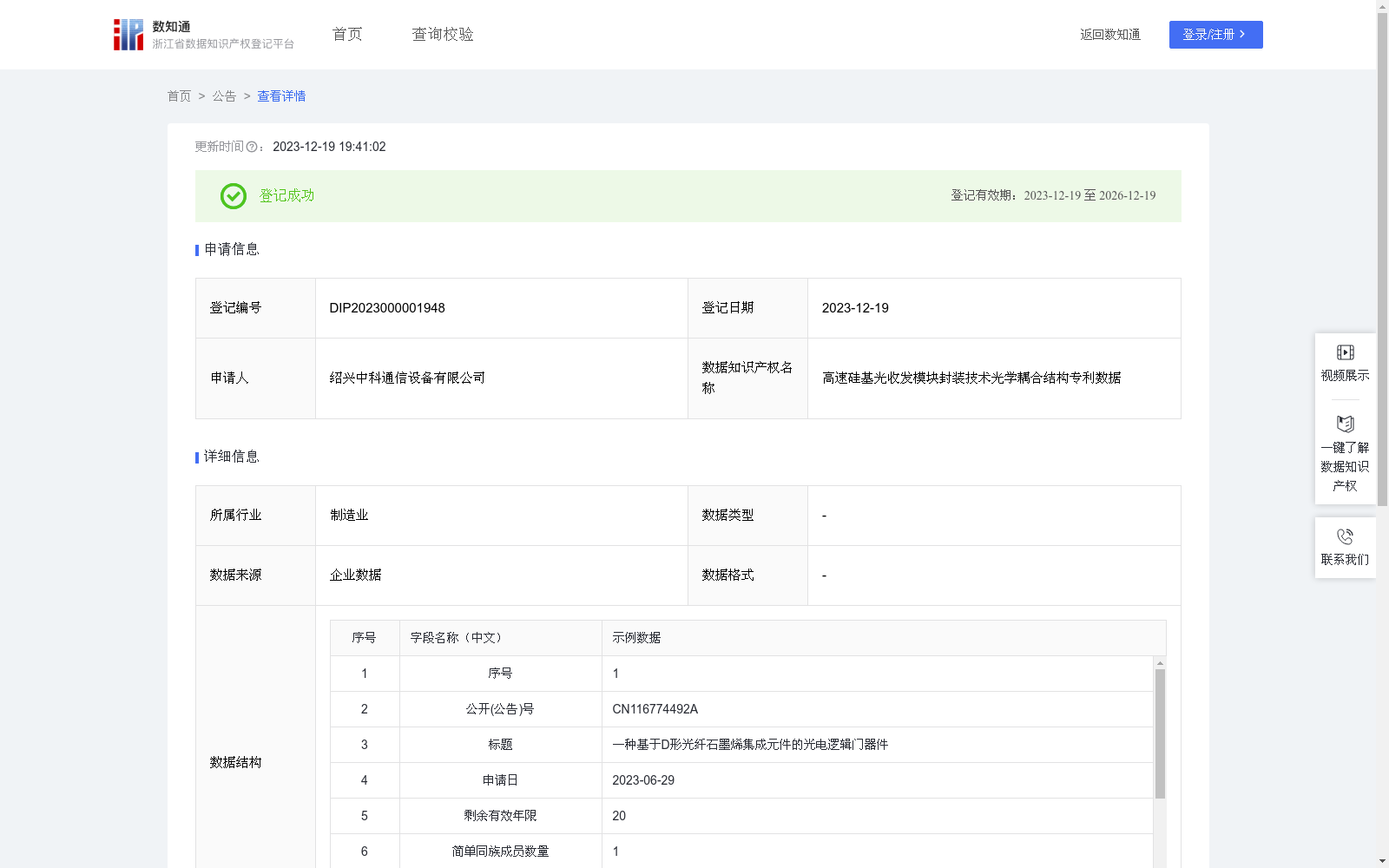
高速硅基光收发模块封装技术光学耦合结构专利数据
收藏资源简介:
对高速硅基光收发模块封装技术光学耦合结构相关专利进行质量等级评价,能够梳理出本领域优质专利,可以为企业的技术引进提供指引;对优质专利进行技术拆解分析,可以为企业攻克技术难题提供启示以及规避重复研发风险;对优质专利进行统计分析,能够梳理出企业在本领域存在竞合关系的专利申请主体。1、数据采集:通过第三方知识产权检索平台,对高速硅基光收发模块封装技术光学耦合结构相关专利进行检索,去除不属于分析范围的专利数据、有缺失(影响分析)的数据、重复数据等噪音数据。 2、数据处理:对专利的多个维度进行评分,根据评分总分将专利质量分成5个等级,即完成专利质量等级评价,具体评价方法为。 根据评价维度对应的数值进行打分,打分越高表示越好,打分范围为0至最高分,评价的具体维度和该维度对应的总分为:剩余有效年限(20)、简单同族成员数量(10)、IPC分类数量(5)、引用专利数量(5)、被引用专利数量(5)、文献页数(20)、权利要求数(35);统计打分总分,根据总分将专利分成5个质量等级:0-19分(差)、20-39分(较差)、40-59分(一般)、60-79分(较好)、80-100分(好)。
Conducting quality level evaluation on patents related to the optical coupling structure of high-speed silicon-based optical transceiver module packaging technology can screen out high-quality patents in this field, providing guidance for enterprises' technology introduction. Technical disassembly and analysis of these high-quality patents can offer enterprises insights to overcome technical challenges and avoid redundant R&D risks. Statistical analysis of high-quality patents can help enterprises identify patent applicants with competitive or cooperative relationships in this field. 1. Data Collection: Retrieve patents related to the optical coupling structure of high-speed silicon-based optical transceiver module packaging technology via third-party intellectual property retrieval platforms, and eliminate noise data including patents outside the analysis scope, data with missing information that impacts analysis, and duplicate records. 2. Data Processing: Score patents across multiple dimensions, and classify patent quality into 5 levels based on the total score to complete the patent quality level evaluation. The specific evaluation method is as follows: Score is determined based on the values corresponding to each evaluation dimension, with higher scores indicating better patent quality. The scoring range spans from 0 to the maximum total score of each dimension. The specific evaluation dimensions and their corresponding maximum scores are: remaining valid years (20), number of simple patent family members (10), number of IPC classification codes (5), number of backward citations (5), number of forward citations (5), number of document pages (20), number of claims (35). Calculate the total score, and divide patents into 5 quality levels according to the total score: 0-19 (poor), 20-39 (relatively poor), 40-59 (average), 60-79 (relatively good), 80-100 (excellent).