
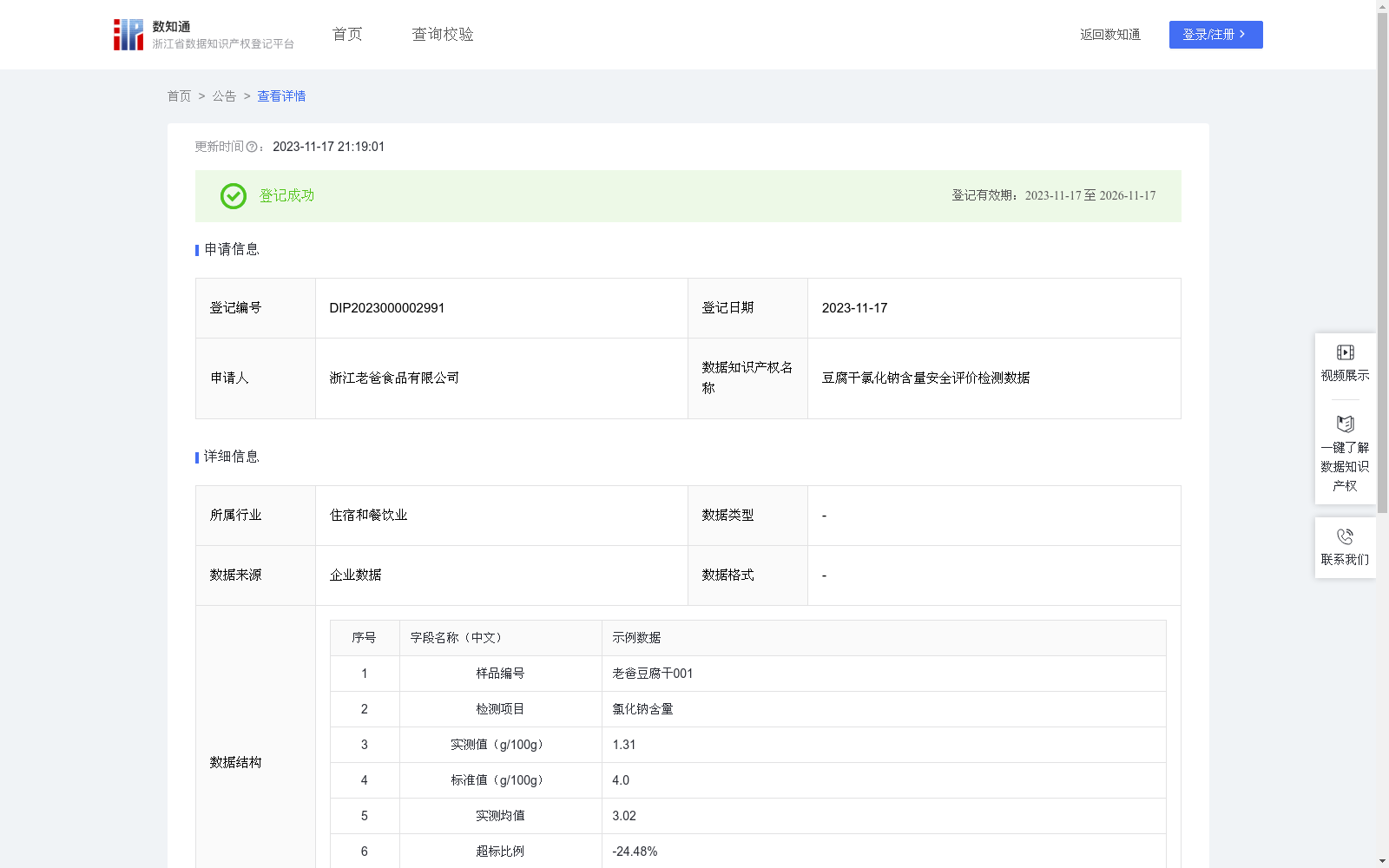
豆腐干氯化钠含量安全评价检测数据
收藏浙江省数据知识产权登记平台2023-11-17 更新2024-05-08 收录
下载链接:
https://www.zjip.org.cn/home/announce/trends/11815
下载链接
链接失效反馈官方服务:
资源简介:
食品添加剂一直是消费者比较关心的食品安全问题,为了确保豆腐干制品的食用安全,对豆腐干制品内食品添加剂需要进行严格控制, 数据对象为氯化钠的相关检测数据,通过检测数据,我们可以判断豆腐干制品中的氯化钠是否符合安全标准,防止因添加过量或不合法导致的食品安全问题,通过数据的实时更新,我们能够实现豆腐干制品生产全过程的实时监控,确保食品安全。1、样本采集:从生产的豆腐干制品中随机取样,并做好样品编号;2、数据检测:对采集的豆腐干制品样本进行预处理,以便进行后续检测,利用适当的仪器和方法对豆腐干制品中的氯化钠进行定量检测,对检测数据进行整理和分析,得出单个样本的氯化钠含量;3、数据处理:按相同的样品名称进行归集分类,去除异常值和缺失值,得出每种样品中各类添加剂的均值,将均值与标准值对比判定该添加剂含量是否合格,标准值来自GB 2760-2014 食品添加剂使用标准,(添加剂的均值-添加剂的标准值)/添加剂的标准值=添加剂的超标比例,
4、数据应用:为生产者提供氯化钠使用的建议和指导,促进其合规生产,为消费者提供选择豆腐干制品的参考依据,提高消费者的食品安全意识。
Food additives have long been a prominent food safety concern among consumers. To guarantee the edible safety of dried bean curd products, strict control over food additives present in such products is imperative. This dataset focuses on the relevant detection data for sodium chloride. By analyzing the detection results, we can assess whether the sodium chloride content in dried bean curd products complies with safety standards, thereby preventing food safety incidents caused by excessive or unauthorized addition of additives. Real-time data updates enable real-time monitoring of the entire production process of dried bean curd products, ensuring food safety throughout the lifecycle.
1. Sample Collection: Randomly sample from the manufactured dried bean curd products, and assign unique numbers to each sample.
2. Data Detection: Preprocess the collected dried bean curd samples to lay a foundation for subsequent testing. Utilize appropriate instruments and testing methods to quantitatively determine the sodium chloride content in the samples. Afterwards, organize and analyze the detection data to derive the sodium chloride content of each individual sample.
3. Data Processing: Group and aggregate the samples based on their product names, eliminate outliers and missing values, and calculate the mean content of each additive for each product type. Compare the calculated mean value with the corresponding standard limit to judge whether the additive content is qualified. The standard limits are sourced from GB 2760-2014 National Standard for the Use of Food Additives. The exceedance ratio of an additive is calculated as: (Mean content of the additive - Standard limit of the additive) / Standard limit of the additive.
4. Data Application: Provide producers with targeted suggestions and guidance on sodium chloride usage to facilitate compliant production; offer consumers reference information for selecting dried bean curd products, and raise consumers' awareness of food safety.
提供机构:
浙江老爸食品有限公司
创建时间:
2023-11-03
搜集汇总
数据集介绍
以上内容由遇见数据集搜集并总结生成



