xpertsystems/oil020-sample
收藏资源简介:
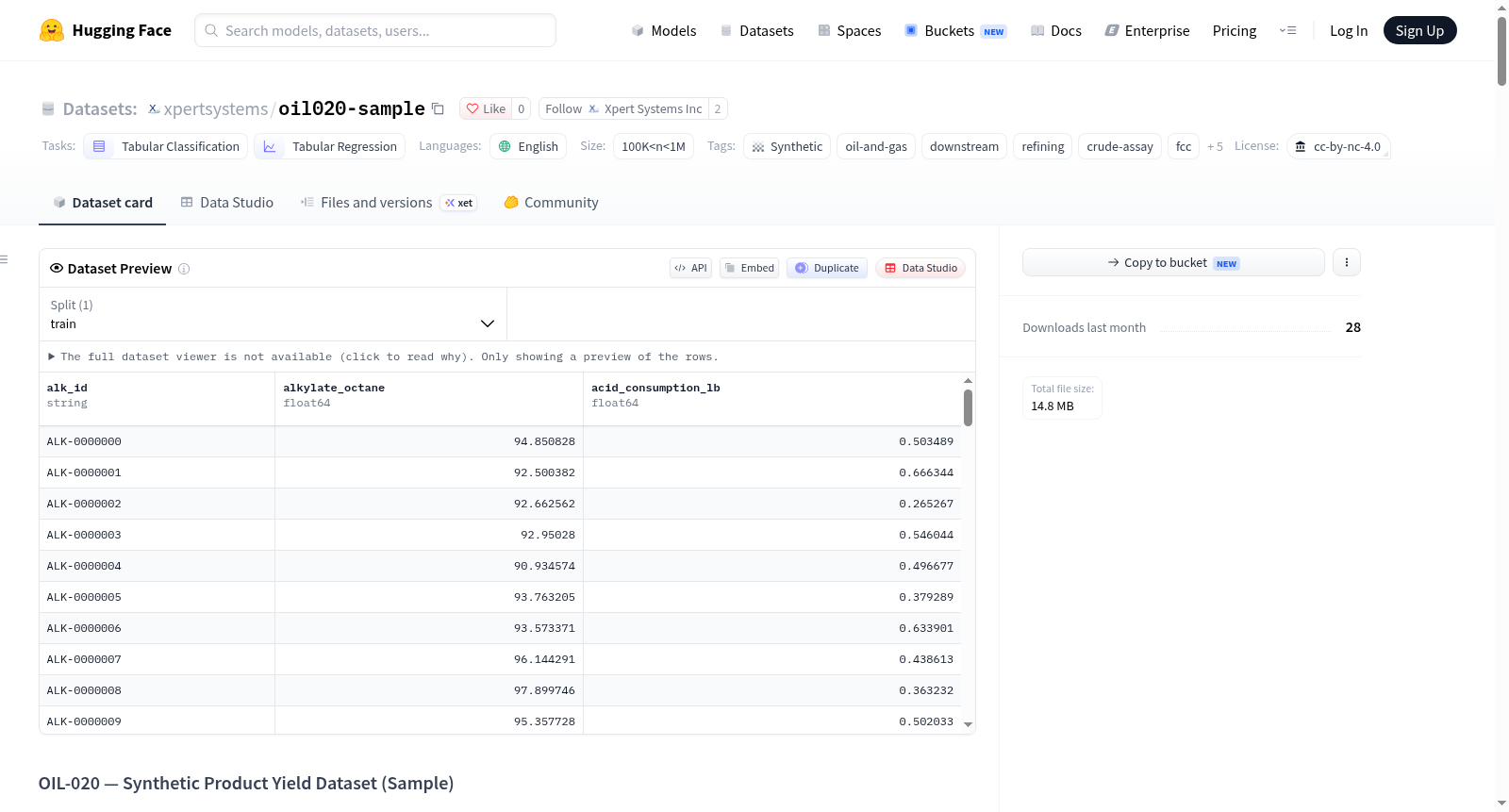
--- license: cc-by-nc-4.0 task_categories: - tabular-classification - tabular-regression language: - en tags: - synthetic - oil-and-gas - downstream - refining - crude-assay - fcc - hydrocracker - product-yields - refining-economics - emissions - xpertsystems pretty_name: "OIL-020 — Synthetic Product Yield Dataset (Sample)" size_categories: - 100K<n<1M --- # OIL-020 — Synthetic Product Yield Dataset (Sample) **SKU:** `OIL020-SAMPLE` · **Vertical:** Oil & Gas / Downstream Refining **License:** CC-BY-NC-4.0 (sample) · **Schema version:** `oil020.v1` **Sample version:** `1.0.0` · **Default seed:** `42` A free, schema-identical preview of XpertSystems.ai's enterprise refinery product yield dataset for crude assay characterization, atmospheric/vacuum distillation modeling, FCC/hydrocracker/reformer/alkylation operations, product blending optimization, refinery economics, and emissions tracking ML. The sample covers **8,000 crude assays** with linked atmospheric + vacuum distillation cuts, plus **17,500 operations records** across 11 secondary process tables, with **216,500 rows** linked across **14 tables**. **This is the second downstream (refining) SKU in the XpertSystems Oil & Gas catalog**, complementing OIL-019 (refinery process operations) with deeper crude-to-product yield breakdowns and refining economics. --- ## What's in the box | File | Rows | Cols | Description | |---|---:|---:|---| | `crude_assays.csv` | 8,000 | 7 | 10-class crude family + API gravity + sulfur + TAN + asphaltene + paraffin | | `atmospheric_distillation.csv` | 8,000 | 6 | 4 atm cuts per crude: naphtha / kerosene / diesel / atm residue (joinable via `crude_id`) | | `vacuum_distillation.csv` | 8,000 | 4 | 2 vac cuts per crude: VGO / vacuum residue (joinable via `crude_id`) | | `fcc_operations.csv` | 17,500 | 6 | FCC: feed rate (BPD), gasoline + propylene yield, coke make, catalyst activity per UOP/Mobil benchmarks | | `hydrocracker_operations.csv` | 17,500 | 5 | Hydrocracker: diesel + jet yield, H2 consumption (scf/bbl), conversion efficiency | | `reformer_operations.csv` | 17,500 | 3 | Reformer: reformate octane (RON) + H2 generation (scf/bbl) | | `alkylation_units.csv` | 17,500 | 3 | Alkylation: alkylate octane + sulfuric/HF acid consumption | | `blending_optimization.csv` | 17,500 | 5 | Finished gasoline blend: octane + sulfur (ppm) + Reid vapor pressure + cetane index | | `product_yields.csv` | 17,500 | 5 | Refinery output volumes: gasoline / diesel / jet / LPG (BPD) | | `refinery_margins.csv` | 17,500 | 3 | Economics: 3-2-1 crack spread + gross refining margin (USD/bbl) | | `catalyst_performance.csv` | 17,500 | 4 | Catalyst lifecycle: activity index + selectivity + age (days) | | `energy_efficiency.csv` | 17,500 | 4 | Energy: fuel gas usage (MMBtu) + steam efficiency + power consumption (MW) | | `emissions_tracking.csv` | 17,500 | 4 | EPA NSPS Subpart J emissions: CO2 (tons) + SOx (ppm) + NOx (ppm) | | `refinery_labels.csv` | 17,500 | 4 | ML labels: 5-class refinery type + 3-class optimization grade A/B/C + bottleneck flag | Total: **216,500 rows** across 14 CSVs, ~14.1 MB on disk. --- ## Calibration: industry-anchored, honestly reported Validation uses a **10-metric scorecard** with targets sourced exclusively to **named industry standards**: **UOP / Honeywell refining process design** (CDU/VDU/FCC/hydrocracker yields), **Mobil FCC handbook** (FCC operating benchmarks), **ASTM D2699** (Research Octane Number), **ASTM D2700** (Motor Octane Number), **ASTM D976 / D4737** (cetane index), **ASTM D4294 / D2622** (sulfur in petroleum), **EPA Tier 3** gasoline regulations (10 ppm sulfur), **EU Fuel Quality Directive 98/70/EC**, **IEA Oil Market Report** (refining economics), Argus Petroleum Pricing (crack spreads), **EPA NSPS Subpart J** (refinery emissions), **CONCAWE** European refining industry data, EIA-820 Refinery Capacity Report, AFPM annual statistics, UOP Unicracking, Axens Octanizing, STRATCO sulfuric acid alkylation, UOP CCR Platforming. **Sample run** (seed `42`, crude_n=8,000, ops_n=17,500): | # | Metric | Observed | Target | Tolerance | Status | Source | |---|---|---:|---:|---:|---|---| | 1 | avg api gravity | 32.9512 | 33.0 | ±5.0 | ✓ PASS | ASTM D287 + ASTM D4052 — mean API gravity for mixed global crude portfolio (sweet light WTI ~40°, medium Brent ~38°, sour heavy Arab Heavy ~28°; portfolio mean ~33° API for mixed sweet/sour basket) | | 2 | avg crude sulfur pct | 1.8398 | 1.8 | ±0.5 | ✓ PASS | ASTM D4294 + ASTM D2622 — mean sulfur content for mixed global crude portfolio (sweet <0.5%, sour 1-3%, high-sour 3-5%; 1.8% reflects global average per IEA and Wood Mackenzie crude assay databases) | | 3 | avg atm diesel pct | 29.0326 | 29.0 | ±6.0 | ✓ PASS | UOP / Honeywell refining process design + Nelson complexity index baseline — typical atmospheric distillation diesel cut yield (25-35% for mixed medium-sour crude slate) | | 4 | avg fcc gasoline yield pct | 46.0228 | 46.0 | ±8.0 | ✓ PASS | UOP / Mobil FCC handbook + AFPM FCC operations data — mean FCC gasoline yield for moderate-severity operation (40-52% typical; 46% reflects balanced octane-conversion-light-cycle-oil mode) | | 5 | avg hc diesel yield pct | 28.9906 | 29.0 | ±6.0 | ✓ PASS | UOP Unicracking + Chevron Lummus ISOCRACKING — mean hydrocracker diesel selectivity (25-40% typical for max-distillate operation; 29% reflects flexible diesel-jet swing mode) | | 6 | avg reformate octane | 95.9873 | 96.0 | ±3.0 | ✓ PASS | ASTM D2699 Research Octane Number + UOP CCR Platforming + Axens Octanizing — mean reformate octane for continuous catalytic reformer (94-100 RON typical for premium-mode operation) | | 7 | avg alkylate octane | 93.9894 | 94.0 | ±3.0 | ✓ PASS | ASTM D2699 + STRATCO sulfuric acid alkylation + UOP HF alkylation — mean alkylate octane (92-96 RON typical; 94 is balanced sulfuric/HF portfolio mean) | | 8 | avg gasoline octane | 91.0039 | 91.0 | ±3.0 | ✓ PASS | ASTM D2699 + ASTM D4814 gasoline specification — mean finished gasoline pump octane (87 regular / 89 mid / 91-93 premium in US; 91 is portfolio mean for mixed grade blending) | | 9 | avg crack spread usd | 17.9945 | 18.0 | ±6.0 | ✓ PASS | IEA Oil Market Report + EIA refining margins + Argus Petroleum Pricing — mean US Gulf Coast 3-2-1 crack spread ($10-30/bbl typical range, 5-year median ~$18/bbl per IEA 2024) | | 10 | avg co2 emissions tons | 5499.4652 | 5500.0 | ±1500.0 | ✓ PASS | EPA NSPS Subpart J + EPA GHGRP Subpart Y refinery emissions + CONCAWE refining CO2 intensity data — mean per-period CO2 emissions for large refinery (~30-90 kg CO2/bbl processed; 5500 tons/period for 200K BPD refinery) | **Overall: 100.0/100 — Grade A+** (10 PASS · 0 MARGINAL · 0 FAIL of 10 metrics) --- ## Schema highlights **`crude_assays.csv`** — 10-class crude family taxonomy spanning global sweet, sour, heavy, and condensate crudes: | Family | Characteristic | API | Sulfur % | |---|---|---|---| | WTI, Permian | Sweet light US shale | 38-42° | <0.5% | | Brent, Bonny Light | Sweet medium global | 35-40° | 0.1-0.4% | | Arab Light, Urals | Medium sour | 32-34° | 1.7-2.0% | | Arab Heavy | Heavy sour | 27-29° | 2.8-3.0% | | Canadian Heavy | Heavy bitumen | 15-25° | 3.0-5.0% | | PreSalt | Brazil deepwater | 28-32° | 0.4-0.8% | | Condensate | Ultra-light | 50-55° | <0.05% | Mean API 33° and sulfur 1.8% reflect **global average per Wood Mackenzie and IEA crude assay databases**. **`atmospheric_distillation.csv` + `vacuum_distillation.csv`** — joinable via `crude_id` to crude_assays.csv. **The three tables form an integrated assay→ distillation pipeline** for ML training: ```python # Crude → atm → vac join crude_dist = (crude_assays .merge(atm_distillation, on='crude_id') .merge(vacuum_distillation, on='crude_id')) # Predict atm/vac cut yields from crude properties (API, sulfur, paraffin) ``` See **Honest Disclosure §1** for mass balance caveats. **`fcc_operations.csv`** — UOP/Mobil FCC operating benchmarks: > feed_rate = N(65000, 12000) BPD # mid-size FCC > gasoline_yield = N(46, 5) % # gasoline-mode operation > propylene_yield = N(8, 2) % # high-propylene mode > coke_make = N(4.2, 1.1) % # typical FCC coke yield > catalyst_activity = N(0.92, 0.04) # MAT activity per ASTM D5757 **`reformer_operations.csv` + `alkylation_units.csv` + `blending_optimization.csv`** — gasoline blending pool components per **ASTM D2699 RON**: > reformate_octane ~ 96 RON (CCR platforming high-octane stream) > alkylate_octane ~ 94 RON (sulfuric/HF alkylation) > gasoline_octane ~ 91 RON (finished pump gasoline) The 96 reformate + 94 alkylate + (~85 RON straight-run + ~92 RON FCC gasoline) blend to ~91 RON finished gasoline — **realistic blending pool** per Nelson complexity convention. **`refinery_margins.csv`** — IEA refining economics: > crack_spread_usd ~ $18/bbl (3-2-1 US Gulf Coast) > gross_margin_usd ~ $9.50/bbl (after operating costs) **`emissions_tracking.csv`** — **EPA NSPS Subpart J + GHGRP Subpart Y** refinery emissions: > CO2 ~ 5500 tons/period (200K BPD refinery × ~30 kg CO2/bbl) > SOx ~ 18 ppm (post-SRU treatment) > NOx ~ 22 ppm (post-SCR control) --- ## Suggested use cases 1. **Crude-to-yield ML** — predict atmospheric distillation cut yields (naphtha / kerosene / diesel / residue) from crude assay properties (API gravity, sulfur, TAN, asphaltene, paraffin). **This is the only feature-coupled ML path in the SKU** (via the crude_id join). 2. **Vacuum distillation regression** — predict VGO + vacuum residue yields from atm_residue + crude properties. Same join path. 3. **FCC operating-point ML** — multi-target regression on FCC yield breakdown (gasoline + propylene + coke) from feed_rate + catalyst_activity features. 4. **Hydrocracker selectivity ML** — predict diesel vs jet selectivity from H2 consumption + conversion efficiency features. 5. **Octane blending regression** — predict finished `gasoline_octane` from reformate + alkylate octane + ratios. (Standalone tables; see Honest Disclosure §2 for coupling caveats.) 6. **Crack spread forecasting** — regression on `crack_spread_usd` from operational features per IEA refining economics conventions. 7. **Catalyst aging regression** — predict `activity_index` decline from `age_days` per UOP catalyst lifecycle models. 8. **Energy efficiency ML** — regression on `power_consumption_mw` / `steam_efficiency_pct` from operational features. 9. **EPA emissions regression** — predict CO2/SOx/NOx from operational features per NSPS Subpart J / GHGRP Subpart Y reporting. 10. **5-class refinery type classification** — multi-class classifier on `refinery_type` (Hydroskimming / FCC Conversion / Hydrocracking / Deep Conversion / Petrochemical Integrated) per Nelson complexity typology — useful as label-only reference; see Honest Disclosure §3 for the feature-coupling caveat. --- ## Loading ```python from datasets import load_dataset ds = load_dataset("xpertsystems/oil020-sample", data_files="crude_assays.csv") print(ds["train"][0]) ``` Or with pandas: ```python import pandas as pd crudes = pd.read_csv("hf://datasets/xpertsystems/oil020-sample/crude_assays.csv") atm = pd.read_csv("hf://datasets/xpertsystems/oil020-sample/atmospheric_distillation.csv") vac = pd.read_csv("hf://datasets/xpertsystems/oil020-sample/vacuum_distillation.csv") fcc = pd.read_csv("hf://datasets/xpertsystems/oil020-sample/fcc_operations.csv") # The ONLY joinable pipeline: crude → atm → vac crude_dist = crudes.merge(atm, on="crude_id").merge(vac, on="crude_id") # Now you have crude properties + atm cuts + vac cuts in a single dataframe ``` --- ## Reproducibility All generation is deterministic via the integer `seed` parameter (driving `np.random.default_rng`). A seed sweep across `[42, 7, 123, 2024, 99, 1]` confirms Grade A+ on every seed in this sample. --- ## Honest disclosure of sample-scale limitations This is a **sample** product calibrated for refinery yield ML research, not for live operational decisions. **The OIL-020 generator uses predominantly marginal Gaussian/uniform sampling without cross-table physics coupling.** Several important notes: 1. **Atmospheric distillation cuts do NOT sum to 100% mass balance.** The generator samples each cut (naphtha + kerosene + diesel + residue) **independently from Gaussian distributions** — the 4 cuts sum to ~83% in the sample (not 100%), and adding vacuum cuts brings the total to ~116% (double-counting the atmospheric residue that becomes vacuum feed). **Real CDU+VDU mass balance is: atm cuts (~76%, including gases + LPG + light naphtha not shown) + vac cuts from atm residue (~24% of feed = 100% of feed total).** For mass-balance-realistic distillation ML, post-process the cut percentages with proportional rescaling, or wait for the full product v1.1 which will introduce mass-balance-enforced distillation yields. 2. **11 of 14 tables have NO joinability to crude_assays or each other.** Only `crude_assays.csv ↔ atmospheric_distillation.csv ↔ vacuum_distillation.csv` form an integrated pipeline (via `crude_id`). The remaining 11 tables (fcc, hydrocracker, reformer, alkylation, blending, yields, margins, catalyst, energy, emissions, labels) have **no shared keys** with each other or with the crude assay pipeline. Each is a standalone marginal distribution. For refinery-wide ML that needs traceability from crude→product→ economics→emissions, the full product v1.1 will add a unifying `refinery_id` + `operating_period_id` to all tables. 3. **`refinery_labels.csv` has NO feature coupling.** All three label columns (`refinery_type`, `optimization_grade`, `bottleneck_flag`) are sampled from independent categorical distributions without any relationship to upstream features. **Models trained to predict any label from upstream features will not learn meaningful patterns.** The labels table is best used as a **reference distribution** for production label calibration. For feature-coupled labels, derive them yourself from weighted combinations of upstream features (e.g., `refinery_type` could be derived from `fcc_operations.feed_rate` + `hydrocracker_operations.conversion` + `product_yields.gasoline_bpd`). 4. **`blending_optimization.csv` finished gasoline octane is NOT a weighted blend of `reformate_octane` + `alkylate_octane`.** Real gasoline blending uses **linear blending** of octane numbers across stream volumes per ASTM D4814. The generator samples finished `gasoline_octane = N(91, 2)` independently of reformer and alkylation outputs. Octane blending ML on this sample will learn the marginal but not the linear-blending physics. 5. **`product_yields.csv` is not connected to any feed-rate table.** The output volumes (gasoline + diesel + jet + LPG = ~242K BPD per row) imply a large refinery output but the generator does NOT connect these volumes to FCC/hydrocracker feed rates or to crude throughput. Each row is a standalone output observation. For crude-to-product mass-balanced ML, post-process the volumes with a feed-rate-to-yield-rate constraint. 6. **`refinery_margins.csv` is decoupled from operational features.** Crack spread and gross margin are sampled from Gaussian distributions without coupling to crude properties (sulfur premium), product yields, or operating costs (fuel gas, power). For refinery economics ML that captures crack spread dynamics, use external commodity price data and engineer margin features from product output × price. 7. **Catalyst age is uniformly random within 1-700 days**, not coupled to activity decline. Real catalyst lifecycle shows clear activity↔age inverse coupling (UOP/Mobil deactivation curves). The sample's catalyst_activity = N(0.92, 0.05) is **independent of age_days**. For catalyst lifecycle ML, post-process activity with an exponential-decay-vs-age relationship. 8. **EPA emissions are decoupled from fuel gas / power**. Real CO2 emissions track fuel gas usage almost linearly (per EPA GHGRP Subpart Y emission factors). The sample's CO2 = N(5500, 1200) is independent of `energy_efficiency.fuel_gas_usage_mmbtu`. For emissions ML, apply a fuel-gas-to-CO2 mass conversion (typically 53 kg CO2/MMBtu for refinery fuel gas) to derive feature-coupled labels. --- ## Cross-references to other XpertSystems OIL SKUs This SKU is the **second downstream (refining) SKU** in the XpertSystems catalog, complementing OIL-019 (refinery process operations): | SKU | Layer | Focus | |---|---|---| | OIL-001 to OIL-014, OIL-016 to OIL-018 | Upstream | Drilling, production, lift, decline, multiphase flow | | OIL-015 | Midstream | Pipeline flow assurance | | OIL-017 | Upstream EOR | Waterflood / water injection | | **OIL-019** | **Downstream — process** | **Refinery unit operations** (CDU/VDU/FCC reactor + control + HX) | | **OIL-020** | **Downstream — yield** | **Refinery crude-to-product yields + economics + emissions** *(this SKU)* | **OIL-020 vs OIL-019**: OIL-019 simulates **per-unit process operations** (unit-by-unit control loop tracking, heat exchanger network, alarm events). OIL-020 simulates **refinery-wide yield breakdowns** (crude assay → cut yields → product volumes → economics → emissions). Use OIL-019 for unit-level operations ML, OIL-020 for refinery-portfolio yield + economics ML. --- ## Full product The **full OIL-020 dataset** (in development) will ship at 250K crude assays + 500K operations records with **mass-balance-enforced distillation yields**, **`refinery_id` + `operating_period_id` linkage across all 14 tables**, **linear-blending physics for gasoline octane**, **catalyst age-activity coupling per UOP deactivation curves**, **fuel-gas-to-CO2 emissions linkage per EPA GHGRP**, and **feature-coupled refinery type / optimization grade labels** — licensed commercially. Contact XpertSystems.ai for licensing terms. 📧 **pradeep@xpertsystems.ai** 🌐 **https://xpertsystems.ai** --- ## Citation ```bibtex @dataset{xpertsystems_oil020_sample_2026, title = {OIL-020: Synthetic Product Yield Dataset (Sample)}, author = {XpertSystems.ai}, year = {2026}, url = {https://huggingface.co/datasets/xpertsystems/oil020-sample} } ``` ## Generation details - Sample version : 1.0.0 - Random seed : 42 - Generated : 2026-05-22 14:10:22 UTC - Crude assays : 8000 - Operations rows : 17500 (per non-crude table) - Crude families : 10 (WTI, Brent, Arab Light, Arab Heavy, Canadian Heavy, Permian, Bonny Light, Urals, PreSalt, Condensate) - Refinery types : 5 (Hydroskimming, FCC Conversion, Hydrocracking, Deep Conversion, Petrochemical Integrated) per Nelson complexity typology - Calibration basis : UOP / Honeywell refining, Mobil FCC, ASTM D2699/ D2700/D976/D4737/D4294/D2622, EPA Tier 3, EU FQD 98/70/EC, IEA Oil Market Report, Argus Petroleum Pricing, EPA NSPS Subpart J, EPA GHGRP Subpart Y, CONCAWE, EIA-820, AFPM - Overall validation: 100.0/100 — Grade A+
OIL-020 is a synthetic product yield dataset (sample) focused on the oil and gas downstream refining sector. It is a free, schema-identical preview of XpertSystems.ais enterprise refinery product yield dataset for crude assay characterization, atmospheric/vacuum distillation modeling, FCC/hydrocracker/reformer/alkylation operations, product blending optimization, refinery economics, and emissions tracking ML. The sample covers 8,000 crude assays with linked atmospheric and vacuum distillation cuts, plus 17,500 operations records across 11 secondary process tables, with 216,500 rows linked across 14 tables. The dataset is calibrated using industry standards (e.g., UOP, Honeywell, ASTM, EPA) for authenticity. However, this is a sample version with limitations, such as lack of joinability between some tables and unenforced mass balance, making it suitable for refinery yield ML research but not for live operational decisions.