
TeichAI/Claude-Sonnet-4.6-Reasoning-1100x
收藏Hugging Face2026-04-06 更新2026-04-05 收录
下载链接:
https://hf-mirror.com/datasets/TeichAI/Claude-Sonnet-4.6-Reasoning-1100x
下载链接
链接失效反馈官方服务:
资源简介:
---
license: apache-2.0
configs:
- config_name: default
data_files:
- split: train
path: data/train-*
dataset_info:
features:
- name: messages
list:
- name: role
dtype: string
- name: content
dtype: string
- name: thinking
dtype: string
- name: name
dtype: string
splits:
- name: train
num_bytes: 4411730
num_examples: 1096
download_size: 4418082
dataset_size: 4411730
---
## Claude Sonnet 4.6 - High Reasoning
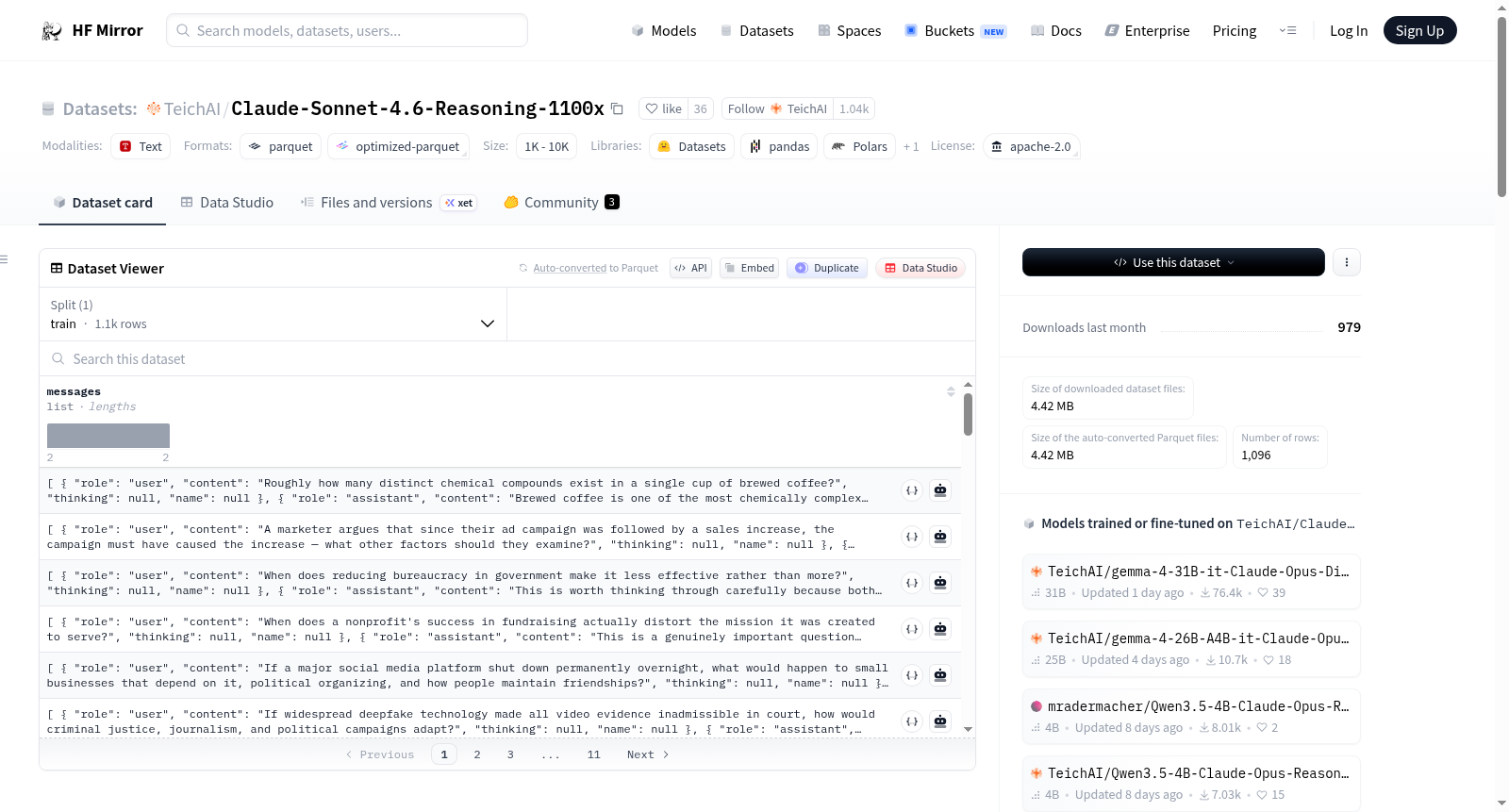
**1096 conversations**, all single-turn user → assistant pairs created using Claude Sonnet 4.6 with reasoning effort set to high.
This is a pure reasoning/critical-thinking distillation dataset. Heavily weighted toward analytical thinking across economics, ethics, public policy, psychology, and epistemology.
## Dataset Format
```
{
"messages": [
{"role": "user", "content": "..."},
{"role": "assistant", "thinking": "Reasoning...", "content": "Final answer..."}
]
}
```
## Stats
- **Cost:** $ 15.80 (USD)
- **Tokens (input + output):** 1.09 M
## Prompt Distribution
### 1. Systems Thinking / Causal Chains (~40 prompts)
*Prompts: #1–15, #168–177, etc.*
"If X happens, what are the downstream effects on Y and Z?" Economics, urban planning, public health, ecology, geopolitics.
### 2. Paradox Resolution (~30 prompts)
*Prompts: #16–30, #178–190, #550–554, #636–640*
"We're told A but also B — how do you reconcile?" Contradictory conventional wisdom across health, education, economics, psychology.
### 3. Constrained Problem-Solving (~30 prompts)
*Prompts: #31–45, #191–202, #555–559, #641–645*
"How would you solve X if you couldn't use Y or Z?" Creative solutions under tight constraints.
### 4. Logical Fallacy Identification (~20 prompts)
*Prompts: #46–60, #203–212, #560–564, #646–650*
"Someone argues X therefore Y — what's wrong with this reasoning?" Correlation/causation, survivorship bias, post hoc, etc.
### 5. Counterintuitive / Paradoxical Outcomes (~30 prompts)
*Prompts: #61–84, #213–227, #565–570, #651–656*
"When does doing more of X actually produce the opposite result?" Backfire effects, unintended consequences.
### 6. Fermi Estimation (~30 prompts)
*Prompts: #85–108, #227–240, #571–578, #657–663*
"Roughly how many X exist / how far would Y stretch?" Order-of-magnitude reasoning.
### 7. Causal Inference / Correlation vs. Causation (~30 prompts)
*Prompts: #109–115, #241–253, #340–356, #579–584, #664–668, #711–715*
"X correlates with Y — does X cause Y?" Confounders, selection bias, reverse causation.
### 8. Ethical Dilemmas (~100+ prompts)
*Prompts: #116–167, #311–339, #512–543, #616–630, #696–706, #736–745, #754–760, #770–779, #790–799*
Real-world moral trade-offs: whistleblowing, triage, conflicting obligations, professional ethics, parental decisions.
### 9. Belief Revision / Epistemics (~30 prompts)
*Prompts: #254–267, #357–381, #585–590, #669–673, #716–720*
"What evidence would change your mind about X?" Intellectual humility, falsifiability.
### 10. Reframing / Paradigm Shifts (~30 prompts)
*Prompts: #268–283, #382–404, #591–597, #674–679, #721–725*
"What if we thought about X not as Y but as Z?" Shifting mental models on poverty, addiction, education, politics.
### 11. Hypothetical Scenario Modeling (~50 prompts)
*Prompts: #284–297, #405–427, #544–549, #598–607, #631–635, #680–686, #706–710, #726–730, #746–749, #762–766, #780–785*
"If [big policy/technology change], what happens?" Thought experiments with second/third-order effects.
### 12. Steelmanning Controversial Positions (~80 prompts)
*Prompts: #298–310, #428–511, #608–615, #687–694, #731–735, #750–753, #767–769, #785–789*
"Make the strongest argument for [unpopular position]." Covers everything from drug legalization to authoritarian governance to organ markets.
---
This dataset was generated using [**TeichAI/datagen**](https://github.com/TeichAI/datagen). Check it out to see how this dataset was made and/or to make datasets like these.
提供机构:
TeichAI
搜集汇总
数据集介绍
构建方式
在人工智能推理能力蒸馏的背景下,Claude-Sonnet-4.6-Reasoning-1100x数据集通过调用Claude Sonnet 4.6模型,并将其推理努力参数设置为最高级别而构建。该过程生成了1096个单轮对话样本,总计消耗约109万令牌,成本为15.80美元。数据生成严格遵循用户提问、助理先进行内部思考再给出最终答案的结构化格式,确保了每个样本都承载了模型的高强度逻辑推演过程。
使用方法
该数据集主要适用于训练或评估旨在提升复杂推理能力的大语言模型。使用者可直接加载数据集,其标准化的消息列表格式便于集成到现有的模型微调流程中。每个样本中的“thinking”字段可作为监督信号,用于训练模型生成中间推理步骤,从而模仿Claude Sonnet 4.6的高强度推理模式。研究人员亦可依据其丰富的主题分类,针对特定类型的推理任务进行子集筛选和专项分析。
背景与挑战
背景概述
在人工智能领域,大型语言模型(LLMs)的推理能力一直是核心研究议题。Claude-Sonnet-4.6-Reasoning-1100x数据集由TeichAI团队于近期创建,旨在通过高推理强度的Claude Sonnet 4.6模型生成对话数据,专门针对经济学、伦理学、公共政策、心理学和认识论等领域的深度分析思维进行提炼。该数据集包含1096个单轮对话,侧重于系统思维、悖论解析、约束问题解决及伦理困境等复杂认知任务,为提升语言模型的批判性思维与逻辑推理能力提供了高质量的训练资源,对推动AI在复杂决策和抽象推理方面的发展具有显著影响力。
当前挑战
该数据集致力于解决高级推理任务中的领域挑战,包括系统因果链分析、逻辑谬误识别、反直觉结果预测以及伦理权衡模拟等,这些任务要求模型超越表面模式匹配,进行深层次的多步推理和上下文整合。在构建过程中,挑战主要源于生成高质量、多样化的推理内容,需确保提示工程覆盖广泛主题(如政策、哲学、科学),同时保持思维链的连贯性与逻辑严谨性,并平衡成本控制与数据规模,以有限的资源(约1.09百万令牌)实现有效的知识蒸馏。
常用场景
经典使用场景
在人工智能推理能力研究领域,Claude-Sonnet-4.6-Reasoning-1100x数据集常被用于训练和评估大型语言模型在复杂思维任务上的表现。该数据集聚焦于高阶分析性思考,涵盖经济学、伦理学、公共政策等多个学科,通过单轮对话形式呈现用户提问与助理的深度推理过程。研究人员利用这些富含逻辑链条和批判性思维的数据,能够系统地提升模型在因果推断、悖论解析和约束性问题解决等方面的能力,为构建具备人类水平推理智能的系统提供关键训练素材。
解决学术问题
该数据集有效应对了人工智能研究中模型缺乏深度逻辑推理与批判性思维的普遍挑战。它通过提供结构化、多领域的推理范例,帮助研究者探索如何让模型超越表面模式匹配,实现真正的因果分析和伦理权衡。在认知科学交叉领域,该数据集支持对机器思维过程的可解释性研究,促进了关于人工智能如何模拟人类决策机制、处理道德困境以及进行信念修正等基础问题的探讨,为构建可靠且负责任的人工智能系统奠定了实证基础。
实际应用
在实际应用层面,该数据集能够赋能需要高级分析与决策支持的智能系统。例如,在政策分析与咨询领域,基于此类数据训练的模型可以模拟复杂社会干预的多级效应,辅助制定更周全的公共政策。在商业战略与风险评估中,模型可借鉴数据集中的系统思维与费米估算方法,进行市场预测或危机推演。此外,在教育科技领域,它可作为开发智能辅导工具的核心资源,帮助学生培养批判性思维和解决开放式问题的能力。
数据集最近研究
最新研究方向
在人工智能推理能力蒸馏领域,Claude-Sonnet-4.6-Reasoning-1100x数据集正推动前沿探索。该数据集聚焦于高阶思维任务,涵盖系统思考、悖论解析、伦理困境等多元主题,为模型提供深度分析训练素材。当前研究热点集中于利用此类高质量推理数据,提升大型语言模型在复杂场景下的因果推断与批判性思维能力。相关进展呼应了业界对可解释AI与稳健决策系统的迫切需求,其影响延伸至自动化政策分析、伦理对齐及认知科学交叉应用,为构建具备人类水平逻辑深度的AI系统奠定了数据基石。
以上内容由遇见数据集搜集并总结生成



