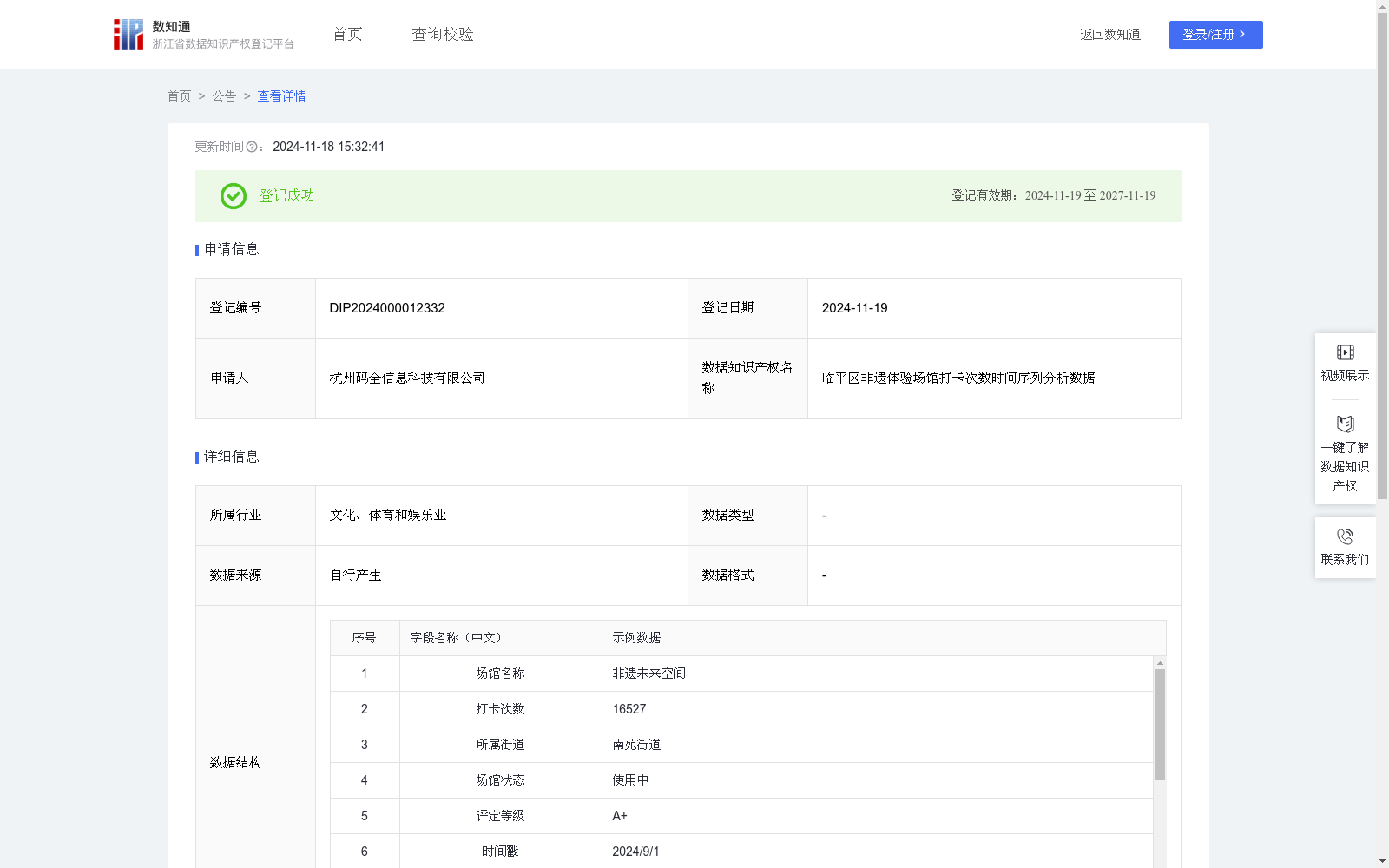
临平区非遗体验场馆打卡次数时间序列分析数据
收藏资源简介:
临平区非遗体验场馆的打卡次数时间序列分析数据能够为场馆运营、市场营销、旅游规划、文化活动安排、公共服务改进、学术研究以及智能导航系统等多个领域提供决策支持。通过分析打卡次数的变化趋势、周期性和季节性模式,管理者可以优化资源配置,策划吸引人的活动,提升游客体验,并在高峰时段提供更好的服务。同时,这些数据也能帮助政府和研究机构评估和改进文化服务,以及预测和应对潜在的运营挑战。1.数据收集与处理:(1)从公司文化保障卡服务系统中自动抽取临平区非遗体验场馆打卡数据(场馆名称、所属街道、场馆状态、打卡次数、评定等级、时间戳)。(2)数据清洗:检查数据的一致性和完整性,去除或修正缺失、错误或异常的数据。(3)异常值检测:使用Z分数公式识别“打卡次数”中的异常值。 2.特征提取:利用“时间戳”字段构建时间序列数据。对“打卡次数”使用移动平均法进行数据平滑。 3.预测未来访问量:基于时间序列数据,使用指数平滑模型(Holt-Winters模型),预测未来访问量。使用MSE函数评估预测的准确性。 4.趋势、季节性及周期性分析:(1)趋势分析:利用线性回归分析“时间序列数据”的趋势。(2)季节性分析:使用季节性分解方法分析“时间序列数据”的季节性。(3)周期性分析:利用傅里叶变换检测“时间序列数据”的周期性。
The time series analysis data of check-in frequencies of intangible cultural heritage (ICH) experience venues in Linping District can provide decision support for multiple fields including venue operation, marketing, tourism planning, cultural event arrangement, public service improvement, academic research, and intelligent navigation systems. By analyzing the changing trends, periodic and seasonal patterns of check-in frequencies, managers can optimize resource allocation, plan attractive activities, enhance visitor experience, and provide better services during peak hours. Meanwhile, this data can also help governments and research institutions evaluate and improve cultural services, as well as predict and address potential operational challenges. 1. Data Collection and Processing: (1) Automatically extract check-in data of ICH experience venues in Linping District from the Company Cultural Security Card Service System, including venue name, affiliated street, venue status, check-in frequency, rating level, and "timestamp". (2) Data Cleaning: Check the consistency and integrity of the data, and remove or correct missing, erroneous or abnormal data. (3) Outlier Detection: Use the Z-score formula to identify outliers in the "check-in frequency" field. 2. Feature Extraction: Construct time series data using the "timestamp" field. Perform data smoothing on the "check-in frequency" using the moving average method. 3. Future Visitor Volume Prediction: Based on the time series data, use the exponential smoothing model (Holt-Winters model) to predict future visitor volume. Use the MSE (Mean Squared Error) function to evaluate the prediction accuracy. 4. Trend, Seasonality and Periodicity Analysis: (1) Trend Analysis: Use linear regression to analyze the trend of the "time series data". (2) Seasonality Analysis: Use the seasonal decomposition method to analyze the seasonality of the "time series data". (3) Periodicity Analysis: Use Fourier transform to detect the periodicity of the "time series data".