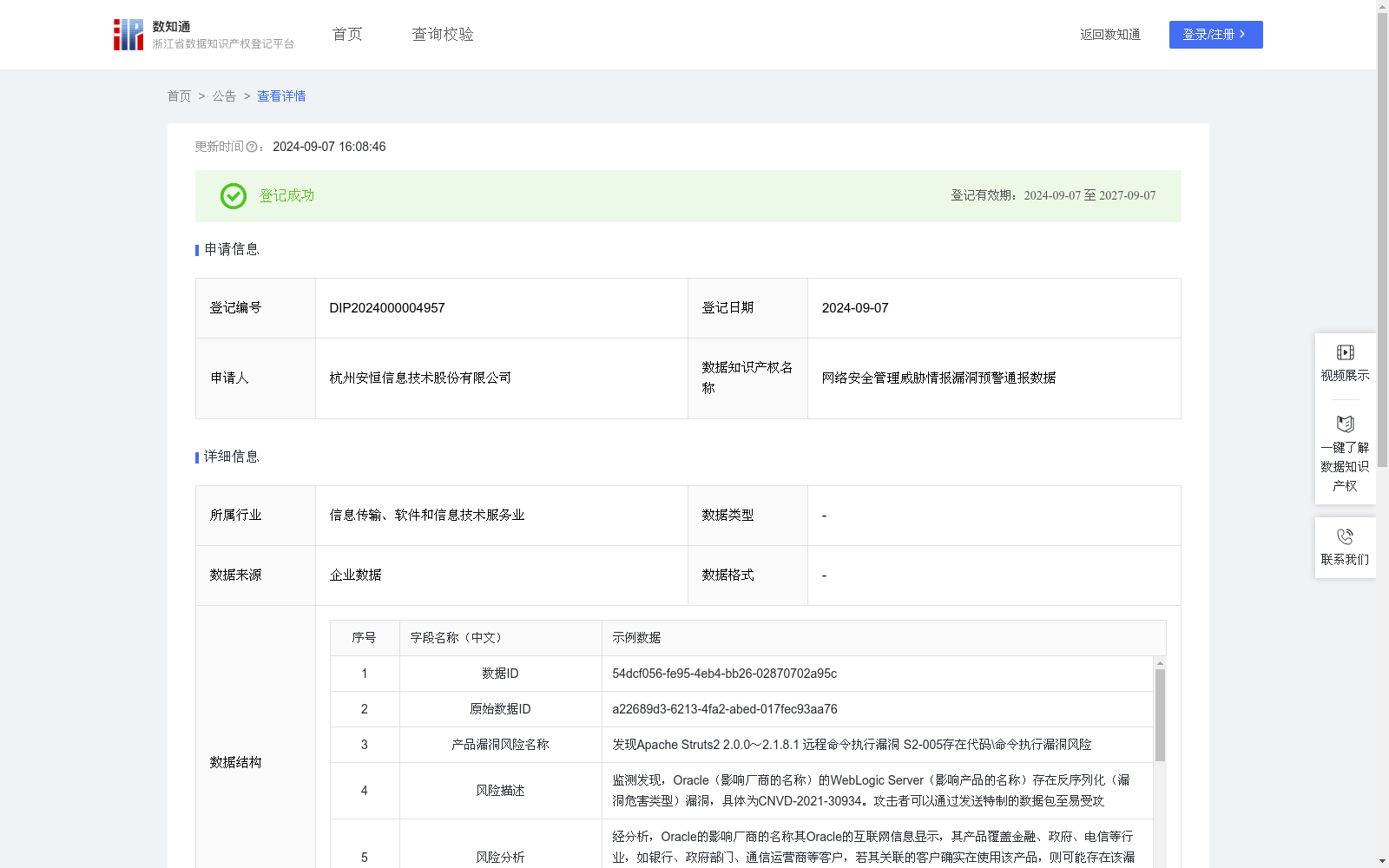
网络安全管理威胁情报漏洞预警通报数据
收藏资源简介:
网络安全管理威胁情报漏洞预警通报数据的应用场景:1.安全管理-漏洞扫描与漏洞管理: 漏洞库是漏洞扫描和漏洞管理系统的核心组件。系统通过定期扫描网络资产,比对漏洞库中的已知漏洞信息,发现潜在的安全风险。同时,管理员可以利用漏洞库中的修复建议和补丁信息,及时对漏洞进行修复和管理,降低安全风险。 2.端点安全-终端防病毒与终端安全管理: 终端防病毒软件和终端安全管理平台可以利用漏洞库中的信息,对终端系统进行风险评估和加固。例如,通过检测终端上是否存在漏洞库中的已知漏洞,并采取相应的防护措施,如隔离感染终端、更新安全补丁等,防止恶意软件利用这些漏洞进行攻击。 3.安全解决方案-安全运营/MDR/MSS: 在安全运营、托管检测与响应(MDR)以及托管安全服务(MSS)中,漏洞库是提供全面安全服务的重要支撑。通过实时更新漏洞库中的信息,安全团队能够为客户提供及时的漏洞预警、风险评估和应急响应服务,确保客户资产的安全。 4.工控安全-工控安全管理平台与工控安全审计: 在工控安全领域,漏洞库对于确保工业控制系统的安全至关重要。工控安全管理平台可以利用漏洞库中的信息,对工业控制系统进行风险评估和加固。网络安全管理威胁情报漏洞预警通报数据的算法规则:1. 数据收集与标准化:收集漏洞数据,包括但不限于数据ID、来源ID、风险名称、风险描述、风险分析、处置建议、漏洞类型、受影响厂商、受影响产品、受影响版本、相关报告等。 2. 风险评估:分析漏洞的严重性,考虑漏洞的影响范围、潜在威胁、已知晓的利用情况以及漏洞被利用可能导致的后果。 3. 漏洞特征提取:提取漏洞的关键特征,如受影响的产品、版本号、已知的攻击向量、利用效果等。4. 影响分析:根据受影响的厂商和产品,分析可能受影响的行业和领域,评估漏洞被利用可能导致的业务影响。5. 修复措施制定:根据漏洞详情和相关报告,制定具体的修复措施,包括软件更新、补丁应用、配置更改等。6. 通报机制: 设计通报机制,确保漏洞信息能够及时准确地传达给相关利益相关者,包括监管机构、厂商、用户等。
Application Scenarios of Cybersecurity Management Threat Intelligence Vulnerability Early Warning Notification Data: 1. Security Management - Vulnerability Scanning and Vulnerability Management: The vulnerability database is the core component of vulnerability scanning and vulnerability management systems. The system regularly scans network assets and compares them with known vulnerability information in the vulnerability database to identify potential security risks. Meanwhile, administrators can use the repair suggestions and patch information in the vulnerability database to promptly repair and manage vulnerabilities and reduce security risks. 2. Endpoint Security - Endpoint Antivirus and Endpoint Security Management: Endpoint antivirus software and endpoint security management platforms can use the information in the vulnerability database to conduct risk assessment and hardening on terminal systems. For example, by detecting whether known vulnerabilities in the vulnerability database exist on terminals and taking corresponding protective measures such as isolating infected terminals and updating security patches, malicious software can be prevented from exploiting these vulnerabilities to launch attacks. 3. Security Solutions - Security Operations / MDR / MSS: In security operations, managed detection and response (MDR), and managed security services (MSS), the vulnerability database is an important support for providing comprehensive security services. By updating the information in the vulnerability database in real time, security teams can provide customers with timely vulnerability early warning, risk assessment, and emergency response services to ensure the security of customer assets. 4. Industrial Control Security - Industrial Control Security Management Platform and Industrial Control Security Audit: In the field of industrial control security, the vulnerability database is crucial to ensuring the security of industrial control systems. Industrial control security management platforms can use the information in the vulnerability database to conduct risk assessment and hardening on industrial control systems. Algorithm Rules of Cybersecurity Management Threat Intelligence Vulnerability Early Warning Notification Data: 1. Data Collection and Standardization: Collect vulnerability data, including but not limited to data ID, source ID, risk name, risk description, risk analysis, disposal suggestions, vulnerability type, affected vendors, affected products, affected versions, related reports, etc. 2. Risk Assessment: Analyze the severity of vulnerabilities, taking into account the scope of impact of the vulnerability, potential threats, known exploitation status, and possible consequences of the vulnerability being exploited. 3. Vulnerability Feature Extraction: Extract key features of vulnerabilities, such as affected products, version numbers, known attack vectors, exploitation effects, etc. 4. Impact Analysis: Analyze possible affected industries and fields based on affected vendors and products, and evaluate the business impact that may be caused by the exploitation of vulnerabilities. 5. Remediation Measure Formulation: Formulate specific remediation measures based on vulnerability details and related reports, including software updates, patch application, configuration changes, etc. 6. Notification Mechanism: Design a notification mechanism to ensure that vulnerability information can be communicated to relevant stakeholders, including regulatory agencies, vendors, users, etc., in a timely and accurate manner.