cot-oracle-convqa-chunked
收藏资源简介:
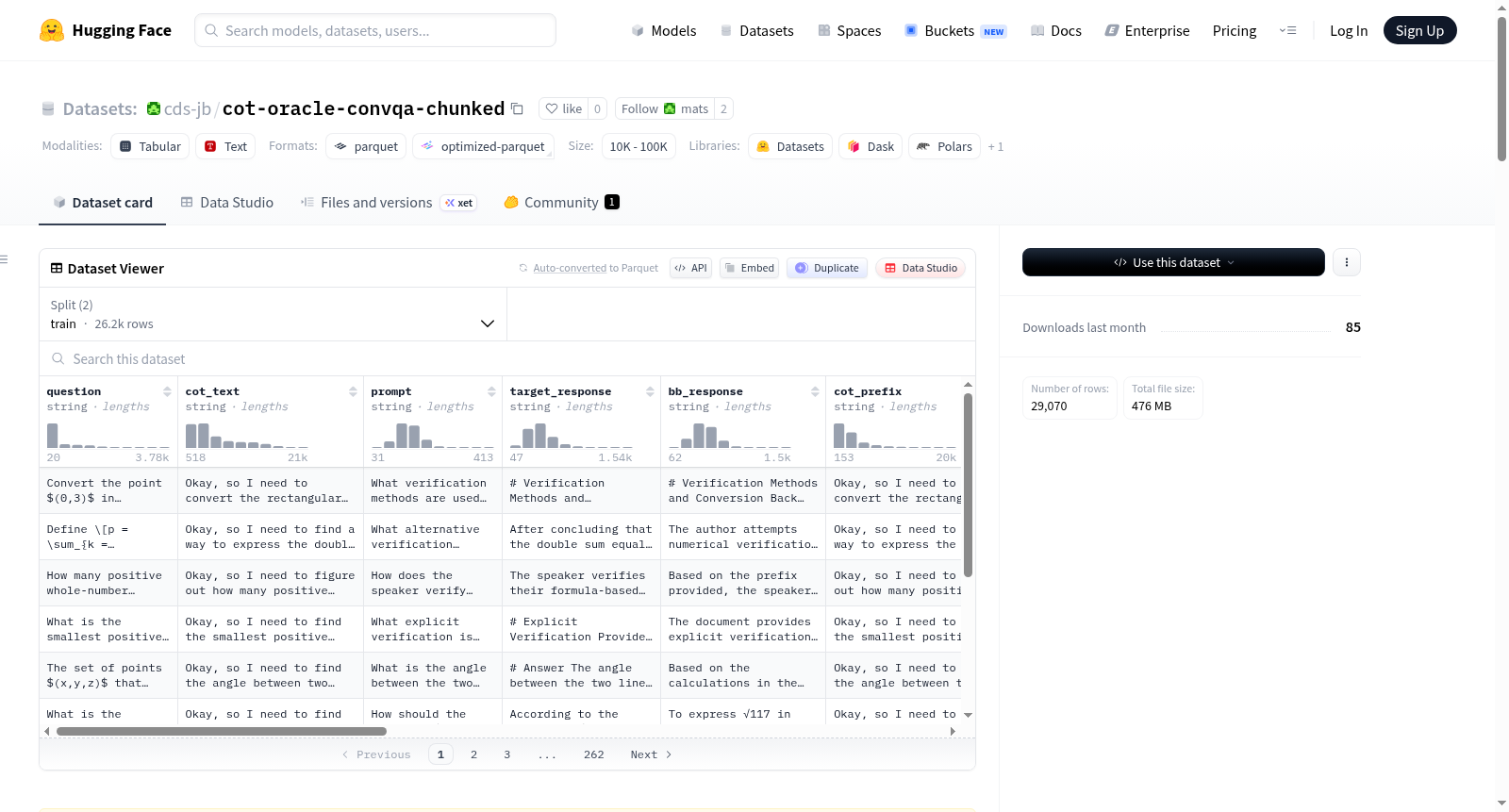
CoT Oracle: Chunked ConvQA (Haiku-rerun) 是一个专门用于评估和基准测试模型在信息间隙(oracle或info-gap)场景下推理能力的对话式问答(ConvQA)数据集。其构建方法基于大型语言模型(Anthropic Haiku 4.5)阅读完整思维链(CoT)文档,在自然转折点分割后生成问题(第一轮),仅基于前缀生成基线答案(第二轮),仅基于后缀生成标准答案(第三轮)。数据集通过比较基线答案与标准答案,由Haiku 4.5自动评分,以衡量模型利用有限上下文填补信息缺口的能力。数据来源于`cds-jb/cot-oracle-convqa-chunked`数据集的`cot_text`字段,经过句子级分词处理。每个样本包含原始问题文本、完整思维链文档、生成的问题、标准答案、基线答案及丰富元数据(如分割点、句子数量、来源任务域如MATH、GSM8K等、文档标识符)。新增字段包括:1) `target_response_distractor`:一个与标准答案在长度、结构和词汇上高度匹配但包含关键事实错误的强干扰项,用于更困难的识别评估;2) `question_category`:二元分类标签,将问题区分为“元认知类”(询问说话者状态或推理过程)和“程序类”(询问推理内容如计算或事实)。数据集规模为训练集26,180条,测试集2,890条,总计29,070条样本。基线模型在测试集上的平均正确率为57.5%,平均分级得分为0.588(5分制)。适用于模型推理分析、信息提取、答案识别(尤其存在强干扰项时)以及元认知与程序性提问理解等方面的评估和研究。
CoT Oracle: Chunked ConvQA (Haiku-rerun) is a conversational question answering (ConvQA) dataset specifically designed for evaluating and benchmarking model reasoning capabilities in information-gap (oracle or info-gap) scenarios. Its core construction pattern involves: first, a large language model (Anthropic Haiku 4.5) reads a complete chain-of-thought (CoT) document and selects a natural turning point to split it, generating a question about the suffix content (which cannot be directly inferred from the prefix, first round). Then, the model generates a baseline (BB) answer based solely on the prefix (second round). Finally, the model generates a ground truth (GT) answer based solely on the suffix (third round). The dataset automatically scores by comparing baseline answers with ground truth answers using the Haiku 4.5 model, thereby measuring the models ability to fill information gaps with limited context (prefix). The content primarily originates from the `cot_text` field of the `cds-jb/cot-oracle-convqa-chunked` dataset (full documents), processed with sentence-level tokenization. Each data sample includes the original question text, complete CoT document, generated question, ground truth answer, baseline answer, and rich metadata for reproduction and analysis, such as document prefix/suffix split points, sentence counts, source task domains (e.g., MATH, GSM8K), and unique document identifiers. The dataset specifically adds two new fields: 1) `target_response_distractor`: a strong distractor that closely matches the ground truth answer in length, structure, and vocabulary but contains a key factual error, used for more difficult recognition evaluation. 2) `question_category`: a binary classification label that categorizes generated questions into metacognitive (inquiring about speaker state or reasoning process itself, such as final answer, confidence, strategy shifts) and procedural (inquiring about reasoning content, such as calculations, formulas, factual recall). The dataset scale is 26,180 training samples and 2,890 test samples, totaling 29,070 samples. The baseline model achieves an average accuracy of 57.5% on the test set, with an average graded score of 0.588 (on a 5-point scale). It is suitable for evaluating and researching model reasoning analysis, information extraction, answer recognition (especially with strong distractors), and understanding of metacognitive vs. procedural questions.