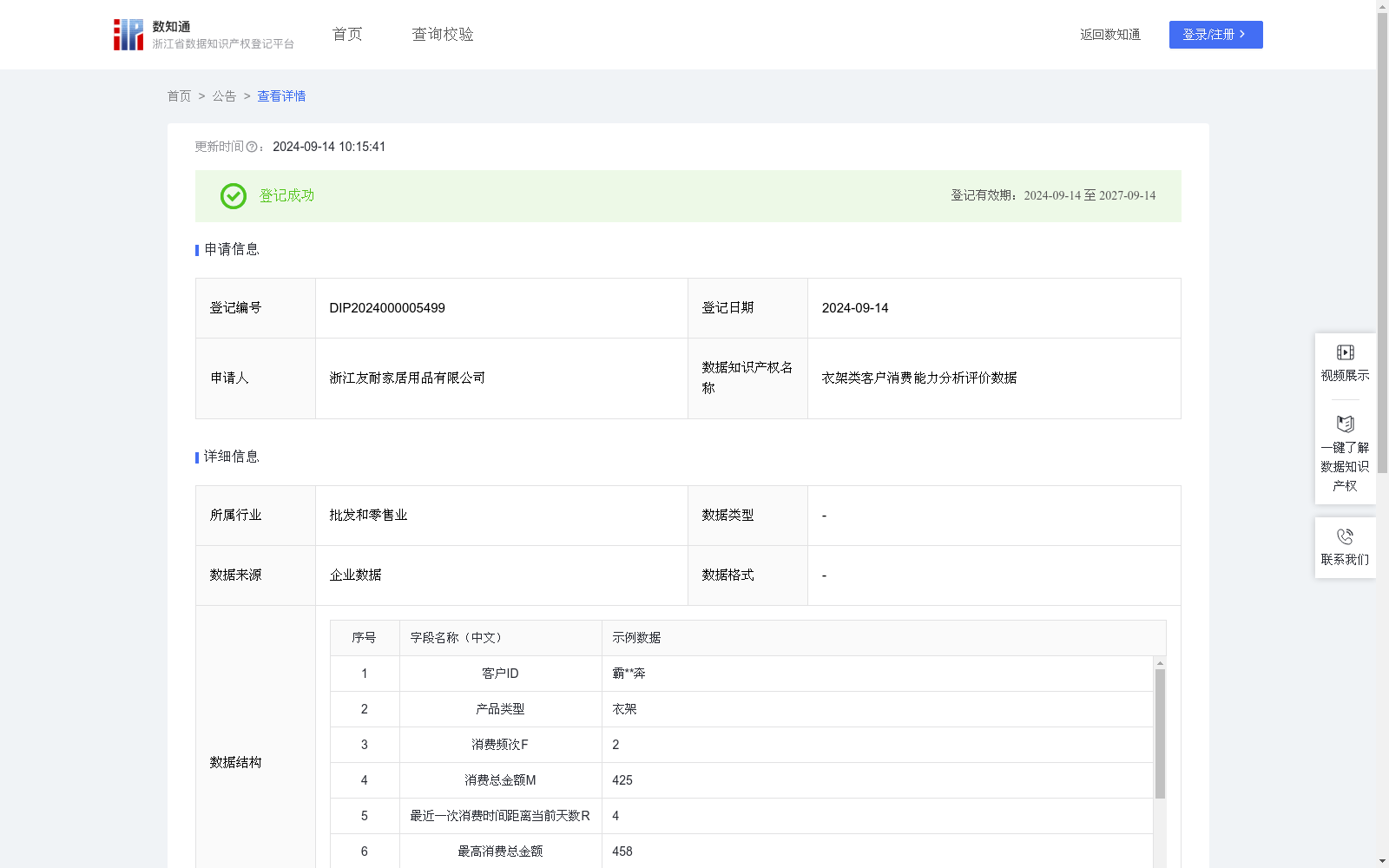
衣架类客户消费能力分析评价数据
收藏资源简介:
统计分析公司销售平台购买衣架类客户消费记录数据,通过对历史下单客户建立画像,对客户进行标签制定,定位客户消费级别,为精准营销提供必要的客户分类数据,针对不同级别客户有针对性的制定广告营销策略提供数据支持。研究机构等可以利用RFM客户消费能力分析评价数据,了解不同行业或细分市场的消费者行为特点,从而洞察市场趋势和潜在机会。金融机构(如银行、消费金融公司等)在审批信贷申请时,可以参考RFM数据来评估申请人的消费能力和还款意愿。高F值和M值的消费者可能表现出更强的还款能力和更高的信用评级。供应商和制造商可以利用RFM数据中的消费频次(F)和消费总金额(M)信息,预测不同产品的市场需求,从而优化生产计划和库存管理。 客户分类的算法规则采用RFM数据模型排序、聚类的方法,对平台上下单衣架的客户进行汇总,通过对客户的消费频次和消费时间间隔、消费总金额的排序、聚类,对客户进行分类。 1.数据来源:采集公司网络平台的销售数据,对数据进行清洗、去除无效数据等操作。 2.数据处理:采用RFM数据模型。通过对客户ID的聚类汇总消费频次F、消费总金额M、最近一次消费时间距离当前天数R,以此为维度对客户进行分类。 3.数据计算:R值得分=(30-R)/30*10,当R大于30天,则计0分;M值得分=M/最高消费总金额*10,最高消费总金额为采集时间段内客户下单总额的最高值;F值得分=F/最高消费频次*10,最高消费频次为采集时间段内客户消费频次的最高值;RFM综合评分=a*R值得分+b*F值得分+c*M值得分,a,b,c为权重系数分别为0.3,0.3,0.4。再根据RFM综合评分对客户进行分类,RFM综合评分≥7,为A类,RFM综合评分≥4,分为B类,RFM综合评分<4,为C类,对客户进行标签制定,定位客户消费级别,为精准营销提供必要的客户分类数据,针对不同级别客户有针对性的制定广告营销策略提供数据支持。
This dataset contains consumer transaction records of customers who purchased hangers from the sales platform of a statistics and analysis company. It builds customer profiles, develops customer tags, and classifies customers by their consumption levels, providing necessary categorized customer data for precision marketing, and supporting the formulation of targeted advertising and marketing strategies for different customer tiers. Research institutions can use the RFM-based consumer spending capability analysis and evaluation data to understand consumer behavior characteristics across various industries or market segments, so as to gain insights into market trends and potential opportunities. Financial institutions such as banks and consumer finance companies can refer to RFM data when reviewing credit applications to evaluate applicants' spending capacity and repayment willingness. Consumers with high F-values and M-values typically demonstrate stronger repayment capability and higher credit ratings. Suppliers and manufacturers can utilize the purchase frequency (F) and total transaction amount (M) information in RFM data to forecast market demand for different products, thereby optimizing production planning and inventory management. The customer classification algorithm adopts sorting and clustering methods based on the RFM data model. It aggregates customers who placed orders for hangers on the platform, and classifies customers by sorting and clustering their purchase frequency, time interval since last consumption, and total transaction amount. The specific implementation steps are as follows: 1. Data Source: Sales data was collected from the company's online platform, followed by data cleaning and removal of invalid data. 2. Data Processing: The RFM data model was applied. Aggregated metrics including purchase frequency (F), total transaction amount (M), and days since the most recent purchase (R) were obtained via clustering based on customer IDs, and these metrics were used as dimensions for customer classification. 3. Data Calculation: The R score is calculated as (30 - R)/30 * 10; if R exceeds 30 days, the score is set to 0. The M score is calculated as M / max_total_transaction * 10, where max_total_transaction refers to the highest total transaction amount of customer orders during the data collection period. The F score is calculated as F / max_purchase_frequency * 10, where max_purchase_frequency refers to the highest purchase frequency of customers during the data collection period. The comprehensive RFM score is calculated as a*R_score + b*F_score + c*M_score, with the weight coefficients a, b, and c being 0.3, 0.3, and 0.4 respectively. Customers are then classified based on their comprehensive RFM scores: Category A for scores ≥7, Category B for scores ≥4, and Category C for scores <4. This classification supports the development of customer tags and positioning of customer consumption levels, providing necessary categorized customer data for precision marketing and targeted advertising and marketing strategies for different customer tiers.