
近单一FCC相AlCoCrFeNi高熵合金的常温摩擦学行为及典型磨损机制
收藏中国科学院兰州化学物理研究所科学数据中心2023-08-16 更新2024-04-26 收录
下载链接:
https://ggjsfwdata.licp.cn/dataDetails/fb8ce924d5ee432684bc893ba8addc91
下载链接
链接失效反馈官方服务:
资源简介:
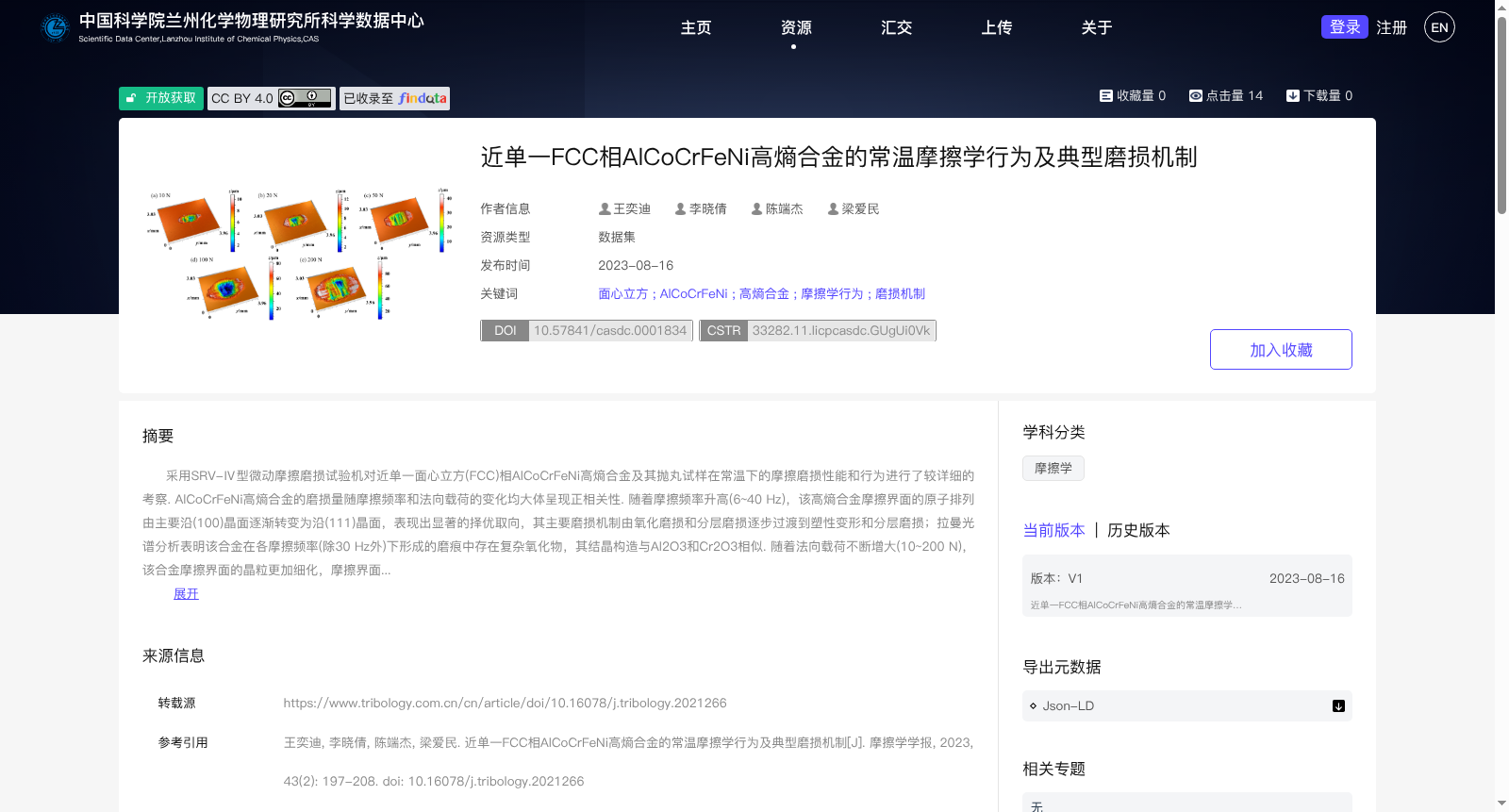
采用SRV-Ⅳ型微动摩擦磨损试验机对近单一面心立方(FCC)相AlCoCrFeNi高熵合金及其抛丸试样在常温下的摩擦磨损性能和行为进行了较详细的考察. AlCoCrFeNi高熵合金的磨损量随摩擦频率和法向载荷的变化均大体呈现正相关性. 随着摩擦频率升高(6~40 Hz),该高熵合金摩擦界面的原子排列由主要沿(100)晶面逐渐转变为沿(111)晶面,表现出显著的择优取向,其主要磨损机制由氧化磨损和分层磨损逐步过渡到塑性变形和分层磨损;拉曼光谱分析表明该合金在各摩擦频率(除30 Hz外)下形成的磨痕中存在复杂氧化物,其结晶构造与Al2O3和Cr2O3相似. 随着法向载荷不断增大(10~200 N),该合金摩擦界面的晶粒更加细化,摩擦界面的原子排列更加趋向沿(111)晶面,其主要磨损机制由氧化磨损过渡到疲劳磨损,最终转变为黏着磨损. 由于细晶强化作用,经抛丸处理后该AlCoCrFeNi高熵合金表面显微硬度达403 HV,相比抛丸前提高近1倍. 抛丸处理形成的表面强化层有利于降低合金的磨损,其厚度约为25 μm. 随着摩擦时间延长,该高熵合金抛丸试样的主导磨损机制由塑性变形和分层磨损逐渐转变为同时出现一定程度的氧化磨损;其中,塑性变形和分层磨损机制的组合能导致该合金抛丸试样发生零磨损行为. 近单一FCC相AlCoCrFeNi高熵合金及其抛丸试样因其特殊的元素组成和原子排布表现出丰富而典型的磨损行为和机制. 本研究阐明了该高熵合金在常温下的几种典型磨损机制,评估抛丸处理对其造成的实际影响,为该体系高熵合金和含有FCC相的复合结构高熵合金在磨损防护领域的合理运用及深入理解其使役行为提供重要依据.
A SRV-IV fretting friction and wear testing machine was used to conduct a detailed investigation on the friction and wear properties and behaviors of near-single face-centered cubic (FCC) phase AlCoCrFeNi high-entropy alloy (HEA) and its shot-peened specimens at room temperature. The wear loss of the AlCoCrFeNi HEA generally shows a positive correlation with changes in both friction frequency and normal load. As the friction frequency increases (6–40 Hz), the atomic arrangement at the friction interface of this HEA gradually shifts from primarily along the (100) crystal plane to the (111) crystal plane, exhibiting significant preferred orientation. Meanwhile, its dominant wear mechanism gradually transitions from oxidative wear and delamination wear to plastic deformation and delamination wear. Raman spectroscopic analysis reveals that complex oxides, whose crystal structures are similar to Al₂O₃ and Cr₂O₃, exist in the wear scars formed by this HEA at all friction frequencies except 30 Hz.
As the normal load continuously increases (10–200 N), the grains at the friction interface of this HEA become further refined, and the atomic arrangement at the interface increasingly tends to align along the (111) crystal plane. Its dominant wear mechanism transitions from oxidative wear to fatigue wear, and finally to adhesive wear. Owing to the fine-grain strengthening effect, the surface microhardness of this AlCoCrFeNi HEA after shot peening reaches 403 HV, which is nearly doubled compared to that before shot peening. The surface strengthening layer formed by shot peening helps reduce the wear of the alloy, with a thickness of approximately 25 μm.
As the friction time prolongs, the dominant wear mechanism of the shot-peened HEA specimens gradually shifts to a certain degree of oxidative wear coexisting with plastic deformation and delamination wear. Notably, the combination of plastic deformation and delamination wear can lead to zero-wear behavior in these shot-peened specimens. The near-single FCC phase AlCoCrFeNi HEA and its shot-peened specimens exhibit rich and typical wear behaviors and mechanisms due to their unique elemental composition and atomic arrangement.
This study clarifies several typical wear mechanisms of this HEA at room temperature, evaluates the actual impact of shot peening treatment on it, and provides important guidance for the rational application of this series of HEAs and composite structural HEAs containing FCC phases in the field of wear protection, as well as for in-depth understanding of their service behaviors.
提供机构:
中国科学院兰州化学物理研究所科学数据中心
创建时间:
2023-08-16
搜集汇总
数据集介绍
背景与挑战
背景概述
该数据集研究近单一面心立方(FCC)相AlCoCrFeNi高熵合金在常温下的摩擦学行为和磨损机制,通过SRV-Ⅳ型微动摩擦磨损试验机分析磨损量随摩擦频率和法向载荷的变化,揭示从氧化磨损到塑性变形等机制转变。同时,考察抛丸处理对表面硬度和磨损的影响,为高熵合金在磨损防护领域的应用提供实验依据。
以上内容由遇见数据集搜集并总结生成


