
Responses to low phosphorus conditions of <i>Triadic sebifera</i> (Euphorbiaceae), an invasive plant species on Miyajima Island, southwest Japan
收藏DataCite Commons2025-03-05 更新2025-01-06 收录
下载链接:
https://tandf.figshare.com/articles/dataset/Responses_to_low_phosphorus_conditions_of_i_Triadic_sebifera_i_Euphorbiaceae_an_invasive_plant_species_on_Miyajima_Island_southwest_Japan/27965534/1
下载链接
链接失效反馈官方服务:
资源简介:
Phosphorus (P) is a crucial nutrient for plant growth, but its availability in soils is often limited. Invasive plants have shown enhanced utilization of essential elements in soil, including P, compared to native plants, contributing to their success. This study investigated the responses of <i>Triadic sebifera</i>, an invasive species, to low P conditions. We compared <i>T. sebifera</i> with native <i>Mallotus japonicus</i> and other local plants in field conditions and further examined <i>T. sebifera</i>‘s response to low P availability using hydroponic systems and RNA-seq analysis. The hydroponic experiments involved three treatment groups with different P concentrations (0, 6.4, and 64 µM ). Field survey results revealed that <i>T. sebifera</i> exhibited higher P use efficiency and more efficient P resorption compared to other native plants on Miyajima Island. However, no significant differences in P concentrations were found between <i>T. sebifera</i> and native plant <i>M. japonicus</i>, another member of the Euphorbiaceae family. This suggests that the efficient use and resorption of P may not be unique to the invasive species <i>T. sebifera</i>, but rather a trait shared by members of the Euphorbiaceae family. Hydroponic experiments further demonstrated the response of <i>T. sebifera</i> to low P availability. Under 0 µM P treatment, <i>T. sebifera</i> showed enhanced secretion of acid phosphatase (AcPase). At 6.4 µM P treatment, the plant maintained growth, exhibited potential enhancement in root development, high chlorophyll content, and high root biomass, and demonstrated relatively high AcPase secretion, but displayed a P-deficient state compared to the 0 and 64 µM P treatments. RNA-seq analysis provided insights into the potential strategies of <i>T. sebifera</i> in low P environments. It revealed that <i>T. sebifera</i> under 0 µM P treatment exhibits upregulation of transcripts related to P acquisition, antioxidant activities, stress responses, and arsenate uptake risk or regulation. Additionally, <i>T. sebifera</i> showed upregulation of transcripts associated with secondary metabolism under 6.4 µM P treatment, suggesting mechanisms for more efficient P acquisition and environmental stress defense. This study highlights the strategies of <i>T. sebifera</i> under low P availability, suggesting a role in enhancing its own P utilization efficiency, which may contribute to its successful invasion.
磷(Phosphorus, P)是植物生长不可或缺的关键营养元素,但土壤中磷的有效态供给往往受限。相较于本土植物,入侵植物对包括磷在内的土壤必需元素的利用效率更高,这也是其入侵成功的重要原因之一。本研究以入侵物种乌桕(*Triadic sebifera*)为研究对象,探究其在低磷环境下的响应特征。
我们在野外条件下将乌桕与本土植物野桐(*Mallotus japonicus*)及其他本地植物进行了对比,并通过水培系统和RNA测序(RNA-seq)进一步分析乌桕对低磷有效性的响应。水培实验设置了3个不同磷浓度的处理组:0、6.4和64 µM。
野外调查结果显示,在宫岛(Miyajima Island)的样地中,乌桕的磷利用效率及磷回收效率均高于其他本土植物。但乌桕与同属大戟科(Euphorbiaceae)的本土植物野桐之间,磷浓度并无显著差异。这表明高效利用与回收磷并非入侵物种乌桕的独有性状,而是大戟科植物共有的特征。
水培实验进一步验证了乌桕对低磷环境的响应。在0 µM磷处理组中,乌桕的酸性磷酸酶(acid phosphatase, AcPase)分泌量显著提升。在6.4 µM磷处理组中,乌桕能够维持正常生长,根系发育、叶绿素含量及根生物量均表现出潜在提升趋势,同时酸性磷酸酶分泌量仍处于较高水平,但相较于0和64 µM处理组,该组植株仍处于磷缺乏状态。
RNA测序分析揭示了乌桕适应低磷环境的潜在策略。在0 µM磷处理下,乌桕中与磷获取、抗氧化活性、胁迫响应以及砷酸盐吸收风险调控相关的转录本均出现上调表达。
此外,在6.4 µM磷处理下,乌桕中与次生代谢相关的转录本上调,这提示其存在更高效的磷获取机制与环境胁迫防御机制。本研究阐明了乌桕在低磷有效性环境下的适应策略,表明其可通过提升自身磷利用效率来增强竞争力,这可能是其成功入侵的关键机制之一。
提供机构:
Taylor & Francis创建时间:
2024-12-05
搜集汇总
数据集介绍
背景与挑战
背景概述
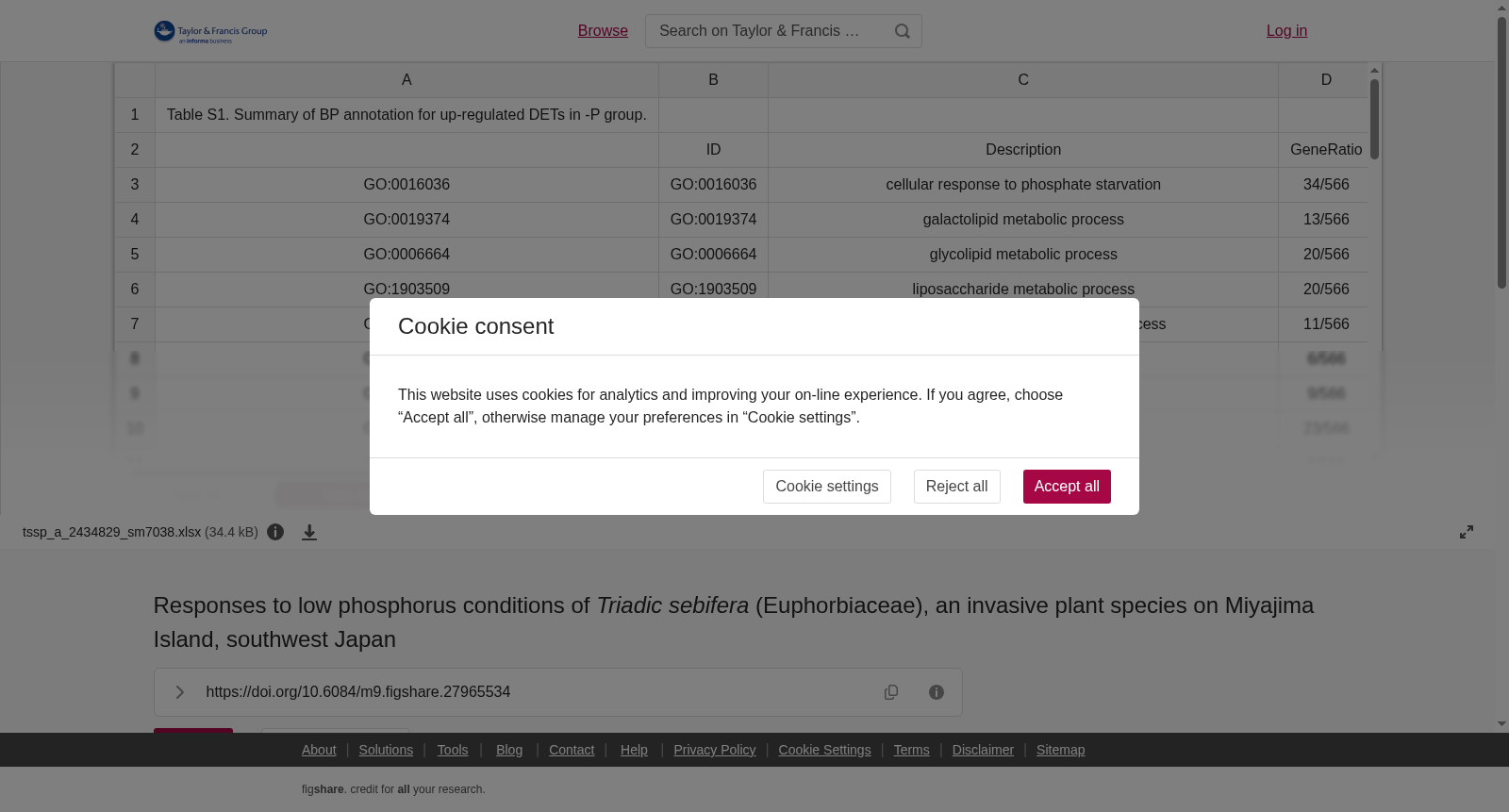
该数据集研究了入侵植物Triadic sebifera在低磷条件下的生理和分子响应机制,通过野外调查、水培实验和RNA-seq分析,揭示了其较高的磷利用效率和适应性策略,如酸性磷酸酶分泌增强和转录组上调,这些特性可能部分与大戟科植物共有,有助于理解其入侵成功的原因。数据以Excel表格形式提供,包含实验和转录组分析结果。
以上内容由遇见数据集搜集并总结生成


