The Dark (and Bright) Side of IoT: Attacks and Countermeasures for Identifying Smart Home Devices and Services Dataset
收藏数据集概述
数据集名称
The Dark (and Bright) Side of IoT: Attacks and Countermeasures for Identifying Smart Home Devices and Services -- Dataset
数据收集方法
- 使用[Airodump-ng]识别受害接入点和连接设备。
- 获取设备的MAC地址和WiFi信道信息。
- 设置Alfa卡信道与智能设备信道一致。
- 使用[TCPDump]或[Wireshark]收集并过滤来自接入点至各IoT设备的流量。
- 提取每条无线消息的时间和包大小。
数据集内容
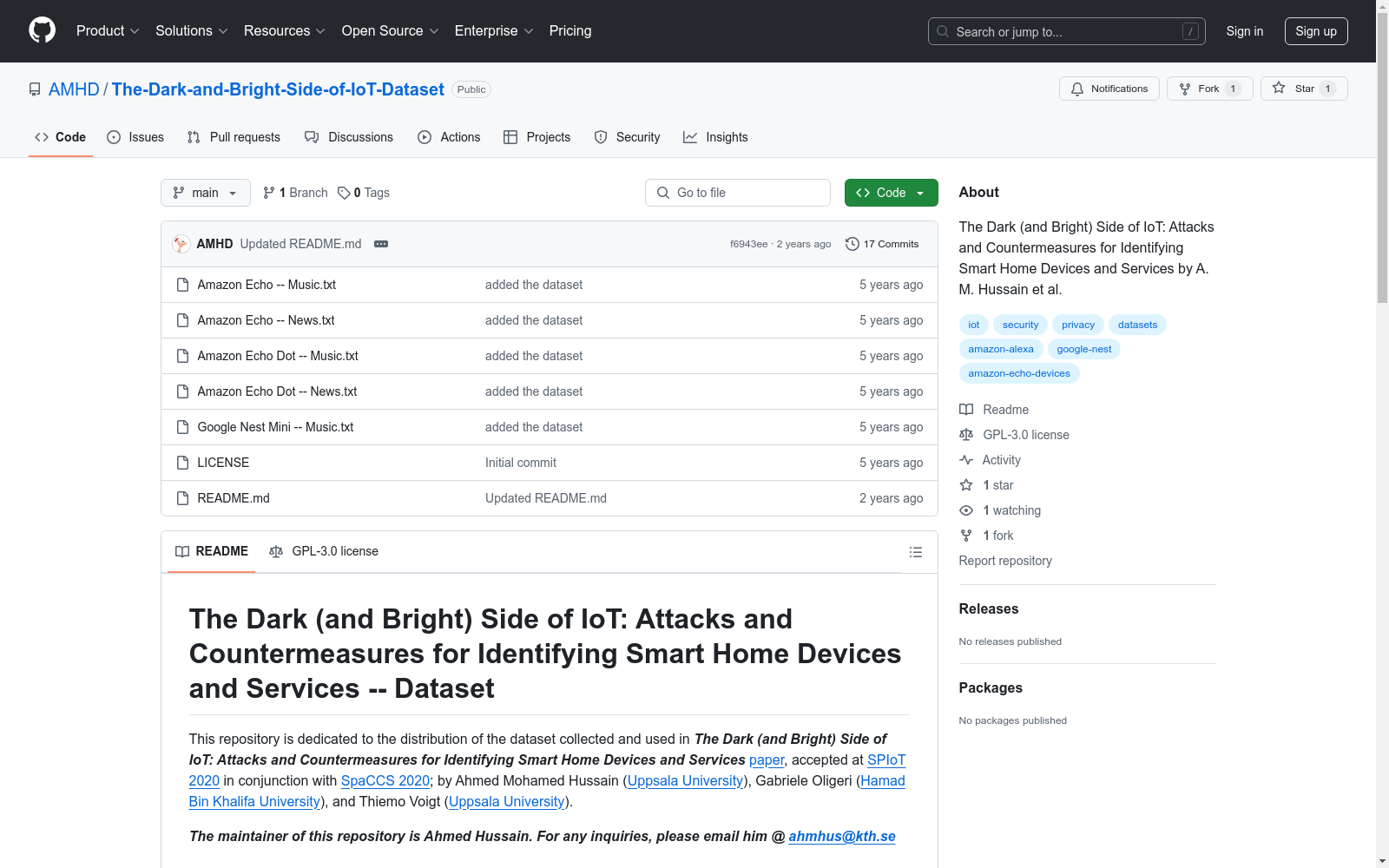
- Amazon Echo -- Music
- Amazon Echo -- News
- Amazon Echo Dot -- Music
- Amazon Echo Dot -- News
- Google Nest Mini -- Music
文件格式
- RAW Time: 捕获开始以来的秒数
- RAW Packet size: 字节数
引用信息
当使用此数据集时,请按以下方式引用相关论文:
@inproceedings{hussain2020dark, title="{The Dark (and Bright) Side of IoT: Attacks and Countermeasures for Identifying Smart Home Devices and Services}", author={Hussain, Ahmed Mohamed and Oligeri, Gabriele and Voigt, Thiemo}, booktitle={International Conference on Security, Privacy and Anonymity in Computation, Communication and Storage}, pages={122--136}, year={2020}, organization={Springer} }
或
@article{hussain2020dark, title="{The Dark (and Bright) Side of IoT: Attacks and Countermeasures for Identifying Smart Home Devices and Services}", author={Hussain, Ahmed Mohamed and Oligeri, Gabriele and Voigt, Thiemo}, journal={arXiv preprint arXiv:2009.07672}, year={2020} }
或
@InProceedings{hussainIoTDark, author="Hussain, Ahmed Mohamed and Oligeri, Gabriele and Voigt, Thiemo", editor="Wang, Guojun and Chen, Bing and Li, Wei and Di Pietro, Roberto and Yan, Xuefeng and Han, Hao", title="{The Dark (and Bright) Side of IoT: Attacks and Countermeasures for Identifying Smart Home Devices and Services}", booktitle="Security, Privacy, and Anonymity in Computation, Communication, and Storage", year="2021", publisher="Springer International Publishing", address="Cham", pages="122--136", abstract="We present a new machine learning-based attack that exploits network patterns to detect the presence of smart IoT devices and running services in the WiFi radio spectrum. We perform an extensive measurement campaign of data collection, and we build up a model describing the traffic patterns characterizing three popular IoT smart home devices, i.e., Google Nest Mini, Amazon Echo, and Amazon Echo Dot. We prove that it is possible to detect and identify with overwhelming probability their presence and the services running by the aforementioned devices in a crowded WiFi scenario. This work proves that standard encryption techniques alone are not sufficient to protect the privacy of the end-user, since the network traffic itself exposes the presence of both the device and the associated service. While more work is required to prevent non-trusted third parties to detect and identify the users devices, we introduce Eclipse, a technique to mitigate these types of attacks, which reshapes the traffic making the identification of the devices and the associated services similar to the random classification baseline.", isbn="978-3-030-68884-4" }
许可证