VynFi/vynfi-journal-entries-10m
收藏资源简介:
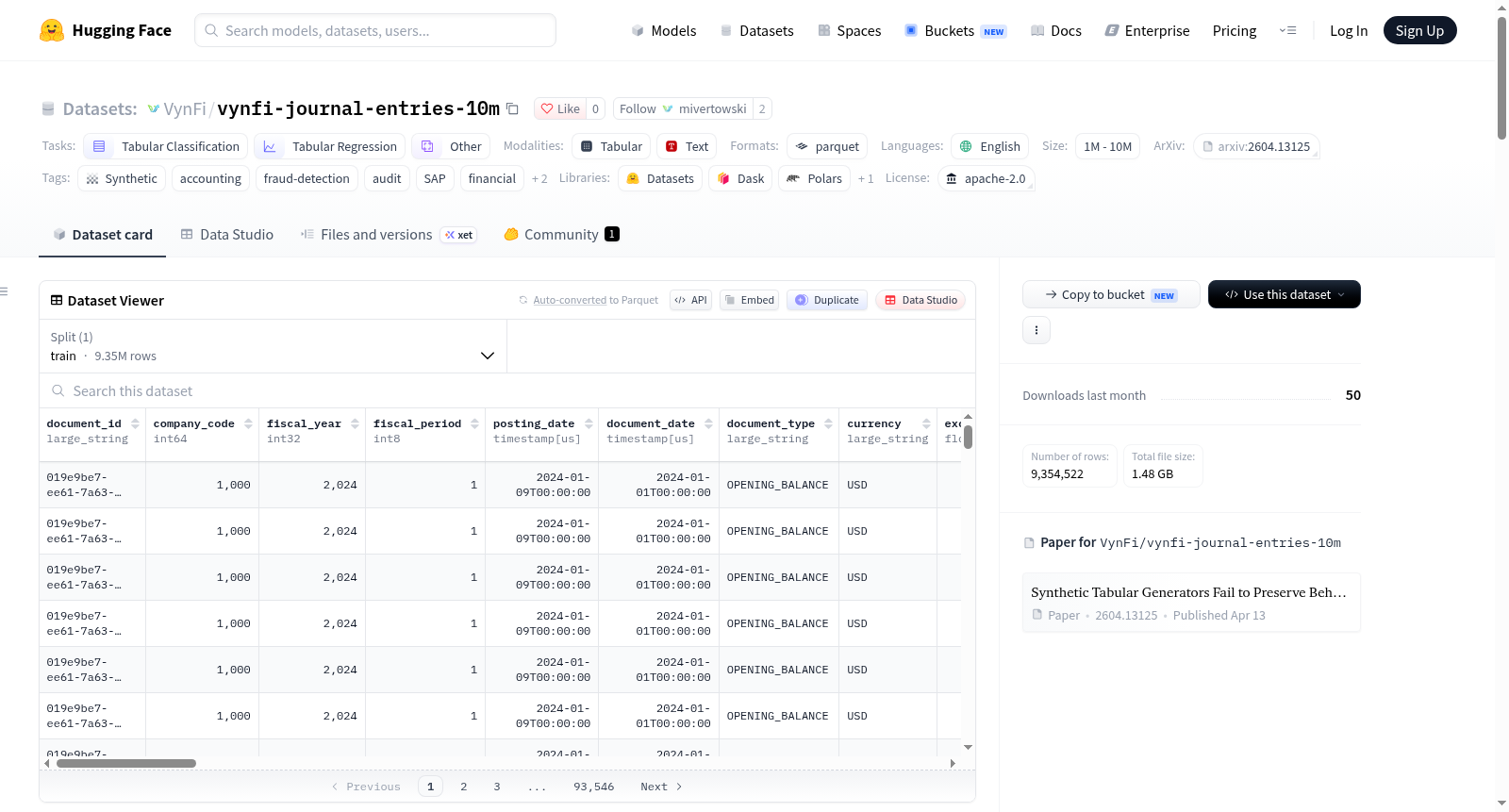
--- license: apache-2.0 task_categories: - tabular-classification - tabular-regression - other language: en size_categories: - 10M<n<100M tags: - synthetic - accounting - fraud-detection - audit - SAP - financial - benchmark - research-scale configs: - config_name: default data_files: - split: train path: data/train-*.parquet --- # VynFi Journal Entries — 10M (v5.29 SOTA mode, research scale) > **Research-scale synthetic GL dataset.** ~10.9 M journal-entry lines from > a 10-company multinational, generated by DataSynth v5.29.0 with the full > SOTA-N structural-fidelity round + the central concentration abstraction > (`ConcentrationPipeline`, #143). Companion to > [`VynFi/vynfi-journal-entries-1m`](https://huggingface.co/datasets/VynFi/vynfi-journal-entries-1m) > (same generator, same lever stack, same fraud-typology + anomaly-type > columns) but ~10× scale, for behavioural-fidelity research, GNN training > at scale, and head-to-head benchmarks against learned tabular generators > (CTGAN / TVAE / GaussianCopula / TabularARGN). ## Why a 10M variant exists alongside the 1M one - **1M** is the canonical showcase — small enough to download (~70 MB compressed) and benchmark on a laptop, used for the published BF numbers + dataset cards. - **10M** is the same data shape at 10× volume — adequate for training GraphSAGE / TabularARGN / diffusion models without the per-source IET / autocorrelation undersampling that 1M exhibits at the corpus's wider source vocabulary. ML research scale. Both use the same v5.29 SOTA-mode config (10 companies × `Custom(N)` × 12 months); the 10M variant just bumps the per-company custom volume from 250 K to 2.5 M. ## Structural metrics (vs reference) Cross-industry manufacturing GL, comparison reference at 300k-JE deterministic sample. From `experiments/ml/FINDINGS.md` §10: | Metric (reference target) | v1 (v5.27 baseline) | **v5.29 SOTA** | reference | |---|--:|--:|--:| | account top-10% line share | 0.16 | **0.946** | 0.95 | | recurring-archetype share | 0.131 | **0.885** | 0.967 | | top-50 archetype coverage | 0.030 | **0.480** | 0.651 | | reversal proxy | 0.0015 | **0.034** | 0.100 | | flow-graph edge entropy *(lower=more templated)* | 10.75 | **7.95** | 5.95 | | `AB` allocation lines/JE | absent | **55.7** | 52.2 | | distinct source codes | 429 | 405 | 46 | | Business Unit dimension | absent | **23.5% / 11 BUs, coherent** | 82% / 11 | | multi-currency lines (SAP DMBTR/WRBTR) | absent | **present (3.2%)** | ~3.5% | | blank-source rate (SOTA-7) | 0% | **20.6%** | ~21% | | trading-partner pool size | ~40 | **12** | ~12 | | amount distribution p99 | 16× reference | **reference-match** | — | | lines-per-JE mean | 11 | **4.6** | 4.5 | ## Behavioral fidelity (Sajja 2026 P1-P4 framework) Composite DRs over 26 P1-P4 sub-metrics, computed against a single GL reference shard with `datasynth-data behavioral score --profile gl-source-tp`. Lower is better; 1.0 = real-data 50/50-split noise floor. | Generator | Paradigm | Composite mean | vol-corrected | |---|---|--:|--:| | **DataSynth v5.29 SOTA — 10M (this dataset)** | rule + process + post-process | 251.3× | **65.8×** | | DataSynth v5.27 (v1 baseline) | rule + process (no concentration) | 63.1× | 109.3× | | TabularARGN (Sajja paper) | learned autoregressive (single-row) | 36.3× | n/a | | CTGAN (Sajja paper) | learned GAN | 32.2× | n/a | | TVAE (Sajja paper) | learned VAE (post conditional sampling) | 24.4× | n/a | | GaussianCopula (Sajja paper) | learned copula | 39.0× | n/a | | Real-data noise floor | — | 1.0× | 1.0× | - v5.29 vs v5.27 vol-corrected composite: **-40%** improvement. - The Sajja paper's row-independent paradigm is structurally bound by Propositions 1 & 2 (cannot reproduce P3 graph motifs or positive within-entity IET autocorrelation). DataSynth's rule-based joint JE generation does not have that bottleneck. ### Methodology update — multi-seed variance (2026-05-27) The DRs above are computed from a single half-split of the reference shard (seed=42). A three-seed re-evaluation revealed substantial methodological single-shard variance: | sub-metric | 3-seed mean | std | CV | |---|--:|--:|--:| | P1 IETD W₁ | 37.4 | 21.1 | 56 % | | **P1 IET autocorr** | **29.8** | **30.8** | **103 %** ⚠️ | | P2 Active lifetime | 90.7 | 10.7 | 12 % | | **P2 Burst length** | **12.2** | **0.2** | **1.9 %** ✓ | | P3 Fanout | 298.9 | 75.3 | 25 % | | **Composite** | **93.8** | **23.7** | **25 %** | P1 autocorrelation DR is methodologically unstable (CV 103 %, range 1.96–62.84). P2 burst length is the most reliable fidelity anchor. Single-shard DRs are reference points; the honest single-number Sajja-composite summary is **94 ± 24 (n=3 seeds)**. Future releases will report multi-seed mean + std as the headline. ## Quick start ```python from datasets import load_dataset ds = load_dataset("VynFi/vynfi-journal-entries-10m") print(ds["train"].column_names) # 52 columns print(ds["train"].num_rows) # 10,915,403 lines ``` Aux artefacts in the same repo: - `chart_of_accounts.parquet` - `je_network.parquet` (Method A; ~1 edge / 2-line JE) - `cost_centers.parquet`, `profit_centers.parquet` ## Generation config `configs/examples/hf/journal_entries_1m_sota.yaml` (with per-company volume bumped to `Custom(2_500_000)`) in [`mivertowski/SyntheticData @ v5.29.0`](https://github.com/mivertowski/SyntheticData/releases/tag/v5.29.0). ```bash datasynth-data validate --config journal_entries_1m_sota.yaml datasynth-data generate --config journal_entries_1m_sota.yaml ``` ## Citation ```bibtex @dataset{vynfi_je_10m_2026, author = {Ivertowski, Michael and DataSynth contributors}, title = {VynFi Journal Entries 10M (v5.29 SOTA mode)}, year = {2026}, publisher = {VynFi / Hugging Face}, url = {https://huggingface.co/datasets/VynFi/vynfi-journal-entries-10m}, version = {v5.29.0}, } ``` Companion P1-P4 framework: ```bibtex @article{sajja2026behavioral, author = {Sajja, Bhavana}, title = {Synthetic Tabular Generators Fail to Preserve Behavioral Fraud Patterns: A Benchmark on Temporal, Velocity, and Multi-Account Signals}, year = {2026}, eprint = {arXiv:2604.13125v1} } ``` ## Reproducibility | artefact | path / hash | |---|---| | Generator binary | `datasynth-data 5.29.0` (release tag `v5.29.0`) | | Config | `configs/examples/hf/journal_entries_1m_sota.yaml` @ `v5.29.0` (volume bumped to 2.5M) | | BF score script | `datasynth-data behavioral score --profile gl-source-tp` | | Run seed | `20260526` | | BF reports | `docs/baselines/2026-05-26-v5.29.0-10m/je10m/` | | Trained GNN on this data | [`VynFi/je-fraud-gnn`](https://huggingface.co/VynFi/je-fraud-gnn) (test AUC 0.919) |
Research-scale synthetic GL dataset. ~10.9 M journal-entry lines from a 10-company multinational, generated by DataSynth v5.29.0 with the full SOTA-N structural-fidelity round + the central concentration abstraction (`ConcentrationPipeline`, #143). Companion to [`VynFi/vynfi-journal-entries-1m`](https://huggingface.co/datasets/VynFi/vynfi-journal-entries-1m) (same generator, same lever stack, same fraud-typology + anomaly-type columns) but ~10× scale, for behavioural-fidelity research, GNN training at scale, and head-to-head benchmarks against learned tabular generators (CTGAN / TVAE / GaussianCopula / TabularARGN).