
wikipunk/d3fend
收藏Hugging Face2023-09-29 更新2024-03-04 收录
下载链接:
https://hf-mirror.com/datasets/wikipunk/d3fend
下载链接
链接失效反馈官方服务:
资源简介:
---
language:
- en
license: mit
tags:
- knowledge-graph
- rdf
- owl
- ontology
- cybersecurity
annotations_creators:
- expert-generated
pretty_name: D3FEND
size_categories:
- 100K<n<1M
task_categories:
- graph-ml
dataset_info:
features:
- name: subject
dtype: string
- name: predicate
dtype: string
- name: object
dtype: string
config_name: default
splits:
- name: train
num_bytes: 46899451
num_examples: 231842
dataset_size: 46899451
viewer: false
---
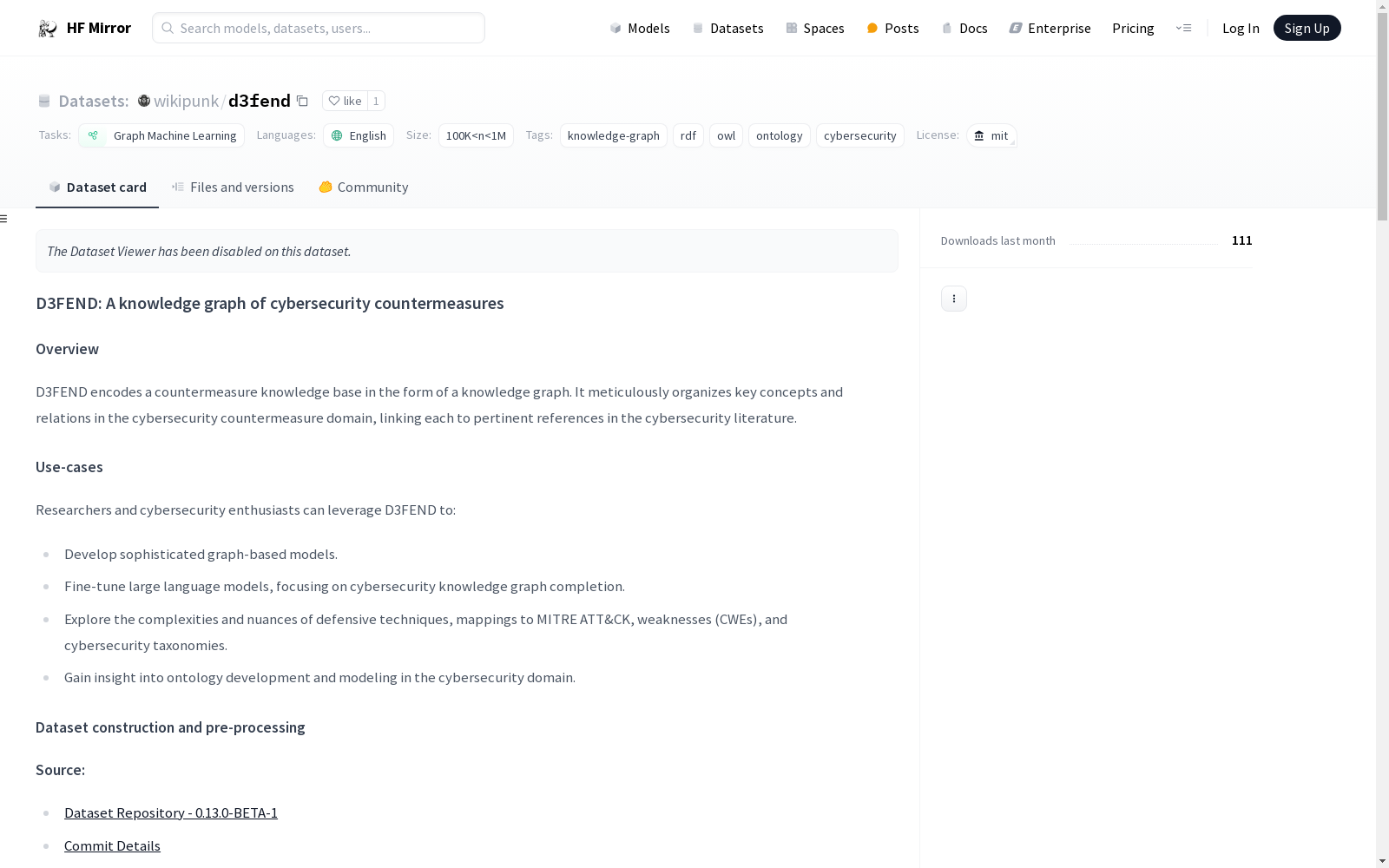
# D3FEND: A knowledge graph of cybersecurity countermeasures
### Overview
D3FEND encodes a countermeasure knowledge base in the form of a
knowledge graph. It meticulously organizes key concepts and relations
in the cybersecurity countermeasure domain, linking each to pertinent
references in the cybersecurity literature.
### Use-cases
Researchers and cybersecurity enthusiasts can leverage D3FEND to:
- Develop sophisticated graph-based models.
- Fine-tune large language models, focusing on cybersecurity knowledge
graph completion.
- Explore the complexities and nuances of defensive techniques,
mappings to MITRE ATT&CK, weaknesses (CWEs), and cybersecurity
taxonomies.
- Gain insight into ontology development and modeling in the
cybersecurity domain.
### Dataset construction and pre-processing
### Source:
- [Dataset Repository - 0.13.0-BETA-1](https://github.com/d3fend/d3fend-ontology/tree/release/0.13.0-BETA-1)
- [Commit Details](https://github.com/d3fend/d3fend-ontology/commit/3dcc495879bb62cee5c4109e9b784dd4a2de3c9d)
- [CWE Extension](https://github.com/d3fend/d3fend-ontology/tree/release/0.13.0-BETA-1/extensions/cwe)
#### Building and Verification:
1. **Construction**: The ontology, denoted as `d3fend-full.owl`, was
built from the beta version of the D3FEND ontology referenced
above using documented README in d3fend-ontology. This includes the
CWE extensions.
2. **Import and Reasoning**: Imported into Protege version 5.6.1,
utilizing the Pellet reasoner plugin for logical reasoning and
verification.
3. **Coherence Check**: Utilized the Debug Ontology plugin in Protege
to ensure the ontology's coherence and consistency.
#### Exporting, Transformation, and Compression:
Note: The following steps were performed using Apache Jena's command
line tools. (https://jena.apache.org/documentation/tools/)
1. **Exporting Inferred Axioms**: Post-verification, I exported
inferred axioms along with asserted axioms and
annotations. [Detailed
Process](https://www.michaeldebellis.com/post/export-inferred-axioms)
2. **Filtering**: The materialized ontology was filtered using
`d3fend.rq` to retain relevant triples.
3. **Format Transformation**: Subsequently transformed to Turtle and
N-Triples formats for diverse usability. Note: I export in Turtle
first because it is easier to read and verify. Then I convert to
N-Triples.
```shell
arq --query=d3fend.rq --data=d3fend.owl --results=turtle > d3fend.ttl
riot --output=nt d3fend.ttl > d3fend.nt
```
4. **Compression**: Compressed the resulting ontology files using
gzip.
## Features
The D3FEND dataset is composed of triples representing the
relationships between different cybersecurity countermeasures. Each
triple is a representation of a statement about a cybersecurity
concept or a relationship between concepts. The dataset includes the
following features:
### 1. **Subject** (`string`)
The subject of a triple is the entity that the statement is about. In
this dataset, the subject represents a cybersecurity concept or
entity, such as a specific countermeasure or ATT&CK technique.
### 2. **Predicate** (`string`)
The predicate of a triple represents the property or characteristic of
the subject, or the nature of the relationship between the subject and
the object. For instance, it might represent a specific type of
relationship like "may-be-associated-with" or "has a reference."
### 3. **Object** (`string`)
The object of a triple is the entity that is related to the subject by
the predicate. It can be another cybersecurity concept, such as an
ATT&CK technique, or a literal value representing a property of the
subject, such as a name or a description.
### Usage
First make sure you have the requirements installed:
```python
pip install datasets
pip install rdflib
```
You can load the dataset using the Hugging Face Datasets library with
the following Python code:
```python
from datasets import load_dataset
dataset = load_dataset('wikipunk/d3fend', split='train')
```
#### Note on Format:
The subject, predicate, and object are stored in N3 notation, a
verbose serialization for RDF. This allows users to unambiguously
parse each component using `rdflib.util.from_n3` from the RDFLib
Python library. For example:
```python
from rdflib.util import from_n3
subject_node = from_n3(dataset[0]['subject'])
predicate_node = from_n3(dataset[0]['predicate'])
object_node = from_n3(dataset[0]['object'])
```
Once loaded, each example in the dataset will be a dictionary with
`subject`, `predicate`, and `object` keys corresponding to the
features described above.
### Example
Here is an example of a triple in the dataset:
- Subject: `"<http://d3fend.mitre.org/ontologies/d3fend.owl#T1550.002>"`
- Predicate: `"<http://d3fend.mitre.org/ontologies/d3fend.owl#may-be-associated-with>"`
- Object: `"<http://d3fend.mitre.org/ontologies/d3fend.owl#T1218.014>"`
This triple represents the statement that the ATT&CK technique
identified by `T1550.002` may be associated with the ATT&CK technique
identified by `T1218.014`.
### Acknowledgements
This ontology is developed by MITRE Corporation and is licensed under
the MIT license. I would like to thank the authors for their work
which has opened my eyes to a new world of cybersecurity modeling.
If you are a cybersecurity expert please consider [contributing to
D3FEND](https://d3fend.mitre.org/contribute/).
[D3FEND Resources](https://d3fend.mitre.org/resources/)
### Citation
```bibtex
@techreport{kaloroumakis2021d3fend,
title={Toward a Knowledge Graph of Cybersecurity Countermeasures},
author={Kaloroumakis, Peter E. and Smith, Michael J.},
institution={The MITRE Corporation},
year={2021},
url={https://d3fend.mitre.org/resources/D3FEND.pdf}
}
```
语言:
- 英语
许可证:MIT许可证
标签:
- 知识图谱(knowledge graph)
- 资源描述框架(RDF)
- Web本体语言(OWL)
- 本体(ontology)
- 网络安全
标注生成者:
- 专家生成
友好名称:D3FEND
样本规模分类:
- 10万<样本数<100万
任务类别:
- 图机器学习(graph-ml)
数据集信息:
特征:
- 名称:subject(主题),数据类型:字符串
- 名称:predicate(谓词),数据类型:字符串
- 名称:object(客体),数据类型:字符串
配置名称:default(默认配置)
划分:
- 名称:train(训练集),数据字节数:46899451,样本数:231842
数据集总大小:46899451
数据查看器:未启用
# D3FEND:网络安全防御措施知识图谱
## 概述
D3FEND以知识图谱的形式编码了防御措施知识库,其精心梳理了网络安全防御领域的核心概念与关联关系,并将每个条目与网络安全领域文献中的相关参考文献进行关联。
## 应用场景
研究人员与网络安全爱好者可借助D3FEND完成以下工作:
- 构建复杂的基于图的模型
- 针对网络安全知识图谱补全任务,对大语言模型(LLM)进行微调
- 探究防御技术的复杂内涵与细微差异,以及其与MITRE攻击战术技术和通用知识库(MITRE ATT&CK)、通用弱点枚举(CWE)以及网络安全分类体系的映射关系
- 深入了解网络安全领域的本体开发与建模方法
## 数据集构建与预处理
### 数据源
- [数据集仓库 - 0.13.0-BETA-1版本](https://github.com/d3fend/d3fend-ontology/tree/release/0.13.0-BETA-1)
- [提交详情](https://github.com/d3fend/d3fend-ontology/commit/3dcc495879bb62cee5c4109e9b784dd4a2de3c9d)
- [CWE扩展模块](https://github.com/d3fend/d3fend-ontology/tree/release/0.13.0-BETA-1/extensions/cwe)
#### 构建与验证
1. **构建**:本数据集基于上述引用的D3FEND本体测试版,结合d3fend-ontology仓库中的官方README文档完成构建,生成的本体文件名为`d3fend-full.owl`,其中包含CWE扩展模块。
2. **导入与推理**:将构建完成的本体导入至Protege 5.6.1版本本体开发工具中,并使用Pellet推理机插件进行逻辑推理与一致性验证。
3. **一致性检查**:通过Protege内置的Debug Ontology插件,对本体的连贯性与一致性进行校验。
#### 导出、格式转换与压缩
注:以下步骤均通过Apache Jena命令行工具完成(https://jena.apache.org/documentation/tools/)
1. **导出推理公理**:验证完成后,导出推理得到的公理与显式声明的公理及标注信息。[详细流程](https://www.michaeldebellis.com/post/export-inferred-axioms)
2. **过滤处理**:使用`d3fend.rq`查询文件对实例化后的本体进行过滤,仅保留符合要求的三元组。
3. **格式转换**:将过滤后的本体转换为Turtle与N-三元组(N-Triples)格式以适配不同使用场景。注:优先导出为Turtle格式是因其更便于阅读与校验,随后再将其转换为N-三元组格式。
shell
arq --query=d3fend.rq --data=d3fend.owl --results=turtle > d3fend.ttl
riot --output=nt d3fend.ttl > d3fend.nt
4. **压缩归档**:使用gzip工具对生成的本体文件进行压缩。
## 数据集特征
D3FEND数据集由代表不同网络安全防御措施间关联关系的三元组构成,每个三元组均为一条关于网络安全概念或概念间关系的陈述。本数据集包含以下特征:
### 1. **主题(Subject)**(字符串类型)
三元组的主题是陈述所指向的实体。在本数据集中,主题代表一个网络安全概念或实体,例如特定的防御措施或MITRE ATT&CK技术。
### 2. **谓词(Predicate)**(字符串类型)
三元组的谓词用于描述主题的属性或特征,或是主题与客体之间的关系类型。例如,它可以表示诸如“可关联至”或“包含参考文献”等特定关系。
### 3. **客体(Object)**(字符串类型)
三元组的客体是通过谓词与主题产生关联的实体。它可以是另一个网络安全概念(如MITRE ATT&CK技术),或是代表主题属性的字面量值,例如名称或描述信息。
## 使用方法
首先请确保已安装所需依赖:
python
pip install datasets
pip install rdflib
你可以通过Hugging Face Datasets库加载本数据集,示例Python代码如下:
python
from datasets import load_dataset
dataset = load_dataset('wikipunk/d3fend', split='train')
#### 格式说明
主题、谓词与客体均以N3序列化格式存储,这是一种面向资源描述框架(RDF)的显式序列化方式。用户可通过Python库RDFLib中的`rdflib.util.from_n3`方法,对每个字段进行无歧义解析,示例如下:
python
from rdflib.util import from_n3
subject_node = from_n3(dataset[0]['subject'])
predicate_node = from_n3(dataset[0]['predicate'])
object_node = from_n3(dataset[0]['object'])
加载完成后,数据集中的每条样本均为一个字典,包含`subject`、`predicate`与`object`三个键,分别对应前文描述的特征。
### 示例
以下为本数据集中的一条三元组示例:
- 主题:`"<http://d3fend.mitre.org/ontologies/d3fend.owl#T1550.002>"`
- 谓词:`"<http://d3fend.mitre.org/ontologies/d3fend.owl#may-be-associated-with>"`
- 客体:`"<http://d3fend.mitre.org/ontologies/d3fend.owl#T1218.014>"`
该三元组表示:标识为`T1550.002`的MITRE ATT&CK技术可与标识为`T1218.014`的MITRE ATT&CK技术相关联。
### 致谢
本本体由MITRE公司开发,并采用MIT许可证进行授权。在此感谢原作者的工作,其成果为网络安全建模领域开辟了全新的视角。
若您是网络安全领域专家,欢迎参与[D3FEND项目贡献](https://d3fend.mitre.org/contribute/)。
[D3FEND官方资源](https://d3fend.mitre.org/resources/)
### 引用
bibtex
@techreport{kaloroumakis2021d3fend,
title={Toward a Knowledge Graph of Cybersecurity Countermeasures},
author={Kaloroumakis, Peter E. and Smith, Michael J.},
institution={The MITRE Corporation},
year={2021},
url={https://d3fend.mitre.org/resources/D3FEND.pdf}
}
提供机构:
wikipunk
原始信息汇总
D3FEND 数据集概述
数据集基本信息
- 语言: 英语
- 许可证: MIT
- 标签: 知识图谱, RDF, OWL, 本体论, 网络安全
- 注释创建者: 专家生成
- 数据集名称: D3FEND
- 数据集大小: 100K<n<1M
- 任务类别: 图机器学习
数据集特征
- 特征:
- subject: 字符串类型
- predicate: 字符串类型
- object: 字符串类型
数据集配置
- 配置名称: default
- 分割:
- train:
- 字节数: 46899451
- 样本数: 231842
- train:
数据集描述
D3FEND 数据集以知识图谱的形式编码了一个网络安全对策知识库。它精心组织了网络安全对策领域中的关键概念和关系,并将每个概念与网络安全文献中的相关参考文献相链接。
使用场景
研究人员和网络安全爱好者可以利用 D3FEND 数据集进行以下工作:
- 开发复杂的基于图的模型。
- 微调大型语言模型,专注于网络安全知识图谱的完善。
- 探索防御技术的复杂性和细微差别,映射到 MITRE ATT&CK、弱点(CWEs)和网络安全分类法。
- 深入了解网络安全领域中的本体开发和建模。
数据集构建和预处理
- 构建: 使用 D3FEND 本体的 beta 版本构建,包括 CWE 扩展。
- 导入和推理: 导入到 Protege 5.6.1 版本中,使用 Pellet 推理插件进行逻辑推理和验证。
- 一致性检查: 使用 Protege 中的 Debug Ontology 插件确保本体的一致性和连贯性。
- 导出、转换和压缩: 使用 Apache Jena 的命令行工具进行导出、过滤、格式转换和压缩。
数据集特征详细描述
- Subject: 三元组的主题,代表一个网络安全概念或实体,如特定的对策或 ATT&CK 技术。
- Predicate: 三元组的谓词,表示主题的属性或特征,或主题与对象之间的关系。
- Object: 三元组的对象,是与主题通过谓词相关联的实体,可以是另一个网络安全概念或主题的属性值。
数据集加载
使用 Hugging Face Datasets 库加载数据集的示例代码: python from datasets import load_dataset dataset = load_dataset(wikipunk/d3fend, split=train)
示例
以下是数据集中一个三元组的示例:
- Subject:
"<http://d3fend.mitre.org/ontologies/d3fend.owl#T1550.002>" - Predicate:
"<http://d3fend.mitre.org/ontologies/d3fend.owl#may-be-associated-with>" - Object:
"<http://d3fend.mitre.org/ontologies/d3fend.owl#T1218.014>"
该三元组表示 ATT&CK 技术 T1550.002 可能与 ATT&CK 技术 T1218.014 相关联。
致谢
该本体由 MITRE 公司开发,并根据 MIT 许可证授权。感谢作者们的工作,让我对网络安全建模有了新的认识。
引用
bibtex @techreport{kaloroumakis2021d3fend, title={Toward a Knowledge Graph of Cybersecurity Countermeasures}, author={Kaloroumakis, Peter E. and Smith, Michael J.}, institution={The MITRE Corporation}, year={2021}, url={https://d3fend.mitre.org/resources/D3FEND.pdf} }
搜集汇总
数据集介绍
构建方式
D3FEND数据集的构建过程严谨而系统,基于D3FEND本体的beta版本,通过详细的README文档指导构建了`d3fend-full.owl`本体文件。该本体在Protege 5.6.1中导入,并使用Pellet推理器插件进行逻辑推理和验证,确保了本体的连贯性和一致性。随后,通过Apache Jena工具导出推断的公理,并使用`d3fend.rq`过滤器保留相关三元组,最终转换为Turtle和N-Triples格式,并进行压缩处理,以适应多样化的使用需求。
特点
D3FEND数据集以三元组的形式呈现,每个三元组由主体、谓词和客体组成,分别表示网络安全概念或实体、属性或关系、以及相关联的实体或属性值。该数据集涵盖了广泛的网络安全防御措施,支持复杂的关系建模,并提供了与MITRE ATT&CK、CWE等网络安全分类的映射,为研究人员提供了深入探索网络安全防御技术的丰富资源。
使用方法
使用D3FEND数据集时,首先需安装`datasets`和`rdflib`库。通过Hugging Face的Datasets库加载数据集后,每个样本将以字典形式呈现,包含`subject`、`predicate`和`object`三个键。用户可利用`rdflib.util.from_n3`解析N3格式的三元组,进一步处理和分析数据。该数据集适用于开发基于图的模型、微调大型语言模型以及深入研究网络安全本体建模等领域。
背景与挑战
背景概述
D3FEND数据集是由MITRE公司开发的一个网络安全对策知识图谱,旨在通过知识图谱的形式系统化地组织和表达网络安全领域的关键概念与关系。该数据集的核心研究问题是如何有效地构建和利用知识图谱来支持网络安全领域的研究与实践。D3FEND的构建基于专家生成的知识,涵盖了从基础概念到复杂防御技术的广泛内容,并与MITRE ATT&CK、CWE等网络安全标准进行了关联。其发布时间为2021年,主要研究人员包括Peter E. Kaloroumakis和Michael J. Smith。该数据集的推出为网络安全领域的知识图谱构建和图机器学习提供了重要的资源,推动了网络安全防御技术的精细化与智能化发展。
当前挑战
D3FEND数据集在构建过程中面临了多个挑战。首先,网络安全领域的知识复杂且动态变化,如何准确捕捉并表达这些知识是构建知识图谱的主要难题。其次,数据集的构建涉及从多种来源整合信息,包括文献引用和标准映射,这要求高度的专业知识和细致的验证过程。此外,知识图谱的逻辑一致性和完整性检查也是一大挑战,需要借助如Pellet推理器等工具进行严格验证。最后,数据集的格式转换和压缩过程需要高效且可靠的技术支持,以确保其在不同应用场景下的可用性。
常用场景
经典使用场景
D3FEND数据集的经典使用场景主要集中在网络安全领域的知识图谱构建与分析。研究人员可以利用该数据集开发复杂的基于图的模型,通过图神经网络等技术深入挖掘网络安全防御措施之间的复杂关系。此外,该数据集还可用于微调大型语言模型,专注于网络安全知识图谱的补全任务,从而提升模型在网络安全领域的推理能力。
解决学术问题
D3FEND数据集解决了网络安全领域中防御措施的系统化建模问题。通过构建一个包含防御措施及其关系的知识图谱,该数据集为研究人员提供了一个系统化的框架,用于探索防御措施与MITRE ATT&CK技术、常见弱点枚举(CWEs)以及网络安全分类法之间的关联。这不仅有助于提升网络安全防御措施的有效性,还为网络安全领域的知识图谱构建提供了新的研究范式。
衍生相关工作
D3FEND数据集的发布催生了一系列相关研究工作。例如,基于该数据集的知识图谱补全算法研究,旨在提升网络安全防御措施的自动化推荐能力。此外,还有研究者利用该数据集进行网络安全领域的图神经网络模型优化,以更好地捕捉防御措施之间的复杂关系。这些衍生工作不仅丰富了网络安全领域的研究内容,还为实际应用提供了技术支持。
以上内容由遇见数据集搜集并总结生成



