
ORCHIDEEv3 (r6863) simulations for TRENDY-v9 / GCB2020
收藏DataCite Commons2022-09-29 更新2025-04-16 收录
下载链接:
https://data.ipsl.fr/catalog/metadata/cdef9909-d915-4846-befd-49d44807686e
下载链接
链接失效反馈官方服务:
资源简介:
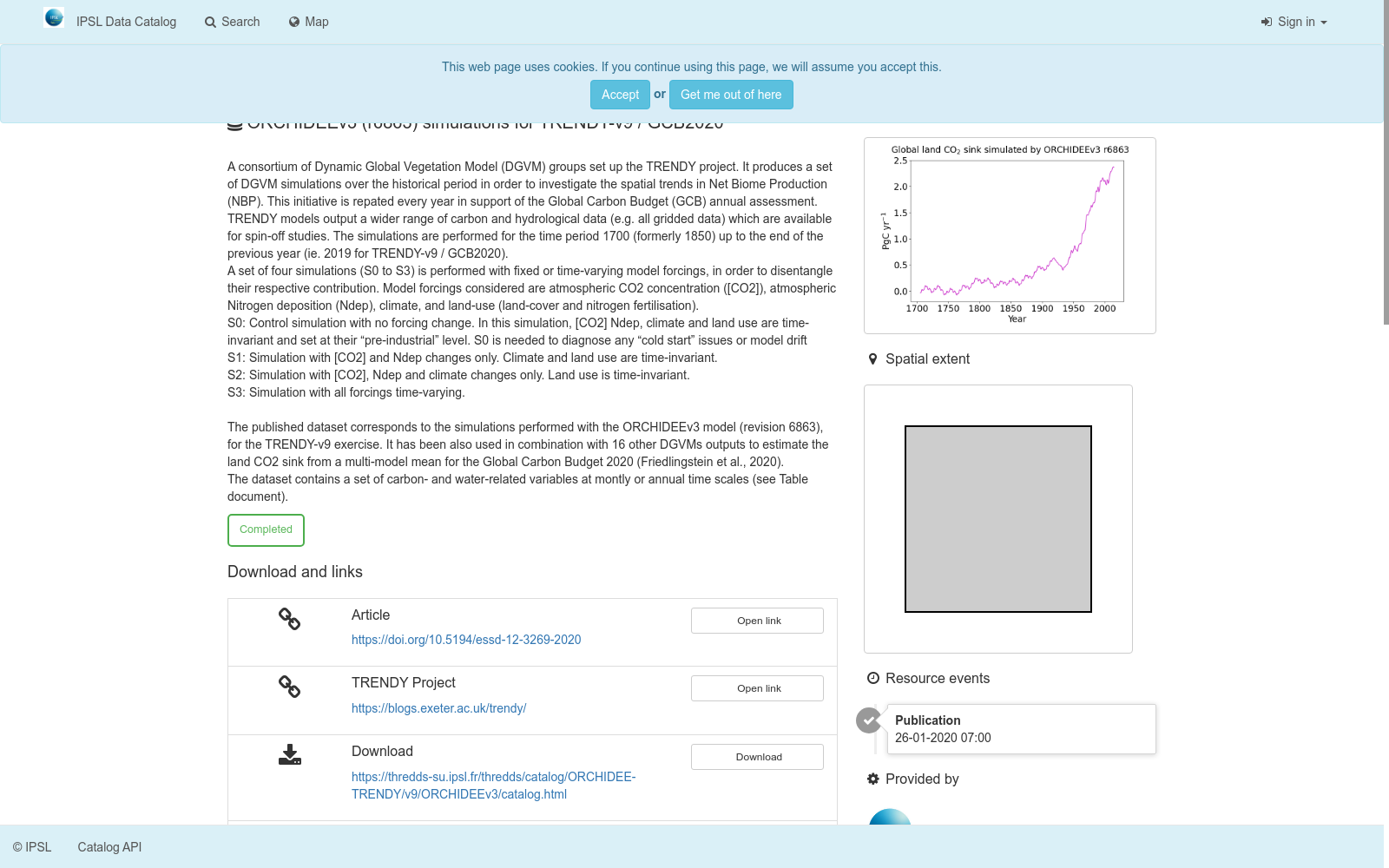
A consortium of Dynamic Global Vegetation Model (DGVM) groups set up the TRENDY project. It produces a set of DGVM simulations over the historical period in order to investigate the spatial trends in Net Biome Production (NBP). This initiative is repated every year in support of the Global Carbon Budget (GCB) annual assessment. TRENDY models output a wider range of carbon and hydrological data (e.g. all gridded data) which are available for spin-off studies. The simulations are performed for the time period 1700 (formerly 1850) up to the end of the previous year (ie. 2019 for TRENDY-v9 / GCB2020). A set of four simulations (S0 to S3) is performed with fixed or time-varying model forcings, in order to disentangle their respective contribution. Model forcings considered are atmospheric CO2 concentration ([CO2]), atmospheric Nitrogen deposition (Ndep), climate, and land-use (land-cover and nitrogen fertilisation). S0: Control simulation with no forcing change. In this simulation, [CO2] Ndep, climate and land use are time-invariant and set at their “pre-industrial” level. S0 is needed to diagnose any “cold start” issues or model drift S1: Simulation with [CO2] and Ndep changes only. Climate and land use are time-invariant. S2: Simulation with [CO2], Ndep and climate changes only. Land use is time-invariant. S3: Simulation with all forcings time-varying. The published dataset corresponds to the simulations performed with the ORCHIDEEv3 model (revision 6863), for the TRENDY-v9 exercise. It has been also used in combination with 16 other DGVMs outputs to estimate the land CO2 sink from a multi-model mean for the Global Carbon Budget 2020 (Friedlingstein et al., 2020). The dataset contains a set of carbon- and water-related variables at montly or annual time scales (see Table document).
由多个动态全球植被模型(Dynamic Global Vegetation Model, DGVM)研究团队组成的联盟发起了TRENDY项目。该项目开展了一系列历史时期的DGVM模拟实验,旨在探究净生物群区生产力(Net Biome Production, NBP)的空间变化趋势。本项目每年更新一次,以支撑全球碳预算(Global Carbon Budget, GCB)的年度评估工作。TRENDY模式输出涵盖多类碳循环与水文数据(如所有格点数据),可用于各类衍生研究。模拟实验的时间范围为1700年(原初始年份为1850年)至上一年年末(如TRENDY-v9 / GCB2020对应的截止年份为2019年)。研究团队设置了四组模拟实验(S0至S3),分别采用固定或时变的模式强迫因子,以厘清各强迫因子的独立贡献。本次研究考虑的模式强迫因子包括大气CO₂浓度([CO₂])、大气氮沉降(Ndep)、气候条件与土地利用(土地覆盖与氮肥施用)。S0:无强迫因子变化的对照模拟实验。该实验中,[CO₂]、氮沉降、气候与土地利用均保持恒定,设定为工业前水平,可用于诊断“冷启动”问题或模式漂移现象。S1:仅考虑[CO₂]与氮沉降变化的模拟实验,气候与土地利用保持恒定。S2:仅考虑[CO₂]、氮沉降与气候变化的模拟实验,土地利用保持恒定。S3:所有强迫因子均为时变的模拟实验。本次公开的数据集对应TRENDY-v9实验中ORCHIDEEv3模型(修订版6863)的模拟结果。该数据集还曾与其他16个DGVM的输出结果结合使用,用于估算2020年全球碳预算(Friedlingstein等, 2020)中的多模式平均陆地CO₂汇。数据集包含月尺度或年尺度的碳循环与水文相关变量(详见附表文档)。
提供机构:
ESPRI/IPSL
创建时间:
2022-09-29
搜集汇总
数据集介绍
背景与挑战
背景概述
该数据集是ORCHIDEEv3模型为TRENDY-v9项目进行的模拟结果,旨在研究历史时期净生物群落生产的空间趋势,支持全球碳预算评估。数据集包含碳和水相关变量的月度或年度数据,覆盖1700年至2019年,通过四种不同强迫情景的模拟(S0至S3)来分析各因素对碳循环的贡献。
以上内容由遇见数据集搜集并总结生成



